Quick Answer
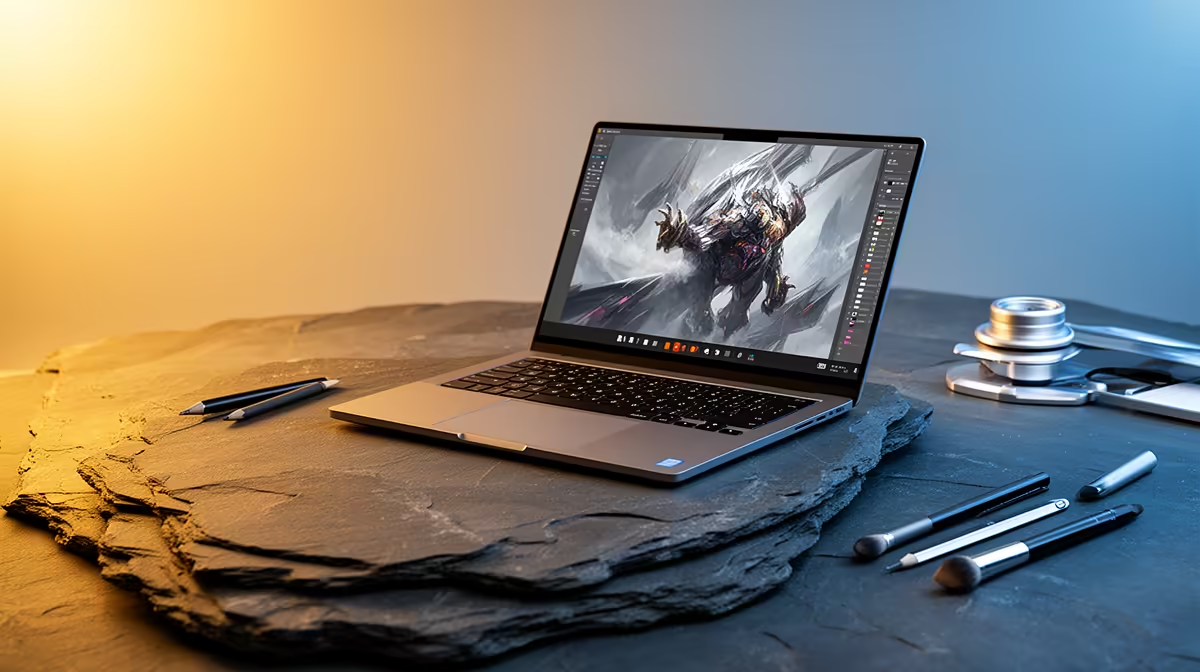
On the NSFAS R15,000 allowance, a electrical engineering student should target a laptop with a Ryzen 7 or Core i7, 16GB RAM, a 512GB SSD and a discrete GPU. Around R15,000 buys a machine that runs MATLAB, PSpice and AutoCAD smoothly. Note the NSFAS device allowance has historically been smaller, so confirm your current allocation and top up if needed.
What electrical engineering software demands
MATLAB, PSpice and AutoCAD and simulation tools need a quad-core or better CPU, 16GB of RAM as a hard minimum, and a dedicated GPU (entry RTX class) for viewport performance. 8GB will swap to disk constantly on large models, so 16GB is non-negotiable. A 512GB NVMe SSD keeps project files and the OS responsive.
Spec targets on R15,000
Aim for: Ryzen 7 7735HS or Core i7, 16GB DDR5, 512GB NVMe, and an RTX 3050/4050-class GPU. This combination handles CAD modelling, circuit simulation and report writing without stutter. A 15.6-inch 1080p IPS panel is the practical sweet spot for reading dense drawings without straining your eyes in a lecture hall.
NSFAS and SA buying context
Evetech's cheapest laptops start at R8,000, so the R15,000 tier comfortably covers an engineering-capable machine. Buy a model with an SSD upgrade slot and accessible RAM so you can add a second 16GB stick later for heavier simulation work. A 3-cell battery that lasts a full lecture block matters as much as raw specs for campus use.
FAQ
Can R15,000 buy a laptop for electrical engineering?
Yes, R15,000 buys a Ryzen 7 or Core i7 laptop with 16GB RAM and a discrete GPU, which runs MATLAB, PSpice and AutoCAD comfortably. It is a capable four-year machine for a electrical engineering degree. Prioritise 16GB RAM and an NVMe SSD above all else.
How much RAM do I need for engineering software?
16GB is the minimum for MATLAB, PSpice and AutoCAD and simulation work; 8GB will swap to disk and slow large models. If the laptop has a free slot, plan to add a second 16GB stick in later years. RAM is the single most important upgrade for CAD and simulation.
Is a dedicated GPU necessary for electrical engineering?
A discrete RTX 3050/4050-class GPU helps viewport rotation in 3D CAD and accelerates some simulation tasks. Integrated graphics will work for 2D drafting but stutter on complex 3D models. For a four-year engineering degree, a dedicated GPU is worth the small premium.
Confirm your current NSFAS device allocation, then match it to a 16GB Ryzen 7 laptop at Evetech. Pick a model with an open RAM slot so you can expand to 32GB for heavier electrical engineering work later in your degree.