


PCIe 5.0 vs PCIe 4.0 for Strategy and Sim Games in SA
PCIe 5.0 and PCIe 4.0 differ most in lane support, compatibility, and upgrade value for strategy and sim games. SA buyers should match the choice to their actual hardware and games.
Read moreIn South Africa, budget around R2,500 to R4,000 for a capable 2K wireless streaming camera with solid battery life and a stable 5GHz link. Entry 2K wireless models start near R2,000 but often trade away range and battery.
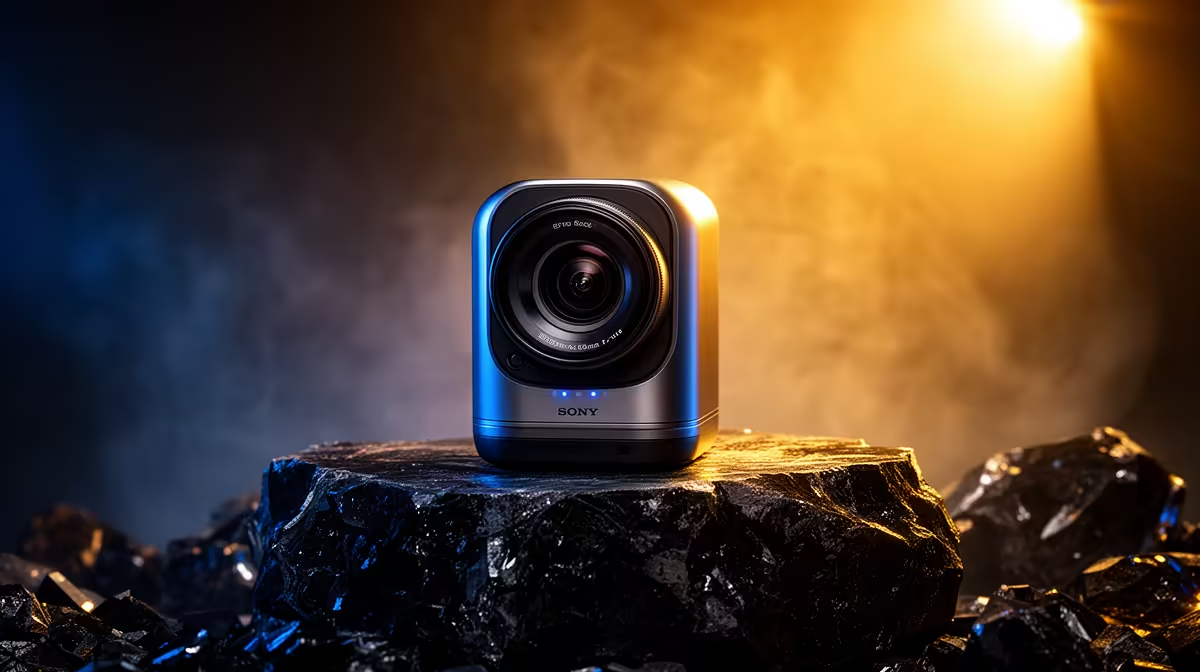
Wireless cameras add freedom but also add cost at every tier. The price of cutting the cable is not just the camera hardware; it is the battery system, the wireless radio, and the electronics that make 1440p transmission stable without a direct connection to the encoder. Understanding where that cost sits in the South African market means knowing what you can realistically expect at each price point before comparing specific models.
A capable 2K wireless streaming camera in South Africa costs around R2,500 to R4,000. That range delivers solid battery life, a stable 5GHz wireless link, and a sensor that holds genuine 1440p quality. Entry models starting near R2,000 often compromise on range, battery endurance, or both.
The lower boundary of 2K wireless cameras in SA sits around R2,000, but the word "capable" does not reliably apply at that price. Cameras in this range often meet the 1440p resolution specification on paper while falling short in the practical demands of actual broadcast use.
Battery capacity at this tier tends to be between 1,000 mAh and 1,500 mAh, which translates to roughly one to two hours of real-world streaming at 1440p with wireless active. For a quick product demonstration or a short social stream, that may be enough. For any session that runs beyond ninety minutes, a camera at this price band becomes a liability.
Wireless range is the other common compromise. Many entry models use single-band 2.4GHz-only radios, which work adequately in an interference-free environment but degrade noticeably in South African apartment buildings where the 2.4GHz band carries high competing traffic from neighbouring units. A camera that holds a clean 1440p stream on a test bench may stutter and drop frames at the same distance in a real Joburg or Cape Town flat.
Moving to the R2,500 to R4,000 range is where genuine reliability appears. The additional spend goes into three areas that improve real-world performance more than they improve specification sheet appearance.
Battery capacity steps up noticeably in this range, with most cameras offering between 2,000 mAh and 3,500 mAh and the more capable models providing swappable packs. The difference between two hours and four to five hours of continuous streaming is the difference between a camera that serves a serious creator and one that requires constant management.
Wireless hardware in this tier is more likely to include dual-band support covering both 2.4GHz and 5GHz. The 5GHz band carries 1440p with less competition and better throughput in most SA indoor environments. A camera that can select the cleaner band for the current location adapts to varying conditions rather than struggling through them.
Sensor size is also typically larger at this tier. The larger sensor at 1440p produces cleaner output under moderate ambient lighting, which matters for creators in south-facing rooms or in the warmer, dimmer interior lighting common in older Cape Town and Durban buildings.
When comparing two cameras at similar prices in this tier, prioritise battery capacity and wireless band specifications over frame rate claims. A camera that streams 1440p at 30fps with a 3,000 mAh battery and dual-band Wi-Fi is more useful in practice than one claiming 60fps with a smaller battery and single-band radio, unless 60fps is a specific production requirement.
The top of the practical 2K wireless range in SA sits around R4,000, and the features that move a camera toward that ceiling are predictable once you know the cost structure.
Longer battery packs with genuine field-use endurance add manufacturing cost that flows directly to retail price. A camera offering swappable battery packs in a design that allows hot-swapping without shutting the device down is engineering the hardware to prioritise uptime, and that is reflected in the price.
AI-assisted subject framing, where the camera tracks and recentres a moving presenter automatically, requires dedicated processing hardware inside the device. That chip adds cost. For solo creators who cannot physically adjust the camera angle during a session, autofaming earns its cost back in workflow simplification. For a fixed camera angle recording a stationary presenter, it is an unnecessary premium.
Some cameras in the upper part of this range also carry weather sealing that makes them suitable for outdoor field use as well as studio setups. For a creator who needs one camera to serve both environments, the additional versatility justifies paying toward R4,000 over buying two separate devices.
The key decision is honest about how the camera will actually be used rather than how it might theoretically be used. A creator who plans occasional 1440p streams from a fixed indoor position with an AC adapter available has very different requirements from one who shoots outdoors or in locations without reliable power.
For fixed indoor use with power available, the entry to mid tier around R2,500 is a reasonable choice if the wireless environment is not heavily congested. A USB-C continuous power input, which many cameras in this tier support, removes the battery concern entirely for desk setups.
For mobile use without power access, the spend toward R3,500 to R4,000 is justified by battery endurance and wireless reliability. The cost difference over two years of regular use is negligible compared to the operational improvement.
Yes, primarily in battery and wireless reliability rather than image quality at good lighting levels. The sensors at both price points produce comparable 1440p output in well-lit conditions. The gap shows in sessions that run long, in locations with heavy wireless congestion, or in environments where ambient light is limited. If your use case involves any of those conditions, the R3,500 tier is worth the difference.
Local warranty coverage varies by distributor. Products sold through authorised South African distributors typically carry a one-year return-to-base warranty. Imported grey-market units may carry international warranty terms that require shipping the device outside the country for repairs, which is impractical. Verify the warranty terms before purchasing, particularly for cameras in the R3,000-plus range where the cost of replacement without warranty cover is significant.
Some cameras support native 4G LTE connectivity with a SIM card slot. Most 2K wireless cameras at this price tier use Wi-Fi only and require a hotspot or access point. For mobile data connectivity without a Wi-Fi network available, check the specifications for LTE support or plan to use the camera tethered to a phone hotspot in the field.
A spare battery or an appropriately rated power bank that supports the camera's charging protocol is the highest priority for wireless cameras. A UV-resistant carrying case protects outdoor units in South African summer conditions. A quality SD card rated for sustained video write speeds is necessary if onboard recording is planned alongside the wireless stream.
Almost certainly over time. Camera hardware pricing in SA has followed the global pattern of declining as technology matures. 2K wireless at R2,500 sits at roughly the price point that 1080p wireless occupied three years ago. As 4K wireless production scales up, 2K models will continue moving toward R2,000 and below for capable units. For current buyers, the R2,500 to R3,500 tier represents the best balance of capability and price before that normalisation occurs.
Ready to find the right 2K wireless camera for your SA streaming budget? Browse the wireless streaming camera range at Evetech and compare battery specs, wireless band support, and sensor sizes to find the model that fits your sessions.
Yes, primarily in battery and wireless reliability rather than image quality at good lighting levels. The sensors at both price points produce comparable 1440p output in well-lit conditions. The gap shows in sessions that run long, in locations with heavy wireless congestion, or in environments where ambient light is limited. If your use case involves any of those conditions, the R3,500 tier is worth the difference.
Local warranty coverage varies by distributor. Products sold through authorised South African distributors typically carry a one-year return-to-base warranty. Imported grey-market units may carry international warranty terms that require shipping the device outside the country for repairs, which is impractical. Verify the warranty terms before purchasing, particularly for cameras in the R3,000-plus range where the cost of replacement without warranty cover is significant.
Some cameras support native 4G LTE connectivity with a SIM card slot. Most 2K wireless cameras at this price tier use Wi-Fi only and require a hotspot or access point. For mobile data connectivity without a Wi-Fi network available, check the specifications for LTE support or plan to use the camera tethered to a phone hotspot in the field.
A spare battery or an appropriately rated power bank that supports the camera's charging protocol is the highest priority for wireless cameras. A UV-resistant carrying case protects outdoor units in South African summer conditions. A quality SD card rated for sustained video write speeds is necessary if onboard recording is planned alongside the wireless stream.
Almost certainly over time. Camera hardware pricing in SA has followed the global pattern of declining as technology matures. 2K wireless at R2,500 sits at roughly the price point that 1080p wireless occupied three years ago. As 4K wireless production scales up, 2K models will continue moving toward R2,000 and below for capable units. For current buyers, the R2,500 to R3,500 tier represents the best balance of capability and price before that normalisation occurs.
PCIe 5.0 and PCIe 4.0 differ most in lane support, compatibility, and upgrade value for strategy and sim games. SA buyers should match the choice to their actual hardware and games.
Read more
AM5 vs AM4 for video editing in 4K Difference explained is mostly about compatibility, budget, upgrade path, and setup fit. SA buyers should check device support and real needs before expecting a clear win from either option.
Read more
OLED vs QD-OLED for strategy and sim games buyers - what changes is mostly about compatibility, budget, upgrade path, and setup fit. SA buyers should check device support and real needs before expecting a clear win from either option.
Read more
DisplayPort 2.1 and 1.4 differences matter when SA PC builders match GPUs, monitors, and refresh targets. Use this difference between displayport 2 1 and displayport 1 4 explained pc builders guide to avoid mismatched parts.
Read more
Ray tracing vs Path tracing depends on Strategy and sim games needs, platform limits, and budget fit. Compare compatibility, latency, upgrade path, and real setup constraints before choosing for an SA build.
Read more
wireless mouse guide for Gqeberha gamers should be shortlisted around the job it must do. South African buyers should compare sensor, shape, weight, and wireless latency, warranty path, and upgrade room before treating any pick as best.
Read more
From 1 October 2026, WhatsApp Business Platform service replies in South Africa are expected to cost about $0.0076, or 12 cents, per delivered message.
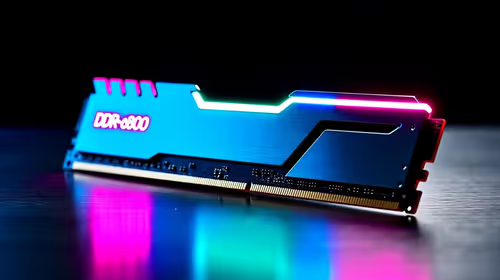
DDR5-8000 RAM Kits pros and cons depend on the build, budget, and workload. Weigh gaming needs, platform fit, power, cooling, warranty support, and South African pricing context before shortlisting it.
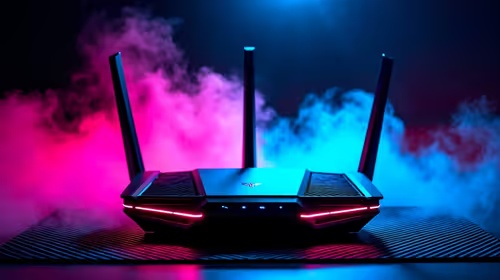
Wi-Fi 6E vs Wi-Fi 6 depends on AAA single-player gaming needs, platform limits, and budget fit. Compare compatibility, latency, upgrade path, and real setup constraints before choosing for an SA build.

Ryzen 9 9950X3D dead pixel checks should isolate the panel first. Run colour fills, inspect the monitor menu, test another cable or input, and capture proof before linking it to the SA CPU upgrade.

YouTube will count public views from the first frame across video formats from 24 August, while earnings and eligibility remain tied to engaged viewing.
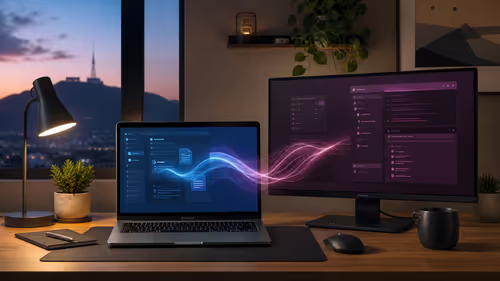
Canonical expects Ubuntu on WSL users to outnumber native Ubuntu desktop users before the end of 2026. The software is open source and runs inside supported Windows PCs.
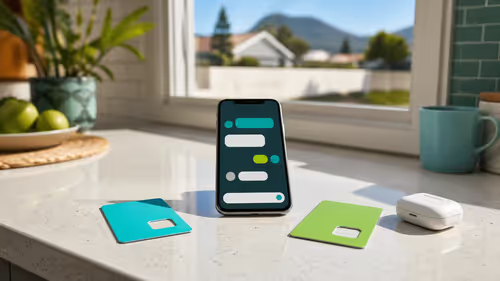
Telkom's daily bundles pair WhatsApp access with 10 all-network voice minutes. The R15 option includes 300MB, while the R17 option uses a fair-use threshold.

A 10,000-hour test found similar image retention across older and newer OLED TVs, while newer panels were brighter and more efficient. Local OLED monitors started at R9,999.
650W for RTX 5090 needs a full-build check, not a simple yes. Review GPU guidance, CPU draw, transient load, connectors, PSU quality, and upgrade plans before deciding.
PCIe 5.0 and PCIe 4.0 differ most in lane support, compatibility, and upgrade value for strategy and sim games. SA buyers should match the choice to their actual hardware and games.

How to fix FPS drops Windows 11 RX 9070 XT starts with GPU drivers, overlays, power plans, and frame pacing checks. For SA gaming PCs, verify chipset updates, HAGS, refresh rate, thermals, and per-game graphics settings.
AM5 vs AM4 for video editing in 4K Difference explained is mostly about compatibility, budget, upgrade path, and setup fit. SA buyers should check device support and real needs before expecting a clear win from either option.