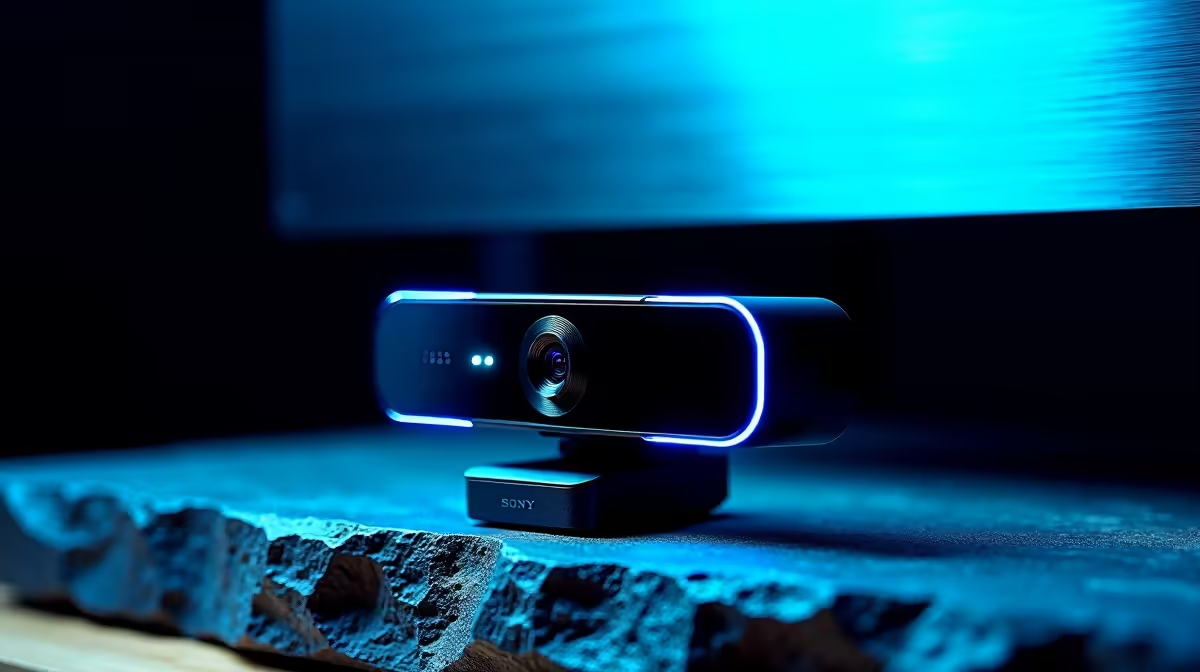
A single unit that combines a webcam and a ring light looks efficient on a spec sheet, but it hides a constraint that only becomes obvious once you start working with light: the camera and the illumination need to do different jobs, and those jobs rarely benefit from sharing the same axis. Independent 1/4 inch thread mounts separate the two, giving each its own head, its own angle, and its own adjustment. Whether that flexibility is worth the extra base on your desk depends on how seriously you take shadow control.
Quick Answer
An independent 1/4 inch mount lets you position camera and light on separate heads so each can aim independently. An integrated webcam-light combo fuses both on one axis and cannot aim them apart. Separates give better shadow shaping; the integrated unit wins on desk space and cost.
🔆 The Geometry of Integrated Units
Most integrated webcam-light products mount a small ring or panel LED directly around the camera lens. The result is a front-on light source that sits exactly where the lens looks. That geometry eliminates most shadows from the face, which sounds desirable, and in harsh overhead fluorescent environments, the fill it provides is genuinely useful.
The problem is that front-on lighting is also the flattest lighting. Without any shadow structure, the face loses depth. Cheekbones, jawline, and forehead become a uniform lit surface rather than a shaped, three-dimensional one. For casual video calls, that flatness is acceptable. For content creation, streaming, or any situation where looking polished on camera matters, it works against you.
Because the light is mechanically tied to the camera, moving the lens angle also moves the light angle. You cannot keep the camera pointing straight at your face while shifting the light to one side to create dimension. The two are permanently linked, and that link is the core trade-off of the integrated approach.
The upside is real: one product, one base, one power cable. If your desk in a Durban apartment is already at full capacity, not adding a second stand is worth something.
🎯 What Independent Mounts Unlock
A 1/4 inch threaded head is the standard fitting for small cameras, LED panels, and microphone-related accessories. When camera and light each sit on their own threaded stand, their angles become completely independent. The light can go to the left or right at roughly 45 degrees off the camera axis, which is the angle that introduces shadow structure without making it harsh.
That 45-degree key light position is a standard in portrait and broadcast photography because it separates the lit side of the face from the shadow side. The camera records that separation as depth, and the result looks more natural and more professional than a flat front-on source. You do not need expensive gear to achieve it; two budget stands with 1/4 inch heads and a decent LED panel will get you there.
You can also adjust the two independently during use. If the light is too harsh, angle it slightly further back. If the shadow is too deep, bring it closer to the camera axis. Neither adjustment requires touching the framing.
The 1/4 Inch Standard Explained
The 1/4 inch 20 UNC thread is the universal screw fitting for this class of equipment. Its 6.35mm diameter makes it small enough for lightweight gear while strong enough to hold a 200g camera or a compact LED panel without flex. Almost every desktop webcam, many small LED panels, and most shock-mount clips carry this thread, which is why one stand can cycle through camera, light, and microphone duty without needing adapter rings or replacement heads.
💰 What Each Approach Costs in Rands
An integrated webcam-light combo typically sits around R500 to R800 for entry-level units and up to R1,200 for ones with better LED quality. A separate webcam on its own stand plus a compact key light on its own stand can be assembled for R900 to R1,800 in total, depending on the quality of each component. The integrated option is cheaper up front, especially when the webcam quality is already acceptable.
The more meaningful cost comparison is total value over time. Separates let you upgrade one component without replacing both. If the light degrades, you replace the light. If you want a better camera, you upgrade only the camera. The integrated unit ties both together, so one failure or one upgrade replaces the whole thing.
Pro Tip ⚡
Start with a decent LED panel at 45 degrees off your camera axis rather than a ring light directly behind the lens. A small panel costs around R250 to R400, takes up one 1 4 inch stand, and gives you the shadow structure a ring can never produce when it is front-on.
✨ Which Setup Makes Sense for Your Desk
The integrated combo makes sense for a compact desk where a second base is genuinely not an option, for users who join calls occasionally rather than creating content daily, and for setups where the existing room light is already challenging and any supplemental fill is better than none.
Independent mounts are the right choice for content creators, streamers, and remote professionals who appear on camera regularly and want their lighting to do visible work for the image quality. The extra base and cable are a modest overhead for a setup that gives precise, adjustable control over how the camera sees your face.
Neither approach is wrong. The integrated unit removes a friction point; the separates solve a problem.
Frequently Asked Questions
What does an independent 1/4 inch mount give you that an integrated combo cannot?
The ability to aim camera and light at entirely different targets. On independent mounts, you position the key light at 45 degrees off the camera axis to shape the face with controlled shadow, while the lens points straight ahead. An integrated unit fuses both on one axis, so moving the light means moving the camera, and true off-axis key lighting is not possible.
Does an integrated webcam-light combo actually save desk space?
Yes, meaningfully. One base versus two means a smaller footprint, one power cable instead of two, and less hardware to manage at a busy desk. For a compact desk or a travel setup, the integrated unit removes a real inconvenience that separates introduce.
Is it possible to aim the light without shifting the camera on most integrated combos?
No. On the vast majority of integrated products, the light ring or panel is fixed relative to the camera housing. Tilting the unit to adjust the light also changes the camera angle. Only a small number of higher-end combos include a separate light-swivel mechanism, and those typically cost more than buying separates to begin with.
Which approach gives better shadow control for streaming and content?
Independent mounts, by a clear margin. Placing a key light at 45 degrees off the camera axis creates shadow structure that shapes the face, while front-on integrated light flattens it. For streamers and content creators who want a broadcast-style image, separates are the correct tool, and the quality difference is visible at normal streaming resolutions.
How much does an integrated combo cost compared to buying separates?
An integrated webcam-light unit typically costs R500 to R1,200. Separate webcam and key light on individual 1/4 inch stands run roughly R900 to R1,800 combined. The integrated option costs less upfront, but separates let you upgrade or replace each component individually, which spreads the longer-term cost more efficiently.
Ready to take control of how your camera and lighting work together?
Browse the webcam accessories and desktop mount range at Evetech to build a setup where every piece points exactly where you need it.