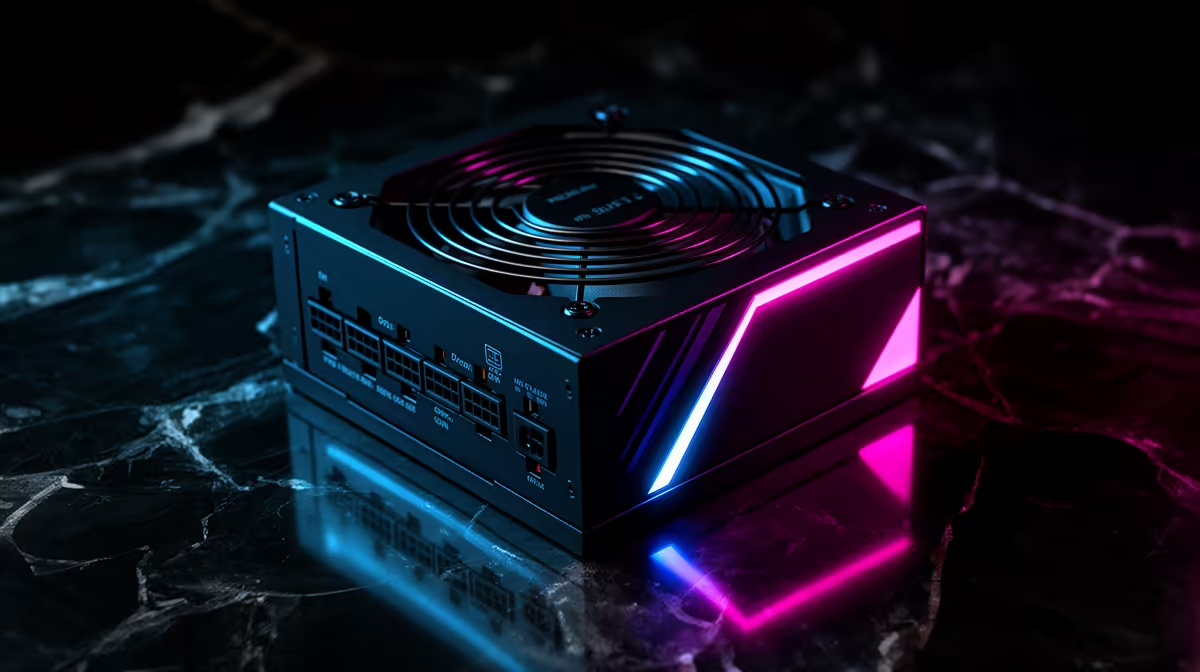
An 850W power supply is enough for a standard RTX 5080 gaming build when it is a quality unit with the correct connector and the rest of the system stays within the design assumptions. NVIDIA rates the reference card at 360W and calls for an 850W supply in the complete PC. Partner cards and high-power CPUs can change that answer.
Quick Answer
Use a reputable 850W PSU for an RTX 5080 with a mainstream Ryzen 7 or similar gaming CPU, normal storage and no extreme overclocking. Prefer a current unit with a native PCIe Gen 5 graphics cable rated for the card, suitable protections and strong independent testing. Move to 1000W when the exact partner card, CPU, sustained creator load or future upgrade pushes beyond the 850W design margin.
What NVIDIA's 850W figure means
The RTX 5080 reference page lists a 360W total graphics power and an 850W required system-power figure. That system figure is based on NVIDIA's stated test assumptions and is not a promise for every combination.
An add-in-board model can use a higher power limit, larger cooler or factory overclock. Its manufacturer may specify a different minimum. Read the exact card product page and installation guide before choosing the PSU.
The required-system number also assumes a suitable PSU, not any unit with 850 printed on it. Age, electrical design, 12V capacity, connectors and transient response matter.
Open the RTX 5080 graphics-card range and identify the exact partner model. Check its dimensions and power guidance rather than carrying the reference card's details across.
Build a realistic power budget
Start with the GPU's stated board power. Add the CPU's sustained package behaviour under your workload, then motherboard, fans, pumps, drives and USB-powered devices. Leave margin for transient demand, ageing, efficiency and a later storage or fan addition.
A mainstream gaming CPU rarely draws its maximum at the same time as every game fully loads the GPU, but stress tests and creation workloads can bring both high. A high-end Intel or AMD flagship with raised limits can consume much more than a value gaming chip.
Do not add every component's nameplate maximum and call the sum measured draw. Use current reviews and monitoring for the exact parts. The calculation should be conservative and connected to the workload.
Quality matters more than unused wattage
A sound 850W unit can outperform a poor 1000W unit in regulation, protection and transient behaviour. Look for independent electrical testing of the exact platform. Efficiency certification describes efficiency at defined loads, not the complete quality.
Check the model's documented response to excess current, excess voltage, low voltage, a short circuit, excessive load and excess heat. Review warranty terms and the current support route.
The Corsair power-supply range provides one brand-specific catalogue, while the PSU best-seller page broadens the comparison. Neither page makes every listed unit an RTX 5080 match; open exact model and cable details.
Connector choice is part of the answer
NVIDIA's reference guidance allows the supplied multi-8-pin adaptor or a suitable PCIe Gen 5 cable, with the reference page calling for a 450W-or-greater Gen 5 cable option. Partner-card requirements may differ.
A current ATX 3.x PSU with the native graphics connector can reduce adaptor bulk. Confirm whether the PSU and cable use 12V-2x6 or another supported implementation and whether the cable is approved for that exact unit.
Never reuse a modular cable from another PSU unless the manufacturer confirms exact compatibility. The PSU-side plug can fit while the pinout differs.
Insert the graphics connector fully and check the latch. Route it without a tight bend at the plug or pressure from the side panel. Follow the card and PSU maker's clearance guidance.
Do not solve a cable shortage with improvisation
When using an included adaptor, connect the required number of separate PSU cable runs according to the card and PSU instructions. Avoid daisy-chaining where the guidance calls for independent leads. Do not use an unapproved extension or adaptor.
Keep connectors clean and free of side load. Recheck after moving the PC with mains power disconnected. Heat discolouration, melting or an electrical smell is a reason to stop using the system and follow the proper support route.
Never open the PSU enclosure. Hazardous stored energy can remain after the unit is disconnected.
When 1000W becomes the better fit
A 1000W unit can make sense with a high-power flagship CPU, raised CPU or GPU limits, several expansion devices or long sustained rendering. It can also provide a future GPU route when that upgrade is already planned.
The larger rating is not required because the PC has several RGB fans or two SSDs. Measure or model the complete load. A gaming-first Ryzen X3D-style system can fit comfortably inside a strong 850W design when the exact card guidance agrees.
Noise can be another reason. A 1000W PSU may operate at a lower share of capacity and keep its fan quieter, though fan curves and efficiency differ. Check acoustics rather than assuming bigger means silent.
Case airflow affects power behaviour
The RTX 5080 releases substantial heat into or through the case. A hot PSU compartment and restricted intake can raise fan noise and component temperature. Keep the PSU intake clear and install it in the orientation the case supports.
Do not use the PSU as the only exhaust for the GPU. Provide a direct case airflow path. Check that a front radiator does not block the card or force the power cable against glass.
Test the completed PC
Run a long game and a combined CPU/GPU workload appropriate to the system. Monitor GPU power, CPU power, temperatures, clocks and stability. A wall power meter can show total input, but it includes PSU efficiency loss and requires safe use.
Unexpected shutdowns need diagnosis. They can come from cable seating, temperature, unstable memory, drivers or the PSU. Do not conclude that wattage is the cause from one black screen.
Keep the known-good firmware and driver noted. Return overclocks to default during fault isolation.
Frequently Asked Questions
Is any 850W PSU enough for an RTX 5080?
No. The exact unit needs suitable quality, 12V output, connectors and support for the complete CPU/GPU configuration.
Does an RTX 5080 need ATX 3.1?
A current ATX 3.x design with a suitable native cable is convenient. Follow the exact GPU and PSU requirements rather than the standard label alone.
Should I buy 1000W for future proofing?
Buy it when a named future component or high-power current workload uses the margin. Otherwise, a strong 850W unit can be the balanced choice.
Match an 850W PSU to the exact RTX 5080 card, CPU load and approved connector path, stepping to 1000W only when the complete system earns it.