Quick Answer
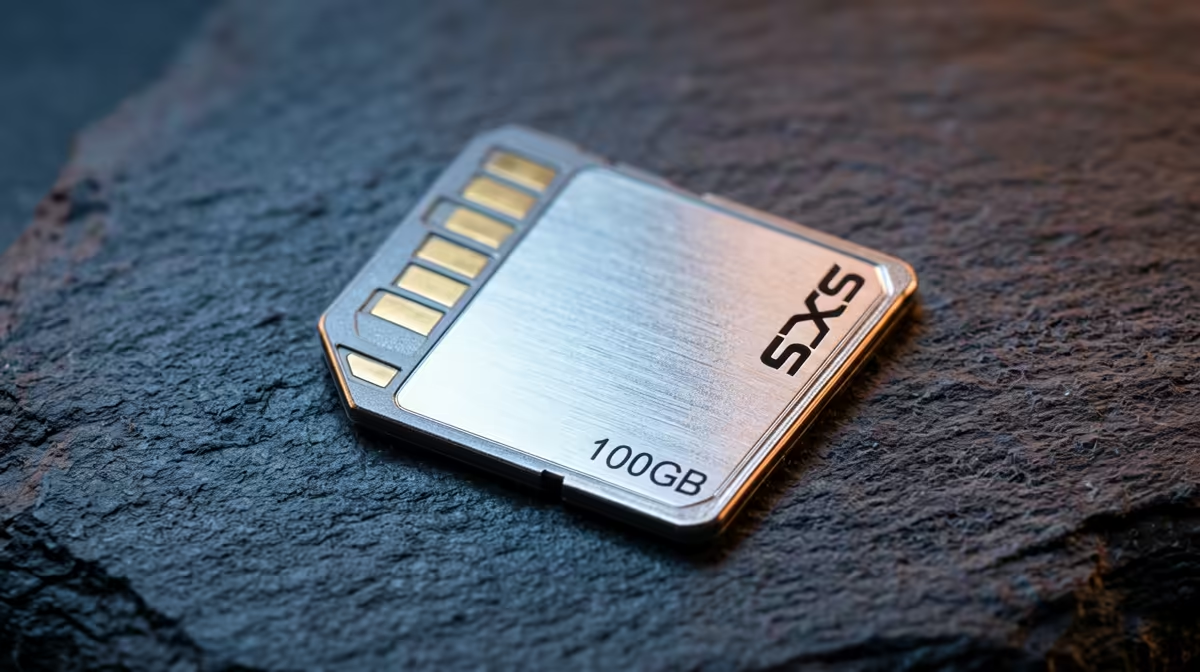
Yes, 256GB is enough for most shooting sessions. At 4K/30fps and 100Mbps bitrate you get around 340 minutes of footage, or roughly 8,500 RAW frames in burst mode. For a full wedding day or multi-location content shoot it is sufficient, though professionals often carry two cards as a safeguard.
How 256GB Breaks Down in Real Shooting Scenarios 📸
Storage estimates depend on your codec and bitrate. Shooting 4K at 100Mbps (common on Sony Alpha and Nikon Z-series bodies) consumes roughly 750MB per minute, so 256GB holds about 340 minutes of continuous footage. Drop to 4K/24fps with a more compressed codec like H.265 and you stretch that to nearly 500 minutes. For burst photographers, a 20-megapixel RAW file averages 25MB to 35MB. At 30MB per file, 256GB holds around 8,500 RAW frames. A 10fps burst for 5 seconds produces 50 frames, so you could run 170 such bursts before filling the card. In practice, mixed shooting days with a blend of video clips and stills rarely push past 150GB.
When 256GB Is Not Enough 🎬
High-bitrate recording changes the maths dramatically. Shooting 4K All-Intra on a Lumix S5 II at 400Mbps chews through 256GB in under 90 minutes. Cinema DNG on a Blackmagic Pocket Cinema Camera 4K can exceed 800MB per minute. Photographers shooting 45-megapixel RAW files on a Sony A7R V at 10fps will fill a 256GB card in roughly 20 minutes of sustained burst. If you work in any of these scenarios, 512GB or dual-card recording is the professional standard. In South Africa, 512GB UHS-I V30 cards are currently priced between R1,200 and R1,800 depending on brand and speed class.
Choosing the Right 256GB Card for Your Workflow 💡
Not all 256GB cards perform the same. A V30-rated card guarantees 30MB/s sustained write and is the minimum for 4K recording. Cards rated V60 or higher sustain 60MB/s and handle high-bitrate codecs without buffer stalls. For burst photography, the card's sustained write speed after the buffer fills determines whether your camera can keep shooting or locks up. A card advertising 160MB/s read and only 60MB/s write may stall a Sony A9 III mid-burst. Always check the write speed figure, not just the headline read speed. In the R600 to R950 price band, 256GB UHS-I U3 cards are widely available in South Africa with solid sustained write performance for everyday 4K work.
Format In-Camera Before Every Shoot ⚡
Always format your 256GB card directly in the camera body you will be using, not on a PC. In-camera formatting creates the correct folder structure and clears fragmentation that builds up from partial deletes, keeping sustained write speeds consistent throughout a long recording session.
FAQ
Does a faster card make my camera take better photos?
Not the photos themselves. A faster card reduces buffer-clearing time, letting your camera resume burst shooting sooner. Image quality is determined by the sensor and lens. However, in continuous autofocus burst situations, a slow card that stalls the buffer can cause you to miss frames.
What is SDXC compared to SDHC?
SDXC (Extended Capacity) supports capacities from 64GB up to 2TB and uses the exFAT file system. SDHC tops out at 32GB. The 256GB card you are buying is definitely SDXC. Most cameras released after 2015 support SDXC; check your manual if you have an older body.
How much does a quality 256GB SDXC card cost in South Africa?
Expect to pay R600 to R950 for a reputable UHS-I U3 256GB card. Cards with V60 rating jump to R1,200 and above. Prices fluctuate with the rand-dollar exchange rate, so stocking up when the rand is stronger saves meaningfully.
Not sure which 256GB card suits your camera?
Evetech stocks a range of SDXC cards across V30, V60, and V90 speed classes. Check what is currently available and filter by capacity to match your shooting style.