Quick Answer
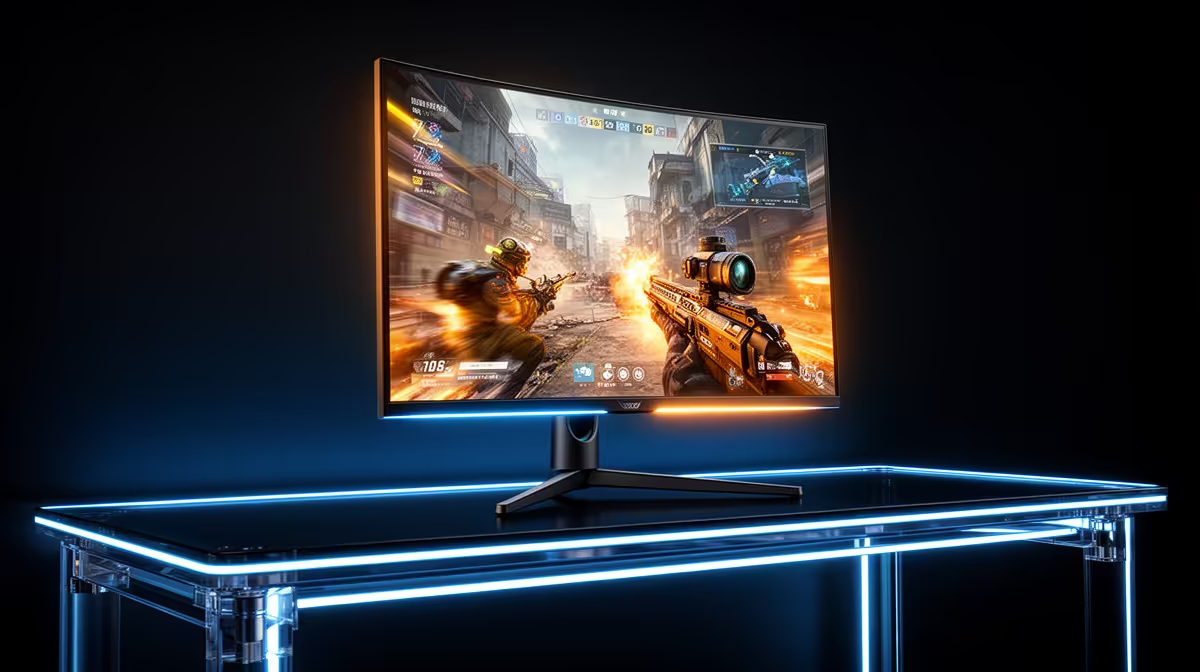
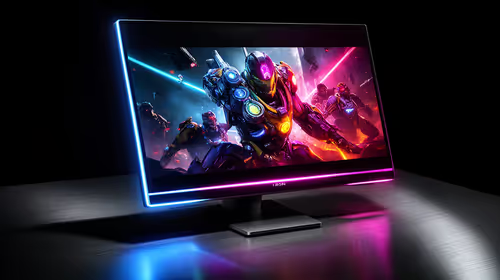
Yes, a 300Hz monitor is worth it for FPS and esports if your GPU consistently produces 250-plus fps in your main titles. At that frame rate, the reduction in display latency and motion blur compared to 165Hz is genuinely noticeable in competitive play. If your GPU averages below 200 fps, a 165Hz monitor and a GPU upgrade deliver more benefit per rand.
The Real Performance Case for 300Hz in Esports 🎮
At 300Hz, a new frame appears every 3.3 ms. At 165Hz, every 6.1 ms. In CS2 or Valorant where a mouse movement produces a rendered frame immediately, displaying that frame 2.8 ms sooner is a measurable input-response improvement. Controlled studies show diminishing returns above 240Hz for most players, but tournament competitors report 300Hz feels smoother during tracking aim and flick sequences. For a player already on 165Hz, the upgrade to 300Hz is a clear improvement in fast-target scenarios. Professional players competing in Valorant and CS2 at LAN events increasingly request 300Hz setups when available.
GPU Requirements to Make 300Hz Worthwhile 🖥️
The monitor's refresh rate is a ceiling, not a guarantee. To make a 300Hz panel earn its cost, your GPU needs to produce at least 250 fps in your main competitive titles at your chosen resolution. At 1080p, an RTX 5070 or RX 9070 XT delivers 300-plus fps in CS2 and Valorant on low to medium settings. At 1440p, the same cards produce 250 to 300 fps in those titles, which is sufficient to make a 300Hz panel meaningful. The RTX 4070 and RX 7800 XT typically produce 150 to 220 fps at 1440p in competitive titles, making them a borderline match for 300Hz. If you are running an older mid-range GPU averaging 150 fps, invest the R2,500 to R4,500 price difference between a 165Hz and 300Hz monitor into the GPU upgrade instead.
Pricing and Value in the SA Market 💰
In the current SA market, quality 300Hz QHD monitors from established brands sit between R6,500 and R9,500. Entry-level 165Hz QHD monitors start at R4,000 to R5,500. The price gap of R2,000 to R4,000 is meaningful in the context of a SA gaming build. For a player investing in a dedicated esports setup with a flagship GPU already, the R2,500 to R4,000 step to 300Hz represents less than 15% of the GPU cost and delivers a visible competitive advantage. For a player still on a mid-range GPU, that same money spent on a GPU upgrade produces a larger overall improvement to the gaming experience than a higher-refresh monitor can.
Benchmark Your Main Game Before You Buy ⚡
Install your game, set your competitive graphics settings (typically low to medium in esports titles), and run a session while monitoring fps with a free overlay tool. If your average fps exceeds 240 consistently, a 300Hz monitor is the right next purchase. If it sits at 150 to 200, prioritise the GPU upgrade first and come back to the monitor.
FAQ
Do you notice 300Hz over 240Hz?
Yes, but less dramatically than 144Hz over 60Hz. The 60 fps additional headroom at 300Hz versus 240Hz produces a smoother experience in fast scenarios, though side-by-side comparison is needed to consistently identify which panel is which. For competitive play, the improvement is real but subtle.
Are 300Hz monitors more expensive to maintain or more likely to fail than 165Hz models?
No. The panel technology (Fast IPS or OLED) determines longevity, not the refresh rate. A 300Hz Fast IPS panel has the same operational lifespan as a 165Hz Fast IPS from the same manufacturer, typically rated for 30,000 hours of backlight life or more.
Is 300Hz available at QHD or only at 1080p in South Africa?
Both resolutions are available at 300Hz in SA. QHD 300Hz monitors are the more commonly stocked option for gaming setups, as 1080p 360Hz panels cater to the very highest-performance competitive tier and are less widely distributed locally.
Ready to upgrade to 300Hz for competitive FPS and esports gaming?
Evetech stocks 300Hz gaming monitors in both 1080p and QHD. Browse the monitor section to find a panel matched to your GPU and your game.