Quick Answer
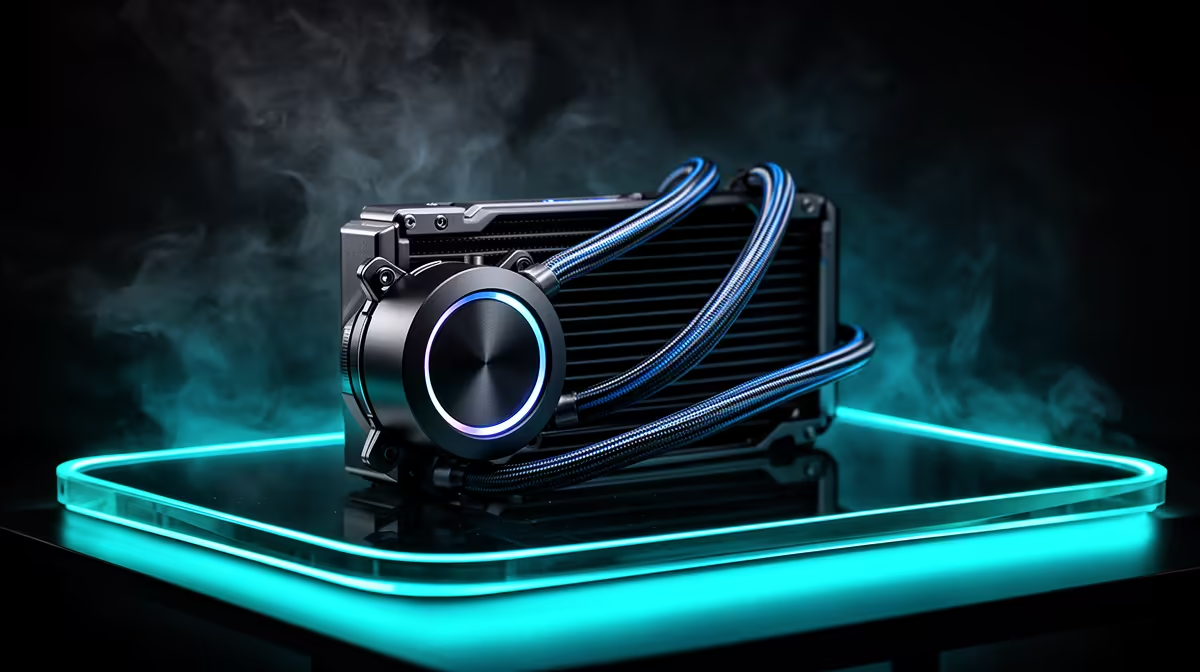
Yes, for a combined gaming-streaming-creation workload a 360mm AIO is worth it. Simultaneous gaming plus software encoding keeps CPU utilisation high for extended periods, and the larger radiator sustains lower temperatures than a 240mm AIO or air cooler under that kind of dual-load stress. Expect to pay R2,000 to R3,500 for a quality unit stocked locally.
The Thermal Reality of Combined Workloads 🎮
When you game and stream simultaneously using CPU-based encoding (x264 or x265 in OBS or Streamlabs), your CPU runs near its peak sustained power draw for the entire session. A Ryzen 9 9900X or Core Ultra 7 265K in this scenario can sustain 120W to 170W continuously rather than the burst spikes that occur during pure gaming. A 360mm AIO handles this sustained load comfortably, typically maintaining temperatures between 72 and 82 degrees Celsius even under prolonged four-hour sessions. A 240mm AIO or a dual-tower air cooler may hit 90 degrees Celsius or above under the same conditions, triggering thermal throttling that reduces encoding frame rate or game frame rate.
Content Creation Workloads and Why Thermals Matter More 🖥️
Video rendering in DaVinci Resolve or Adobe Premiere, 3D modelling in Blender, or compiling large codebases pushes CPU-only workloads to 100% across all cores for minutes or hours at a time. A Ryzen 9 9950X rendering a 4K timeline in Resolve can sustain 170W or more for an extended period, and this is where a 360mm AIO truly separates itself from smaller solutions. Lower sustained temperature translates directly into maintained boost clock speed: a CPU throttling from its target 5.4 GHz boost down to 4.8 GHz due to thermal limits represents a real-world slowdown in render time. For SA content creators processing large video files, this performance difference is measurable in minutes per export.
Noise, Space, and Case Requirements 🔧
A 360mm AIO requires a case with a 360mm radiator mount, which typically means a mid-tower or larger. ASUS, Corsair, and Lian Li produce popular mid-tower cases with top 360mm support, many of which are stocked at Evetech in the R1,500 to R2,500 price range. Acoustically, a quality 360mm AIO at medium fan speed runs between 25 and 35 dB, noticeably quieter than a tower fan working hard to cool the same CPU. For a home streaming or content creation setup in Johannesburg or Cape Town where quiet operation matters during microphone use, this acoustic advantage is worth noting.
OBS GPU Encoder Tip ⚡
If your GPU supports NVENC (NVIDIA) or AV1 hardware encoding, use it in OBS instead of CPU-based x264 encoding. GPU encoders offload the streaming encode task entirely from the CPU, reducing your combined CPU load by 20 to 40% and making even a 240mm AIO viable for most streaming builds. Reserve the 360mm AIO for builds where maximum CPU encode quality is required.
FAQ
Is a 360mm AIO noticeably louder than a 240mm AIO?
At comparable cooling loads, no. The three fans on a 360mm radiator spin at lower RPM than the two fans on a 240mm unit handling the same thermal output, so a 360mm AIO often runs quieter at equivalent CPU temperatures.
What if I only use software encoding occasionally?
A 240mm AIO or quality dual-tower air cooler is sufficient for builds where heavy CPU encoding is occasional rather than sustained. The 360mm format provides the greatest benefit when both high CPU and GPU loads occur simultaneously and continuously.
Does a 360mm AIO help with GPU temperatures?
Not directly. The AIO only cools the CPU. GPU temperatures depend on the graphics card's own cooler design. However, a well-cooled CPU in a well-ventilated case indirectly helps GPU thermals by reducing overall case heat output.
Building a streaming or content creation rig?
Evetech stocks 360mm AIOs with detailed thermal performance specs so you can match your cooler to your CPU's TDP and workload type.