Quick Answer
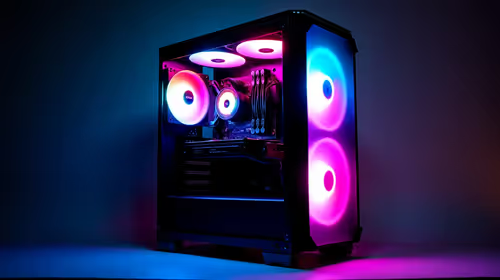
Yes, for any PC that doubles as a gaming and content creation machine, a 360mm AIO liquid cooler is strongly worth the investment. Content creation workloads like 4K video exports in DaVinci Resolve or 3D rendering in Blender sustain all-core CPU loads for minutes to hours at a time, which is far more thermally demanding than gaming alone, and a 360mm AIO manages those sustained loads 8 to 14 degrees Celsius cooler than a 240mm unit.
Gaming Versus Content Creation Thermal Demands 🎮
Gaming typically taxes four to eight cores at moderate-to-high frequencies, producing 60 to 120 watts of CPU heat. Content creation, specifically 4K H.265 encoding, multi-track audio rendering, or large Photoshop file processing, engages all cores simultaneously and can push a Ryzen 9 9900X or Core i9-14900K to 150 to 200 watts for sustained periods. A 240mm AIO handles gaming thermals with margin, but may allow the CPU to thermal-throttle during a 30-minute 4K export, reducing render times and frustrating creators. The additional surface area of a 360mm radiator absorbs that sustained heat load and keeps the CPU boosting at full speed throughout the export.
Real-World Temperature Differences That Matter 💡
In a typical SA home studio with ambient temperatures of 24 to 28 degrees Celsius, a Ryzen 9 7900X on a quality 360mm AIO like the Deepcool MYSTIQUE 360 stays at around 78 degrees Celsius during a Blender render, compared to 89 to 92 degrees on a 240mm unit. That 10 to 14-degree difference keeps the CPU at its maximum boost clock rather than stepping back. For a creator billing time against render speed, faster renders have a direct financial value. Prices for 360mm AIOs locally sit between R2,200 and R4,500, making the step up from a 240mm unit a cost difference of R600 to R1,200 depending on brand.
Noise Profile for a Dual-Purpose Workstation 🔊
Content creators often record voiceovers or video commentary from the same machine they edit on, making fan noise a real concern. A 360mm AIO running three fans at 900 to 1,100 RPM during gaming and light editing is quieter than a 240mm AIO pushing two fans to 1,600 RPM to manage the same heat. This counter-intuitive advantage, more radiator surface means fans run slower for equivalent cooling, is especially relevant in SA home studios where a separate soundproofed recording room is not always possible.
Cap CPU Power Limits for Long Render Sessions ⚡
In your motherboard BIOS, setting a Package Power Tracking (PPT) or PL1 limit to around 125 watts on a high-TDP CPU reduces temperatures by 10 to 15 degrees Celsius during sustained rendering with only a 5 to 8 percent hit to render times. This is a practical tweak for SA creators who need sustained quiet operation during voiceover sessions.
FAQ
Does a 360mm AIO help with GPU temperatures during rendering?
No. A CPU AIO cooler only manages processor temperatures. GPU-intensive rendering workloads like those in Blender Cycles or DaVinci Resolve Studio depend on the graphics card's own cooling system. Ensure your GPU has adequate case airflow rather than relying on the CPU AIO.
Is a 360mm AIO better than a premium air cooler for content creation?
For sustained all-core workloads, a quality 360mm AIO typically outperforms even the best air coolers like the Noctua NH-D15 by 5 to 8 degrees Celsius under prolonged load. The advantage grows as ambient room temperature increases, making liquid cooling more relevant in warm SA workspaces.
What brands of 360mm AIOs are reliably available in South Africa?
Corsair, NZXT, Deepcool, Lian Li, and be quiet! all have 360mm AIO models stocked locally at Evetech with local warranty support. Deepcool and be quiet! offer particularly strong value at the R2,200 to R3,000 price point.
Dual-use PC that needs to stay cool through long renders and gaming sessions?
Evetech stocks 360mm AIO coolers across all budgets from brands with local SA warranty support. Browse the cooling range on the Evetech site to match the right unit to your build.