Quick Answer
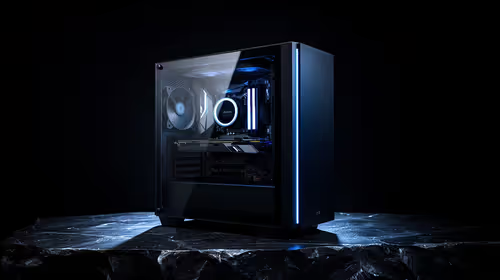
An E-ATX gaming case is worth it in South Africa only if your motherboard requires it. Standard high-end gaming boards on AMD X870E or Intel Z890 are ATX format and fit any ATX case; buying E-ATX overhead for an ATX board wastes R500 to R2,000 on unnecessary size. If your board is E-ATX, you have no choice, and the South African case selection covers the full feature range you need.
Understanding When the Board Dictates the Case 🖥️
The motherboard form factor is the first decision, and the case must accommodate it. E-ATX boards are typically used on HEDT platforms like AMD Threadripper 7000-series or extended premium AM5 boards with more than four PCIe slots. If you are building a gaming-only rig on a Ryzen 9 9900X or Core Ultra 9 285K, you are almost certainly on a standard ATX board. Spending the E-ATX case premium on that build buys extra interior volume and nothing else. For a SA gaming build with a budget of R40,000 to R80,000, the case is 5 to 8 percent of total spend, and that money is better directed at GPU performance than case size.
Where E-ATX Delivers Genuine Value in SA 🔧
For a South African content creator using a Threadripper platform for DaVinci Resolve 4K colour grading, Blender rendering, and gaming, the E-ATX board provides 8 RAM slots, 4 PCIe 5.0 x16 slots, and 10GbE networking that standard ATX cannot match. This platform requires an E-ATX case, and the case's larger interior makes it easier to install two large AIOs, manage cables from a 1,200W PSU, and fit a triple-fan RTX 5090 with room to spare. In this context, a premium E-ATX case at R5,000 is entirely justified within a total build budget exceeding R100,000.
Thermal Advantage in the SA Climate 🌬️
Larger case volume provides a modest but real thermal advantage in South Africa's warm ambient conditions. An E-ATX full-tower with 50 to 80 litres of internal volume maintains slightly lower internal ambient temperature under full load compared to a compact mid-tower, because there is more air volume buffering the heat before it exits. For summer gaming sessions in Gauteng at 35 degrees ambient, this margin of 2 to 4 degrees Celsius sustains boost clocks slightly longer before thermal limits intervene. It is a secondary consideration, not a reason to buy E-ATX alone, but a genuine benefit if you already need the form factor.
Verify Board Form Factor Before Ordering Any Case ⚡
Before placing a case order, find the form factor listed on your motherboard's specification page. The specification will state ATX, E-ATX, or EATX clearly. If it lists ATX, any ATX or E-ATX case will accommodate your board. If it lists E-ATX, only cases explicitly supporting E-ATX will fit, as the board will not align with standard ATX standoff positions. This one check prevents the most common form-factor mismatch error in SA builds.
FAQ
Do E-ATX cases always offer better cooling than ATX cases?
Not automatically. Cooling depends on fan configuration, mesh front panel quality, and radiator support, all available across both form factors at equivalent price tiers. An ATX mid-tower with a mesh front and 420mm radiator will outperform an E-ATX case with a solid front panel and limited fan mounts.
Is it difficult to find E-ATX cases in South Africa?
No. Several premium E-ATX cases are stocked locally and available through Evetech without importing. Local stock means no customs risk, no extended delivery wait, and local warranty support for a product category where transit damage is a real risk.
What GPU clearance should an E-ATX case have for the current SA GPU market?
400mm to 430mm is the target. This covers triple-fan AIB partner cards from the RTX 50-series and RX 9000-series with margin for cable connectors, essential since SA retail often stocks the longer partner cooler variants over Founders Editions.
Weighing up E-ATX for your next SA build?
Browse Evetech's locally stocked E-ATX cases and find the right enclosure for your platform and cooling requirements.