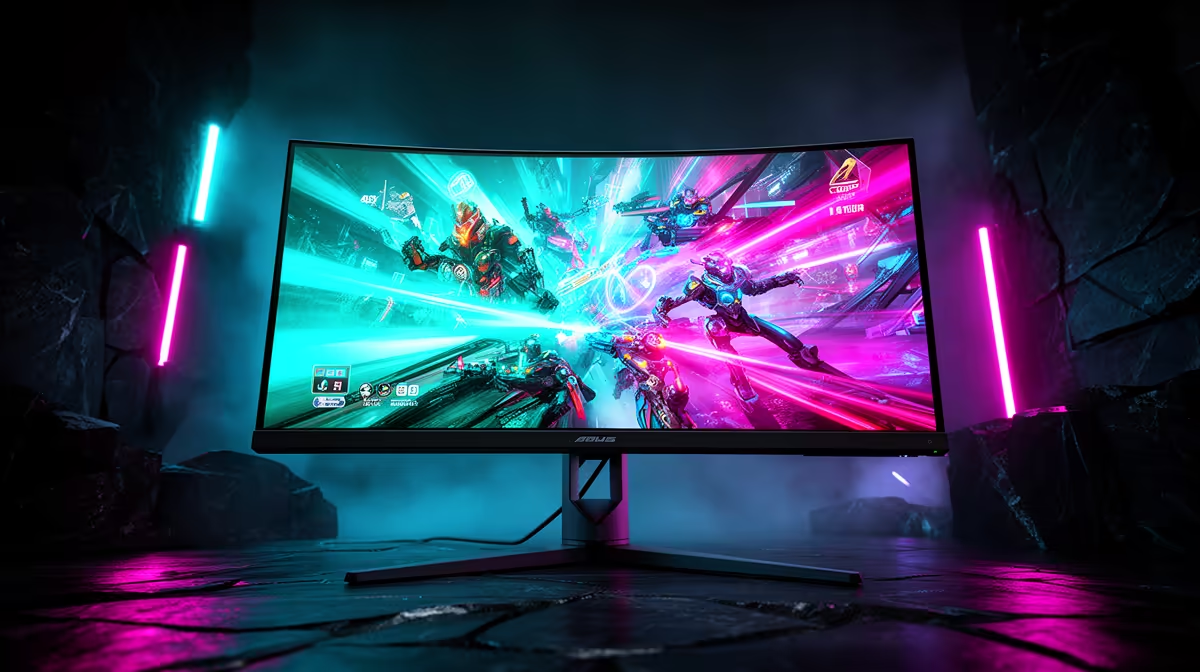
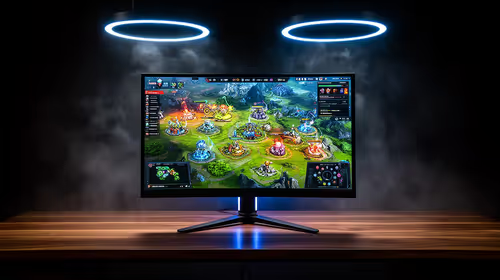
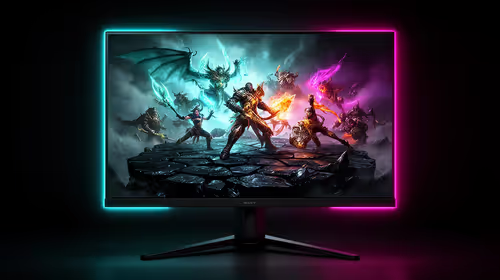
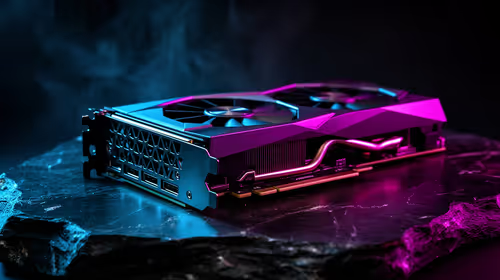
The RX 9070 XT gives you two strong monitor paths. Competitive players can feed a 1440p 240Hz screen, while players chasing detail can move to 4K at 144Hz and let variable refresh absorb the hard scenes. The card has enough range that your game library should choose the monitor, not the other way around.
Quick Answer
Choose 27-inch 1440p at 240Hz for high-frame-rate multiplayer, or 32-inch 4K at 144Hz to 165Hz for sharper AAA and mixed desktop use. A 34-inch 3440x1440 ultrawide is the simulation and immersion option. Across Evetech's in-stock gaming monitors, R4,499 was the July 2026 median; the premium formats suited to an RX 9070 XT can cost much more, so treat that number as category context only.
🏁 Use 1440p 240Hz for a fast library
At 1440p, the RX 9070 XT has more room to push the high real frame rates demanded by shooters and racing games. A 240Hz ceiling gives useful space above 165Hz without forcing you into the extreme prices of specialist esports panels.
Check the processor side. High frame rates increase game-engine and draw-call work, and lowering graphics stops helping once a CPU thread sets the pace. Run a real match at your normal settings before deciding how much of 240Hz you will use.
Evetech's monitor range lets you compare 1440p refresh tiers and panel types in the current catalogue.
🏙️ Choose 4K when detail wins the argument
The RX 9070 XT can deliver a strong 4K experience with settings tuned to the game. A 144Hz monitor gives lighter titles room to run and keeps demanding single-player play smooth across a broad variable-refresh range.
Start with the High preset and measure. Reduce expensive ray tracing, volumetric effects and shadows before sacrificing texture detail the card can hold. Use a quality FSR mode when it produces a clean image on the panel.
A 4K 240Hz screen is a longer-term premium choice. The card will use its full ceiling in lighter games, while demanding releases sit below it. Buy that headroom when the panel quality and ownership horizon make sense, not because 144Hz is somehow too small for the GPU.
🌄 Make ultrawide the genre choice
At 3440x1440, an ultrawide adds peripheral view without reaching the full pixel count of 4K. Sim racing, flight games and exploration benefit immediately. Productivity gains a wider timeline and more side-by-side space.
Check game support and streaming needs. Some competitive titles limit ultrawide views; video and cutscenes may show bars. A 38-inch or 49-inch format raises the pixel load and desk demands again, so treat each resolution as its own target.
Curvature helps keep the edges within a comfortable viewing angle. Measure the stand depth because a wide monitor can push the keyboard toward you on a shallow desk.
🎨 Match panel type to light and content
OLED gives the cleanest dark-room blacks, fast pixel response and strong HDR contrast. It fits a game-heavy desk where motion and cinematic scenes matter. Static work calls for panel-care features and a look at text rendering.
Mini-LED can reach higher bright-scene output and suits rooms with daylight. Local dimming quality decides how much blooming appears around small highlights. Fast IPS provides a lower-risk mixed-use route, with weaker contrast in a dark room.
At 1440p 240Hz, motion response matters across the whole VRR range. At 4K, uniformity, HDR and scaling can matter more. Read reviews for the exact model rather than transferring one panel's reputation to every screen using the same technology.
Run a memory-heavy game through a full route before settling on the preset. Resolution, ray tracing and texture packs can change VRAM demand, and a smooth opening room may hide traversal spikes. Keep texture quality high when the card has room, then reduce the setting that actually causes pressure. The monitor choice should follow stable play across a real level.
Use Evetech's monitor best-sellers for local shopping context after you have selected the format.
🔄 Set up FreeSync and the frame cap
Enable Adaptive-Sync on the monitor and FreeSync in AMD Software, then select maximum refresh in Windows. Run a game that moves through your expected frame range and look for tearing, flicker or overdrive trails.
A cap just inside the monitor's VRR ceiling can keep the system from bouncing against the maximum. Competitive players may choose another latency strategy. Use one limiter and one V-Sync path at a time so the result remains understandable.
Frame generation can add displayed smoothness in supported games. Input response still begins with base performance, which should already feel acceptable for the genre.
🔌 Verify the exact display mode
Use the monitor's DisplayPort or HDMI input that supports native resolution, full refresh, HDR and intended colour depth together. High-bandwidth modes may use Display Stream Compression. Check the on-screen display and Windows information after enabling the maximum rate.
A rated cable matters. If black screens appear only at the top mode, test a shorter certified cable and one display before changing drivers. Add secondary monitors and capture devices after the main link works.
Evetech's RX 9060 XT range provides adjacent AMD-card context; the RX 9070 XT pairing still needs performance expectations from the exact card you own.
Frequently Asked Questions
What resolution suits the RX 9070 XT best?
Both 1440p high refresh and 4K are credible. Choose from competitive speed or visual detail.
Does the RX 9070 XT support 240Hz gaming?
Yes. Reaching 240fps depends on the game, settings and CPU.
Can the RX 9070 XT handle 4K gaming?
Yes with sensible settings and upscaling where needed. Demanding games will use the monitor's VRR range below its ceiling.
Should I choose a 165Hz or 240Hz monitor for this card?
Choose 240Hz when competitive titles frequently exceed 165fps; otherwise spend on panel quality at 165Hz.
Does the RX 9070 XT work well with FreeSync monitors?
Yes. Enable Adaptive-Sync on the display and FreeSync in AMD Software.
Which panel type suits this GPU best?
OLED suits contrast and motion, mini-LED suits bright HDR, and IPS suits straightforward mixed use.
What monitor size fits 1440p on this card?
27 inches is the standard sharp desktop fit, while 34-inch ultrawide uses a different 3440x1440 format.
Choosing between speed and 4K detail for an RX 9070 XT?
Compare high-refresh monitors at Evetech, then let your most demanding game decide which side gets the budget.