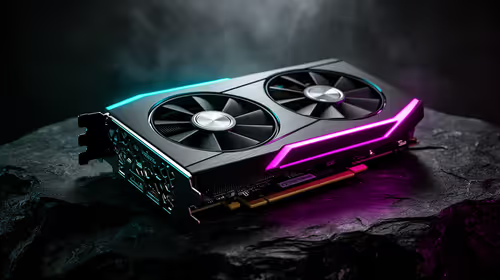
Price tiers are useful when they explain what additional spending changes. Flagship graphics-card price tiers in South Africa should group real costs, complete-build requirements and workloads rather than implying that a higher tier delivers better value to every buyer.
Quick Answer
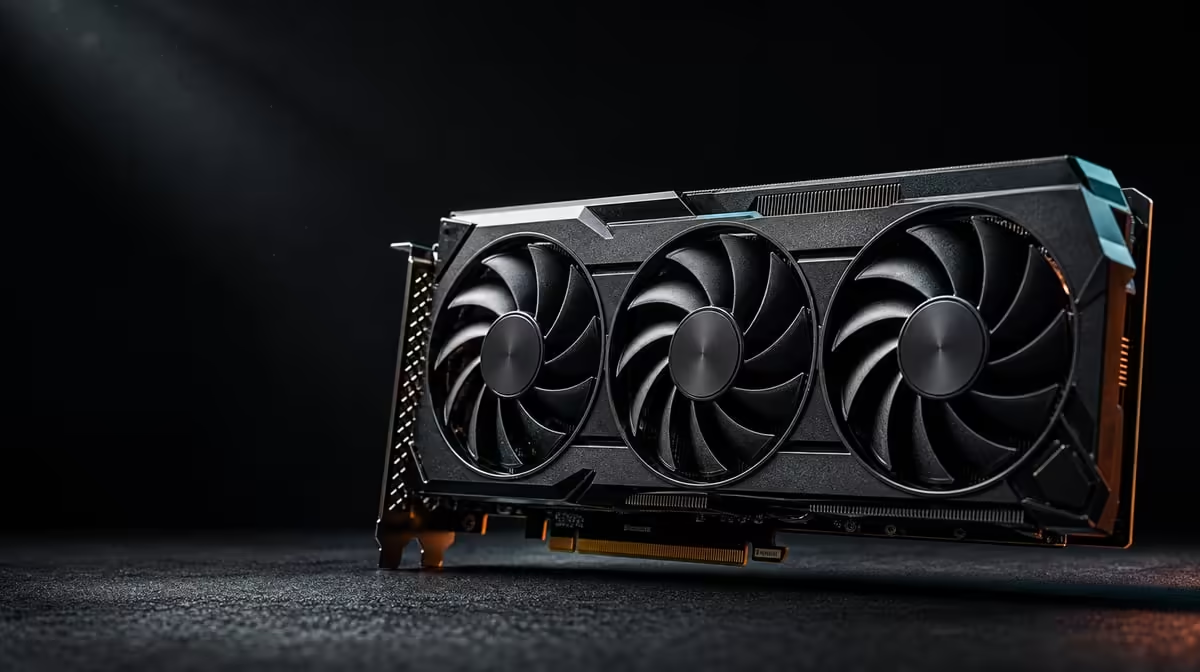
At R73,599, the ASUS TUF RTX 5090 sits above the R50,000 level and belongs in a flagship spending tier. Its 32GB memory, 3352 AI TOPs and five outputs need demanding, repeated use to justify that position in a South African build.
💰 Define tiers with current figures and outcomes
Start by recording dated prices for the candidates. A tier guide is a snapshot; cards can move between bands as pricing changes.
Set boundaries that support a decision. Under R50,000 can be one practical cap, while this R73,599 RTX 5090 clearly belongs above it. Do not stretch a boundary to keep a favoured card inside.
Give every tier an outcome rather than a prestige word. One level may meet a named resolution and settings target; another may add memory room for production; the flagship level may combine demanding gaming, AI and creator roles.
Use the same comparison date across the table. Mixing an old sale price with a current regular figure can make tier boundaries appear more stable than they are.
Keep an "outside this tier" note for products that miss the cap. The RTX 5090 can remain a feature reference for an under-R50,000 comparison without being misrepresented as an eligible choice.
Avoid claiming that all cards within a price band are equivalent. Cooler, memory, outputs, software performance and installation needs can differ widely.
Keep the GPU figure separate from the complete PC ceiling. A card can fit its own tier while forcing platform changes that make the total unaffordable.
Add tax-inclusive purchasing reality and the final checkout figure as displayed when making the decision, without assuming tomorrow's price. The guide should help a buyer recognise affordability at the moment they act.
Explore Evetech's ASUS graphics-card listings with date, price and intended workload in each row.
🧠 Make premium specifications earn a tier jump
The 32GB GDDR7 configuration can support large game assets, substantial creator projects or compatible AI models. Test whether the working set actually needs that room.
Allocation alone is weak evidence. Link memory use to changed settings, project fit, completion reliability or responsiveness. A smaller pool that meets the same target may offer better value.
The 3352 AI TOPs rating describes theoretical supported AI operations. Check application, model and precision. An unsupported tool should not receive flagship points for a number it cannot use.
PCIe 5.0 identifies the host interface, not the entire performance tier. It can suit a modern platform plan, while a PCIe 4.0 system may remain adequate for workloads that do not saturate the link.
Five outputs - three DisplayPort 2.1b routes paired with two HDMI 2.1b links - can add workstation value. Count only the screens and modes that the user actually plans to run.
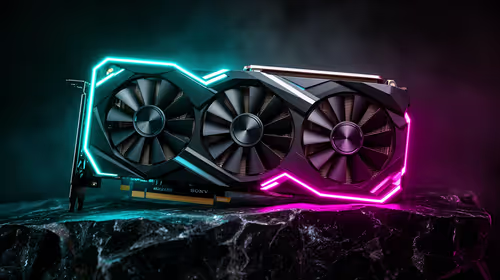
A patented chamber supported by axial-tech fans are named cooling features, while protective PCB coating adds durability context. Neither should receive performance points unless the scoring model clearly separates design from measured output.
Compare complete products in Evetech's NVIDIA GPU category, not rand per isolated specification.
🧱 Include the supporting build in every band
Confirm official card dimensions and measure the chassis with installed fans, radiators and drive structures. A flagship purchase can require a new enclosure when fit was assumed.
Check documented power needs and safe connector routing. Do not invent wattage or rely on the tier to choose a supply. The correct information belongs in the product and power-supply guidance.
Cooling also crosses the tier boundary. The ASUS TUF model has a patented chamber supported by axial-tech fans, but case ventilation must remove the released heat. Price any necessary airflow or chassis correction.
Motherboard slot, firmware and lane layout need review. PCIe compatibility does not resolve physical space, shared lanes or power.
Display costs can be part of realising the purchase. A suitable cable, adapter or monitor may be needed for the intended high-resolution mode, and those costs sit outside R73,599.
Add setup time and downtime for a work machine. A complex rebuild carries an operational cost even when every part is technically reusable.
Budget for safe assembly or qualified technical help when the user is not comfortable installing flagship hardware. The service decision should be made before the components arrive, not after the current PC is already dismantled.
Keep contingency inside the full-build ceiling. Confirming parts reduces surprises, but an expensive system should not rely on every calculation landing exactly at the last rand.
📊 Compare value at the user's frequency
Assign weekly hours or project counts to gaming, AI and creative work. A feature used daily deserves more weight than one demonstrated occasionally.
For games, measure the exact titles, resolution and settings. Include frame-time consistency. For production, time equivalent output and capture failed runs.
Give the strongest recurring activity the highest weight. A buyer who games nightly and explores AI occasionally should not score those roles equally merely because the card supports both.
Compare the flagship card with a less expensive GPU plus another upgrade. The alternative might improve CPU-limited games, host memory, storage or display quality more effectively.
Set a stopping rule. Once a tier meets the accepted target with suitable fit and support, higher spending must solve another named need rather than simply add headroom.
Write what would falsify the flagship choice. If a lower tier meets the same game target, holds the real project and supports the display plan, the premium needs another evidence-based reason or it should remain unspent.
At R73,599, this RTX 5090 should support a strong sentence: which recurring workload uses 32GB, AI processing or the output layout, and why a lower tier cannot meet it. If that sentence is vague, remain below the flagship band.
Review the decision after purchase using saved baselines. A good tier guide learns whether its promised practical difference appeared in the complete system.
Retain the dated table for the next upgrade. Later buyers can update prices and workloads while keeping the same method, avoiding a return to prestige-led comparisons.
Use Evetech's GPU best-seller collection for a final cross-check and confirm current availability when buying.
Frequently Asked Questions
Which tier contains a graphics card priced at R73,599?
It belongs above the R50,000 level in a flagship spending tier.
What can justify moving into a flagship price tier?
Repeated workloads that measurably benefit from premium processing, memory, outputs or another model-specific feature.
How should 32GB of GDDR7 influence the comparison?
Give it value when real games, creator projects or AI models place meaningful pressure on smaller capacity.
Why include the complete PC cost in a GPU tier guide?
Chassis, power, platform, cooling or display changes can materially raise the cost of using the card.
Does a higher price tier ensure better value for every gamer?
No. Value depends on the chosen games, monitor target, system and frequency of use.
Where do 3352 AI TOPs fit in a price-tier decision?
They matter when a named application uses the supported AI processing path and the result improves a recurring job.
How can buyers compare price tiers without chasing specifications?
Define one measurable outcome, total every required part and stop at the lowest tier that meets the goal well.
Comparing South African GPU tiers by real value?
Set the workload, full-build ceiling and stopping rule, then use Evetech graphics-card prices to find the lowest tier that clears them.