Flagship prices make sense only in relation to flagship work. Setting a high-end graphics-card budget in South Africa starts with a defined game, creator or AI outcome, then reserves money for the power, cooling, platform and display environment needed to reach it.
Quick Answer
The ASUS TUF RTX 5090 is priced at R73,599. Treat that figure as one line in the complete PC budget and justify it through sustained use of its 32GB memory, 3352 AI TOPs, five outputs or another measured benefit - not through tier status alone.
🧾 Build the budget from the workload backwards
Write down what the machine must deliver for the next defined period. For gaming, include titles, resolution, desired settings and frame behaviour. For creation, record application, project size, export expectations and the cost of waiting. AI work needs a named model, precision and supported tool.
Turn each goal into evidence. Collect repeatable performance information from comparable systems or test the application directly where possible. Avoid a broad target such as "maximum performance"; it can absorb any amount of money without ever declaring success.
Separate requirements from preferences. A suitable graphics-memory pool for the project can be a requirement. A particular exterior style may be a preference. Both are legitimate, but they should not compete invisibly for the same funds.
Create three numbers: the ideal allocation, the maximum affordable GPU price and the complete-system ceiling. The second stops feature creep inside the card shortlist; the third prevents supporting changes from appearing as a surprise after selection.
Add a timing rule. Decide how long the buyer will compare options and what evidence closes the decision. Endless monitoring of small price movements can consume attention without changing which workload the PC must serve.
Keep a dated copy of every candidate price used in the calculation. If the market changes before purchase, update the figures but retain the same evaluation method. That makes a new shortlist comparable with the old one.
Evetech's ASUS graphics-card range can anchor current comparison once those figures and workload outcomes are written down.
🧱 Price the system around the card
A graphics card must physically fit, receive appropriate power, communicate with the motherboard and release heat into the chassis. Confirm every requirement through the product and component documentation rather than guessing from the high-end label.
Check chassis clearance with any radiator, front fan or drive structure installed. Review the power supply and connection plan, allowing sensible cable routing. Read the motherboard's slot and lane guidance, including how other expansion devices affect the arrangement.
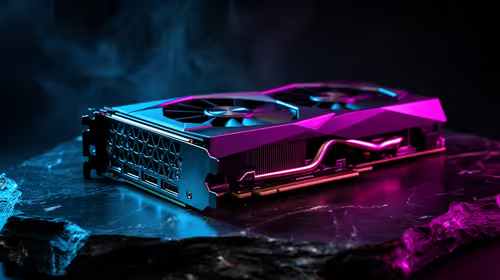
Cooling can create related cost. The ASUS TUF RTX 5090 includes its chamber-and-axial-tech-fan assembly, but the case still needs a useful intake and exhaust route. If the current enclosure traps warm air, budget for the correct solution rather than expecting the card's cooler to compensate.
Displays belong in the same calculation. This model has a three-port DisplayPort 2.1b side plus dual HDMI 2.1b sockets. New cables, adapters or a monitor upgrade may be part of achieving the desired mode, even though none is included in the R73,599 GPU figure.
Do not forget the opportunity cost. Money assigned to the card cannot also improve system memory, storage, processor capability, backup or display quality. Compare which change removes the most expensive daily constraint.
Review Evetech's NVIDIA GPU selection with both GPU-only and full-build totals visible.
🧠 Make premium features earn their share
The RTX 5090's 32GB GDDR7 can matter when games, creative assets or AI models genuinely pressure smaller pools. Monitor a representative project and note whether capacity changes settings, completion or responsiveness. Merely allocating memory is not enough evidence.
Its 3352 AI TOPs describes theoretical operations for supported AI processing. Check application compatibility and hold model, precision and output settings constant during comparison. TOPs should not decide a purchase for software that cannot use the acceleration path.
PCIe 5.0 identifies the host interface. It may fit a new high-end platform plan, yet interface generation does not replace workload results. A builder must still confirm the active link and whether data movement is a meaningful limit.
Five display connections add value when the desk uses them. Map every monitor's input, resolution and refresh target. Physical ports should not be priced as five benefits when only one screen is present.
Use a weighted score. Give the primary workload most of the points, supporting compatibility the next share and nice-to-have features the remainder. Price per score is crude, but it exposes a flagship card receiving full credit for resources the user never employs.
Apply a minimum gate before scoring. Any candidate that fails a required application, display connection, physical-fit or affordability condition should leave the table. A high total cannot compensate for one non-negotiable mismatch.
📈 Decide how the purchase pays back
For a work system, value may come from project throughput, fewer failed jobs or the ability to accept larger work. Estimate frequency and time saved conservatively. A rare best-case improvement should not be multiplied across every working day.
For gaming, the return is experience rather than revenue. Define what improvement is worth paying for: a steadier target, higher chosen settings or longer comfort before another upgrade. The budget still needs a stopping rule.
Ask what the user would notice after the first week and after the first year. Immediate changes can include smoother target performance or a more capable workstation layout. Ground longer-term value in work or gaming that already recurs.
At R73,599, the ASUS card should survive a simple challenge: what repeated activity uses its distinctive resources, and what less expensive configuration fails that test? If the answer is uncertain, retain the budget until the evidence improves.
Set aside contingency inside the complete-system ceiling. A required cable, mounting adjustment or compatibility correction should not force debt or compromise another essential component.
Record the decision date and comparison prices because local pricing changes. Do not let a later figure rewrite why the card was selected; the workload case should remain the foundation.
Keep finance separate from technical enthusiasm. The most capable qualifying card is not automatically affordable, and the largest affordable spend is not automatically necessary. The final choice should satisfy both constraints at once.
Finally, plan a post-build review. Repeat the chosen tests, note whether the promised bottleneck changed and retain the result for the next upgrade cycle. A budget becomes better when it produces evidence rather than only a receipt.
Consult Evetech's GPU best sellers when testing the shortlist against other popular choices, then check current availability before committing.
Frequently Asked Questions
What should define a high-end GPU budget first?
The exact games, applications, displays and outcomes the machine must support should set the initial boundary.
How should buyers interpret the R73,599 price?
It is the GPU's listed figure for this comparison, not the complete cost of a suitable high-end PC.
Which costs sit outside the graphics-card price?
Possible platform, power, chassis, cooling, cable and display changes belong in the full-build calculation.
When can 32GB of GDDR7 justify part of the premium?
When a frequent game, creator project or compatible AI model benefits measurably from that capacity.
How do five outputs affect budget value?
They add practical value only when the planned desk needs their DisplayPort 2.1b and HDMI 2.1b routes.
Should AI TOPs decide the entire buying choice?
No. The software must support the processing, and the rest of the workflow can still limit completion time.
How can buyers control flagship feature creep?
Set separate GPU and total-system ceilings, then require every premium feature to solve a named need.
Ready to price the whole high-end build?
Define the result, reserve funds for the surrounding PC and compare Evetech graphics cards by the repeated work that can repay their premium.