The ceiling light in your room was designed to make the space comfortable to live in, not to make faces look sharp on a webcam. These are different problems with different solutions, and understanding why ordinary room lighting falls short of what a dedicated LED video light provides is the fastest way to decide whether you actually need one.
Quick Answer
Room lighting is almost always a poor substitute for a dedicated video panel. Ceiling fixtures illuminate from above, which deepens facial shadows and forces your webcam to compensate with extra gain and noise. One front-facing LED panel near eye level solves both problems at once, and it costs far less than a camera upgrade.
🔧 Why the Angle of Your Room Light Works Against You
Ceiling fixtures distribute light downward to cover a room evenly for general use. That vertical angle is exactly the opposite of what a webcam needs from its subject. Light falling from directly above creates shadow pockets under the brow ridge, the nose, and the jawline. On a streaming or video call image, those shadows read as a tired or sunken appearance that no amount of camera resolution fixes.
A secondary problem is distance. Ceiling lights are designed to fill a whole room, which means the intensity reaching any individual subject from that height is relatively low. A webcam compensating for low front light has to amplify the signal from its sensor, and that amplification introduces visible grain and softness into the image, especially on budget sensors with smaller photosites.
What Changes When You Add a Front Panel
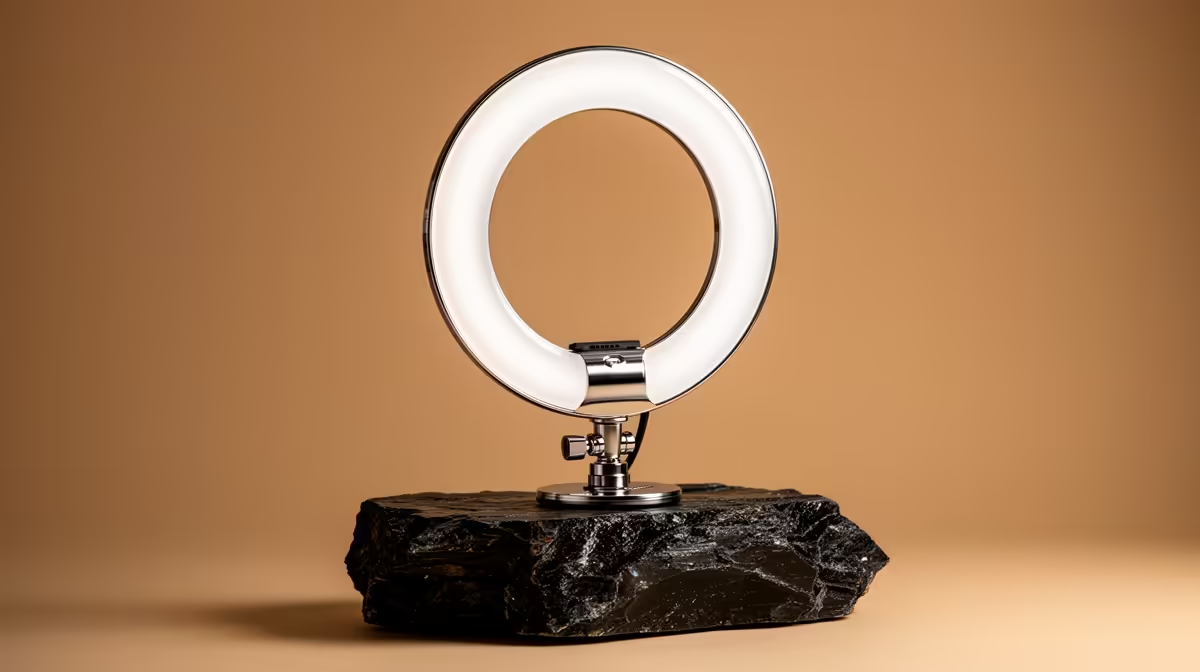
A dedicated LED panel placed at eye level delivers directional, predictable light directly toward your face. The webcam receives a strong, clean signal and can run with minimal amplification, which produces a noticeably sharper image with far less grain. The shadows that room lighting creates are either eliminated or softened, depending on the panel angle.
This is not a subtle improvement. Even a modest LED panel in the right position creates an image shift that viewers notice immediately. Moving a light source from above your head to in front of your face is arguably the highest-leverage change available to a streaming creator at any budget level.
🌗 When Room Lighting Can Work
Standard ceiling lighting is genuinely adequate in one specific situation: when a window or lamp happens to face you directly at a useful angle and provides enough intensity. A north-facing window in a Cape Town flat during morning hours can function as a soft key if you position yourself close to it and face it squarely.
The problem is consistency. Daylight shifts across the day and disappears entirely at night, so a stream that looks good at noon looks different at 3pm and dark at 9pm. A room light-only setup cannot hold a consistent look across streaming schedules that span time zones or session lengths.
A desk lamp with a daylight-rated bulb is a useful intermediate option. It positions a light source closer to eye level than a ceiling fixture and can be aimed at the subject. However, it lacks a diffuser to soften the output, usually cannot adjust its colour temperature, and cannot match the even, purpose-built spread of a proper video panel.
The Noise Problem in Detail
Webcam sensors read noise as visual grain in the image. On a dimly lit face, the sensor must amplify its output to produce a visible image, and that amplification multiplies existing noise alongside the signal. A dedicated LED panel feeds the sensor more raw light, so less amplification is needed, and the grain that was previously amplifying into visibility simply does not appear.
This is why a cheap webcam with good lighting frequently outperforms a more expensive camera in poor light. The limiting factor in most streaming setups is not the sensor. It is the light the sensor has to work with.
Pro Tip ⚡
Place your LED panel so the centre of the beam lands on your face when you are seated at your normal streaming position. Run a short test recording, then review it on a second screen at normal viewing size. You will see the grain reduction immediately compared to the same shot under room light alone.
💰 Cost Versus Upgrade Path Comparison
A basic diffused LED panel capable of transforming a streaming image costs between R600 and R1,500, with price varying based on whether Kelvin tuning is included. That investment produces a larger visible improvement to the stream than a webcam upgrade of three to four times the cost under the same room lighting conditions.
The practical upgrade sequence for most South African streamers should be: room light first, then dedicated LED panel, then camera. Skipping straight to a camera upgrade while keeping inadequate lighting means paying for sensor resolution that your environment cannot extract.
Frequently Asked Questions
Why is ceiling light specifically bad for streaming?
Ceiling fixtures illuminate from above, casting shadows downward across facial features. The webcam sees those shadow areas as regions with low light, amplifies its sensor to compensate, and the resulting image carries grain and lacks front detail. Moving the light source to eye level removes the directional shadow problem and reduces sensor noise at the same time.
Can I get away with a window as my key light?
Sometimes. A large window directly in front of you during morning or midday hours can work well as a key light source. The issues are consistency and control. Cloud cover, time of day, and season all change window light significantly, which makes a repeatable streaming look difficult to achieve without a dedicated panel to fill gaps or take over when natural light is insufficient.
How much does a dedicated LED panel actually improve a budget webcam?
More than most people expect. Budget webcam sensors have smaller photosites that generate noise quickly when light levels drop. A panel feeding clean front light to the sensor reduces the amplification needed and cuts that noise significantly. The same camera, the same settings, and the same scene can look dramatically different with correct front lighting versus ceiling light alone.
Will any desk lamp work as a substitute?
A daylight desk lamp is better than a ceiling fixture and worth using if that is what you have. The shortfall compared to a proper video panel is diffusion, Kelvin adjustability, and physical size. A bare bulb creates hard-edged shadows and hotspots that a panel with a frosted diffuser avoids. For casual calls it is adequate. For serious streaming it is a short-term measure.
At what point should I upgrade the camera instead of the light?
Only after lighting is already sorted. If you are streaming in well-lit conditions with a good front key and the image still looks soft or lacks resolution, a better camera becomes relevant. Until then, camera upgrades in poor light environments return very little in visible quality terms.
Ready to fix the one thing holding your stream quality back?
Browse the LED streaming light range at Evetech and find a front-facing panel that turns your existing webcam into a noticeably sharper broadcast tool.