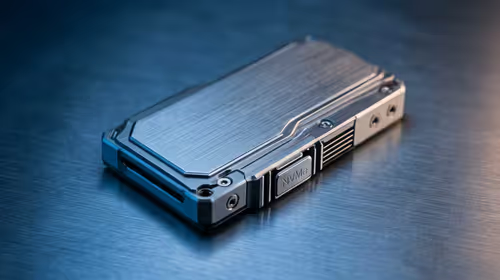
Three years ago, broadcasting a console gaming session at broadcast quality from South Africa meant owning both a high-end gaming PC and a capture device, spending well over R30,000 before a single frame went live. That calculus has shifted. Next-gen console capture hardware has brought professional-grade streaming within reach of anyone with a PS5 or Xbox Series X, a modest PC, and a fibre line running at 25 Mbps upload.
Quick Answer
A PS5 or Xbox Series X outputs 4K60 over HDMI 2.0, and a capture card from around R3,500 sends that feed to streaming software. The console does all the game rendering, so a basic 6-core PC is enough to encode and broadcast. SA fibre at 25/25 Mbps handles the upload.
🎮 How the Console Changes the Hardware Equation
The key shift in console capture is task separation. On a PC streaming setup, the same machine runs the game, renders every frame at high settings, and encodes the video stream simultaneously. Those three jobs compete for the same CPU and GPU resources, which is why a gaming PC that costs R20,000 still struggles to stream demanding titles at 4K60 without dropping performance.
A PS5 or Xbox Series X takes the game rendering entirely off the table. The console handles that work, outputting a finished 4K60 picture over HDMI. The capture card receives that completed signal and sends it to the streaming PC. The PC's only job is encoding the incoming feed and uploading it, which a 6-core processor with 16 GB of RAM does without strain.
This separation means the streaming PC can be genuinely modest. A mid-range office machine or a budget gaming desktop that could not stream its own games competently becomes a capable streaming companion when the heavy rendering shifts to the console.
💰 What the Cost Picture Looks Like in Rand
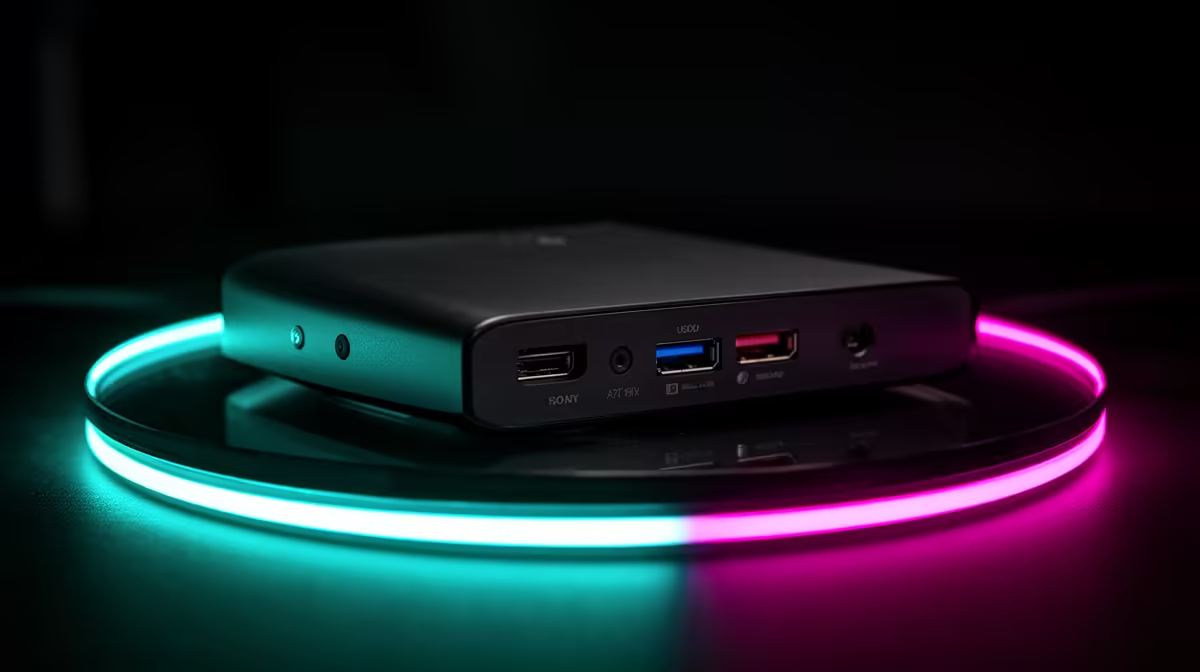
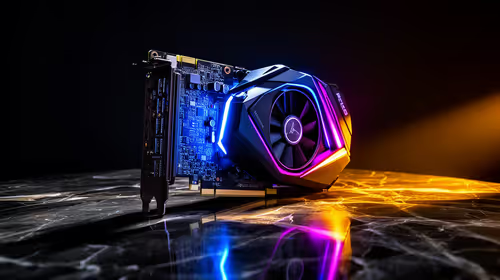
The full setup cost divides into three parts: the console, the capture card, and the PC. South African pricing on the PS5 and Xbox Series X sits around R11,000 to R13,000 depending on timing. A capable 4K60 capture card with HDMI 2.0 input and hardware encoding starts near R3,500 and reaches around R7,000 for premium models with lower latency pass-through.
For the streaming PC, buyers entering at this level often already have a desktop at home. A 6-core machine with 16 GB RAM and an NVMe SSD handles the encoding load without requiring an upgrade. That makes the marginal cost of building a console streaming setup primarily the capture card itself, roughly R3,500 to R5,500 for a solid mid-range unit.
Compare that with the alternative: a gaming PC powerful enough to handle both game rendering and 4K60 streaming in demanding titles starts near R20,000 for the GPU alone. Console capture routes around that cost entirely.
Pro Tip ⚡
Before buying a capture card, confirm your HDMI cable between the console and card is rated for 4K60. A cheap HDMI 1.4 cable caps out at 4K30, and the card gets blamed for a signal problem that is actually in the wire. HDMI 2.0 cables are widely available and inexpensive in South Africa.
🌐 South African Fibre and the Upload Threshold
The timing of SA fibre growth has aligned well with consumer capture hardware. Symmetrical 25/25 Mbps fibre packages are available from multiple providers in Joburg, Cape Town, Durban and most other urban centres, and many households have already upgraded to them for general browsing and remote work without realising the same line is now fast enough for 4K60 streaming.
A 4K60 stream at 12,000 to 15,000 kbps requires a sustained 20 Mbps upload. A 25 Mbps symmetrical line delivers that with a few megabits of headroom, enough to absorb occasional background traffic without interrupting the broadcast. The key requirement is wired delivery: Wi-Fi jitter on a 25 Mbps upload produces a less stable stream than a wired 20 Mbps line, because consistency matters more than peak speed.
Streaming platforms have also matured. Both Twitch and YouTube accept 4K ingest from creators in any region, not just those in North America or Europe. An SA creator on a 25/25 fibre line, streaming over ethernet with a console plus a mid-range capture card, can broadcast at the same technical quality as a studio in London.
🔧 What the Setup Actually Looks Like
The physical chain is four components: console, HDMI cable, capture card, and streaming PC. The console outputs its HDMI signal to the capture card's input port. The card's pass-through HDMI goes to the TV or monitor so gameplay continues without any delay added by the software. The card connects to the PC over USB-C, where software like OBS picks up the feed and handles the rest.
Setup time for this chain, once the hardware is in hand, is typically under an hour. Most current capture cards use a UVC driver model, meaning the PC recognises the device without installing anything beyond the streaming software. The console requires no configuration beyond setting HDMI output to 4K60 in its video settings.
For creators who already own the console and a basic PC, the capture card is the only new purchase. That single R3,500 to R5,500 addition converts an existing gaming setup into a broadcast-capable studio.
Frequently Asked Questions
How has capture hardware grown the SA streaming scene?
Affordable cards from around R3,500, combined with the spread of symmetrical fibre packages with 25 Mbps or higher upload speeds, have lowered both the cost and the technical barrier significantly. Console owners no longer need a high-end streaming PC to broadcast at 4K quality, which has brought a wave of SA creators into streaming who could not justify the previous entry cost.
Does console streaming require a high-powered PC?
No, and that is the point. Because the console does all the game rendering, the PC only encodes the incoming video stream. A 6-core processor and 16 GB of RAM handle that encoding job comfortably. The bottleneck is no longer the PC hardware; it is the upload speed of the fibre connection.
Can current SA fibre handle 4K60 console streaming?
Yes on a 25/25 Mbps or faster symmetrical package. A 4K60 stream at 15,000 kbps uses about 15 Mbps of upload, leaving headroom for background traffic. Wired ethernet is important: the upload speed needs to be consistent rather than just fast at peak, and ethernet delivers that stability.
Which console is better for a new SA streamer starting out?
Both the PS5 and Xbox Series X output 4K60 over HDMI 2.0 and work with the same capture cards. The choice comes down to game library preference rather than streaming compatibility. Either console feeds into a standard mid-range capture card with no modification.
Will a capture card noticeably cut the overall setup cost versus a gaming PC?
Yes, significantly. A PC capable of gaming at 4K settings while simultaneously streaming at 4K60 quality requires a GPU alone that costs more than the entire console-plus-capture-card combination. For a dedicated streaming setup rather than a PC gaming rig, the console route is substantially cheaper at comparable output quality.
Ready to build a 4K console streaming setup from South Africa?
Browse the capture card range and find the model that pairs with your PS5 or Xbox to deliver broadcast-quality video over the fibre line you already have.