NVENC and x264 encode the video, not the whole stream. NVENC uses a dedicated hardware encoder on supported Nvidia GPUs. x264 uses CPU cores. Microphone audio is encoded separately and is a much lighter job. On a budget gaming PC, NVENC often protects game frame time when x264 would compete with the game for processor headroom.
Quick Answer
Use NVENC on a supported recent Nvidia card when you game and stream on one budget PC. Start with the current OBS recommended preset for the platform and test the full scene. Use x264 when the CPU has proven spare headroom, the game is light or you are encoding on a separate machine. Choose from game frame time, OBS lag and final image, not an old claim that one encoder always looks better.
Evetech's streaming essentials help you complete the audio and capture path. The webcam selection lets you size camera sources without overloading the scene.
What NVENC Offloads
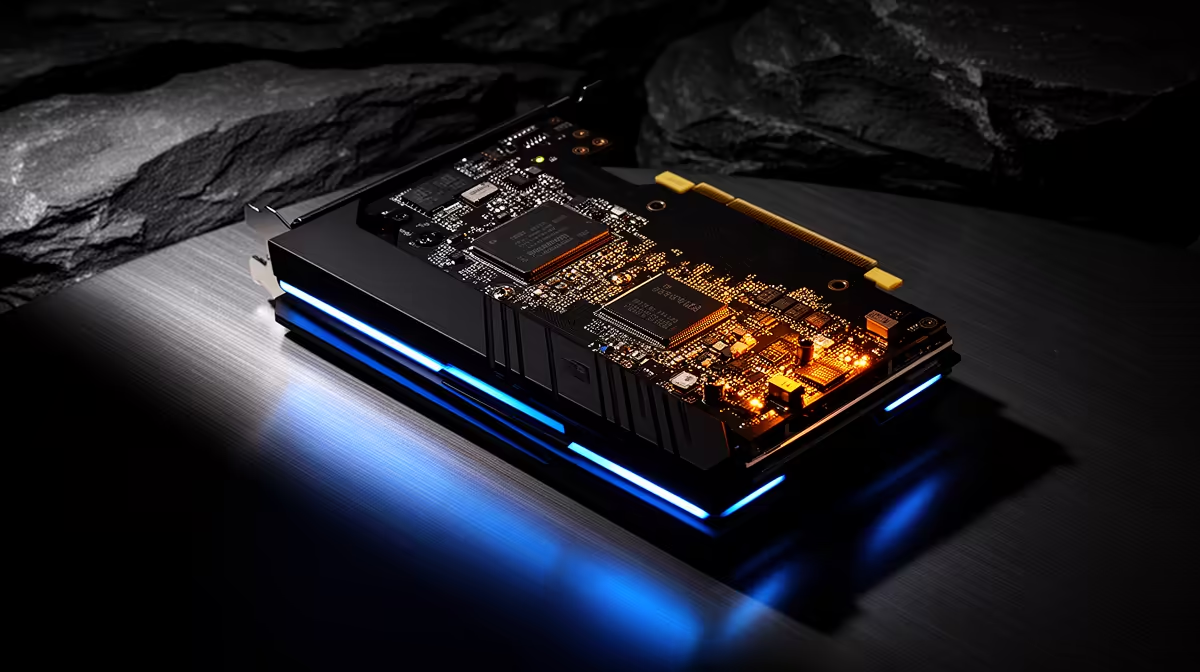
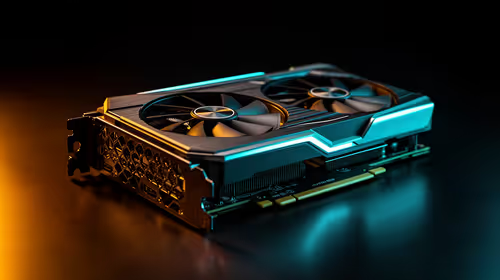
NVENC moves video compression to dedicated hardware on the Nvidia GPU. The game still uses the GPU's rendering resources, and OBS still has to compose the scene.
If the game holds the GPU at its limit, OBS can suffer rendering lag before the encoder becomes the issue. Cap game frame rate or lower settings to preserve composition headroom.
NVENC generation and codec support vary by GPU. Check the exact card and current driver.
What x264 Uses
x264 is a software H.264 encoder that runs on the CPU. Its presets trade processor work for compression efficiency.
A slower preset is more demanding. It can hurt game frame time on a quad-core or other budget CPU long before the stream looks better.
Do not use CPU utilisation alone. One game thread can be saturated while the average appears below 100 per cent.
Audio Is a Separate Light Load
OBS encodes microphone and desktop audio through an audio codec. NVENC does not turn microphone audio into video work.
Audio bitrate is small beside video, though routing and filters can add some CPU use. Noise suppression can be heavier than a basic compressor.
Keep sample rates consistent and monitor the final recording for sync.
Newer Hardware Encoders
Hardware video quality has improved across GPU generations. Codec support can include H.264, HEVC or AV1 depending on card and platform.
The streaming service decides which codecs and settings it accepts. A capable AV1 encoder has little live value on a destination that does not ingest AV1 for your account or workflow.
Use current platform and OBS documentation rather than a comparison from an older NVENC generation.
AMD and Intel Options
NVENC is Nvidia's name. AMD and Intel provide their own hardware video encoders.
OBS can expose those options when the driver and GPU support them. Compare quality, stability and game impact on the exact hardware.
Do not call every GPU encoder NVENC or assume the same preset names mean the same behaviour.
Set Up a Fair Test
Use the same game scene, OBS canvas, output resolution, frame rate, bitrate, keyframe interval and audio. Record or stream each encoder for ten minutes.
Include motion, foliage, dark areas, alerts and the webcam. Easy desktop footage hides compression differences.
Save separate OBS profiles so one test does not inherit another preset.
Read the Stats Window
Encoding lag points towards an encoder that cannot keep up. Rendering lag points towards scene composition or GPU pressure. Network drops point towards upload.
NVENC can show zero encoding lag while the scene still renders late because the GPU has no headroom.
x264 can hurt the game before OBS drops frames. Record game frame time alongside OBS.
Balance Game and GPU Headroom
Cap an uncapped game at a frame rate the system can sustain. This can free GPU resources for OBS composition.
Reduce settings that consume heavy GPU time before lowering stream quality at random. Check VRAM use too.
Run the test in a demanding match or race. Menus and training rooms are too light.
Choose an x264 Preset Carefully
Start with a faster preset that the CPU can hold. Move slower one step only when processor headroom and image comparisons support it.
The preset names describe speed, not a guaranteed quality rank at every bitrate and scene.
Return to NVENC when the x264 gain is hard to see and the game frame time gets worse.
A Second PC Changes the Equation
A dedicated streaming PC can use x264 without sharing cores with the game. It adds a capture path, audio routing, network, power and another machine to maintain.
Use it when production reliability or scene complexity justifies that overhead. A single budget PC with a capable hardware encoder is cleaner for most new streamers.
Measure the single-PC failure before adding another box.
Upload Still Sets the Ceiling
An encoder cannot push more clean detail through a bitrate the line or platform cannot sustain. Test upload with headroom.
At a fixed low bitrate, compression efficiency matters. Stable frame delivery matters more.
Use the platform's current bitrate and keyframe guidance for both encoders.
Judge the Delivered Image
Download or inspect the platform replay after the private test. Transcoding can make the delivered result differ from the local recording.
Compare motion, foliage, text, dark gradients and the facecam at normal viewer size. Pause-frame pixel hunting can exaggerate differences that disappear during play.
Ask whether any x264 gain survives the platform and is visible enough to justify the game-frame cost. If both outputs look close, keep the encoder with the cleaner performance and simpler recovery path.
Price the Complete PC, Not the Encoder Label
If you use a rand figure, name the exact GPU or complete PC from the approved July 2026 price pack. Do not claim every current Nvidia gaming PC has the same NVENC capability.
Include memory, SSD, power and cooling. A suitable encoder on an unstable PC does not make a stream system.
Keep the camera, microphone and lights in their own tested lines.
FAQ
How does NVENC reduce CPU load?
It compresses video on dedicated Nvidia GPU hardware, leaving CPU cores with less encoding work.
Does x264 always look better?
No. Encoder generation, preset, bitrate and scene decide. Compare current hardware with the same output.
Should a budget single PC use x264?
Only when the game and full OBS scene leave proven CPU headroom. NVENC is often the safer gaming path on a supported card.
Record the same demanding scene with NVENC and x264, then keep the encoder that protects game frame time and finishes with zero OBS lag.