Quick Answer
For AAA single-player gaming, OLED wins on contrast and motion with perfect blacks and near-instant pixel response, while Mini-LED wins on sustained brightness and has zero burn-in risk. OLED is the choice for dark-room image quality; Mini-LED suits very bright rooms and all-day desktop use. Both are premium, and the better pick depends on your room and content.
Contrast and Motion vs Brightness
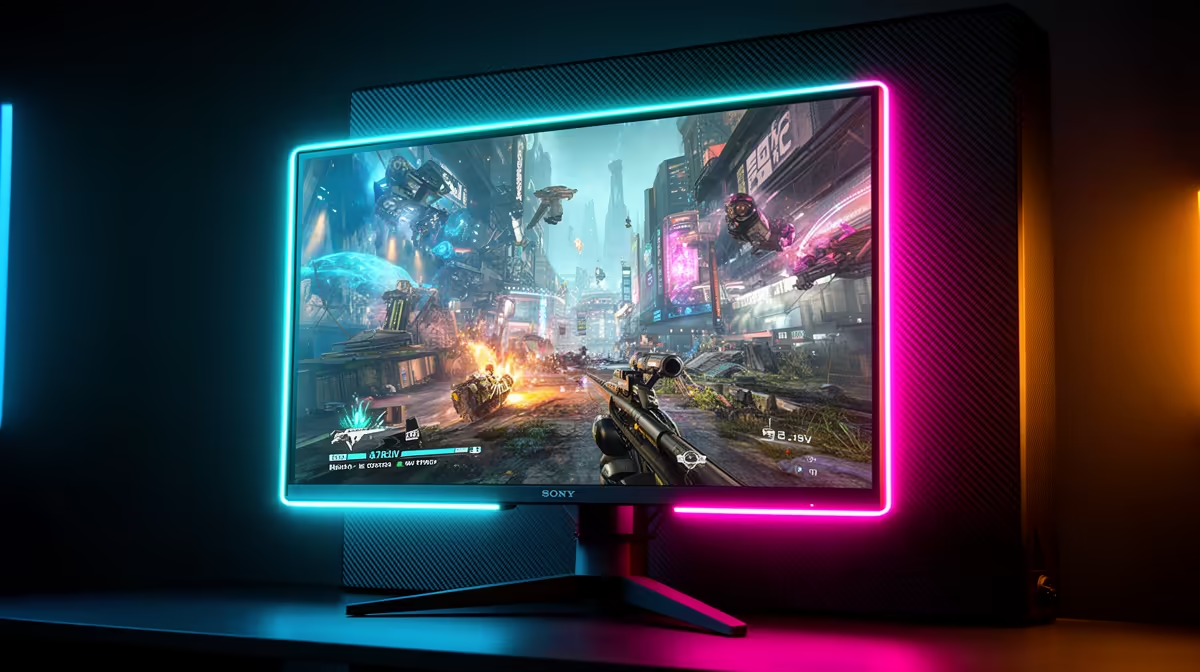
OLED lights each pixel individually, so blacks are truly off and contrast is effectively infinite, with response times around 0.03 ms that eliminate motion blur. Mini-LED uses thousands of tiny backlight zones behind an LCD; it gets far brighter for HDR highlights but can show faint blooming around bright objects on dark backgrounds.
For the latest AAA releases at 1440p or 4K Ultra where every component is pushed hard, OLED's per-pixel control gives the cleaner, more immersive image in controlled lighting, while Mini-LED's higher sustained brightness (often 1,000 nits and up) holds detail in a sun-filled room.
Burn-In, Brightness and SA Buying
Mini-LED has no burn-in risk and tolerates static elements like taskbars and spreadsheets all day, which suits a mixed work-and-play machine. OLED's burn-in risk on current panels is low for varied use but worth managing. At Evetech, both panel types span roughly R10,000 to over R25,000 for high-refresh gaming sizes.
For a AAA single-player gaming setup, pick OLED if you game in a darker room and prize contrast and response; pick Mini-LED if your room is bright, you leave static content on screen, or you want maximum HDR punch without burn-in worries.
FAQ
Is OLED or Mini-LED better for SA gaming?
OLED gives the best contrast and fastest motion for AAA single-player gaming in a controlled-light room, while Mini-LED is brighter and immune to burn-in. If your space is bright or you mix in lots of desktop work, Mini-LED is the safer all-rounder.
Does Mini-LED have any image downsides?
Its main weakness is blooming, a faint halo around bright objects on dark scenes, because the local-dimming zones are larger than individual pixels. Good Mini-LED panels with many zones minimise it, but OLED avoids it entirely.
Will an OLED monitor burn in from daily use?
For typical varied gaming and browsing the risk on modern panels is low, helped by pixel-shift and refresh routines. If you display the same static interface for many hours daily, Mini-LED removes that concern altogether.
Buyer Tip
the panel to your room: choose OLED for a curtained gaming corner where contrast shines, and Mini-LED for a bright lounge or a screen that doubles as an all-day work display.