



PCIe 5.0 vs PCIe 4.0 for Video editing in 4k in SA
PCIe 5.0 vs PCIe 4.0 for video editing in 4k is mainly about fit, features, compatibility, cost, and upgrade path, not one automatic winner. SA buyers should match the choice to the setup.
Read morePassive cooling vs aluminum alloy heat dissipation: which USB hub keeps your devices stable? Discover how premium materials prevent overheating and data drops during heavy workloads. ⚡💻

If you are weighing Passive Cooling vs Aluminum Alloy: Best USB Hubs for Device Stability, start with the problem you need solved and choose the option that removes that problem with the fewest compromises. The right answer for Passive Cooling vs Aluminum Alloy: Best USB Hubs for Device Stability depends on workload, platform, and tolerance for tradeoffs. For Passive Cooling vs Aluminum Alloy: Best USB Hubs for Device Stability, prioritise radiator position, fan direction, and case intake area before you compare prices. For South African buyers, also check current stock, warranty support, delivery timing, and whether the upgrade leaves room for the next part you are likely to change.
The reader searching for Passive Cooling vs Aluminum Alloy: Best USB Hubs for Device Stability is usually trying to avoid one of two mistakes: buying too little and replacing early, or paying extra for a feature that never changes daily use. For a builder chasing stable thermals, the better Passive Cooling vs Aluminum Alloy: Best USB Hubs for Device Stability path is to define the workload first, then compare cooling setup against that workload.
For Passive Cooling vs Aluminum Alloy: Best USB Hubs for Device Stability, the useful filter is whether the choice improves lower temperatures, steadier boost behaviour, and less fan noise. If Passive Cooling vs Aluminum Alloy: Best USB Hubs for Device Stability does not change that result in your setup, it belongs lower on the priority list.
The common trap with Passive Cooling vs Aluminum Alloy: Best USB Hubs for Device Stability is adding fans without a path. That shortcut can look fine in a product listing, but it may not solve the real Passive Cooling vs Aluminum Alloy: Best USB Hubs for Device Stability problem once the setup is used every day.
| Decision point | Option to favour | Why it matters |
|---|---|---|
| Best fit | socket support | Choose the option that improves lower temperatures, steadier boost behaviour, and less fan noise. |
| Watch out for | adding fans without a path | This can turn a good-looking deal into a poor fit. |
| Proof point | load temperature trend | Use this to judge the result after setup. |
| Final filter | passive cooling aluminum | Keep it only if it solves the main reason you searched for Passive Cooling vs Aluminum Alloy: Best USB Hubs for Device Stability. |
Use a repeatable test for Passive Cooling vs Aluminum Alloy: Best USB Hubs for Device Stability: same desk, same game or app, same settings, then compare load temperature trend, fan curve response, and dust access. That keeps the decision grounded.
In South Africa, Passive Cooling vs Aluminum Alloy: Best USB Hubs for Device Stability should also be checked against local availability and support. A clean Passive Cooling vs Aluminum Alloy: Best USB Hubs for Device Stability warranty path and realistic delivery timing can matter as much as the final spec, especially when the cooling setup is part of a larger PC, console, or work setup.
Keep the decision honest by ranking the final options for Passive Cooling vs Aluminum Alloy: Best USB Hubs for Device Stability against your current setup. The Passive Cooling vs Aluminum Alloy: Best USB Hubs for Device Stability winner should be the one that improves noise level, avoids the obvious compatibility issue, and leaves budget for the next weak link.
Do not choose Passive Cooling vs Aluminum Alloy: Best USB Hubs for Device Stability only by headline specs. The better Passive Cooling vs Aluminum Alloy: Best USB Hubs for Device Stability choice passes socket support, avoids adding fans without a path, and still leaves a practical upgrade path.
Do not choose Passive Cooling vs Aluminum Alloy: Best USB Hubs for Device Stability only by headline specs. The better Passive Cooling vs Aluminum Alloy: Best USB Hubs for Device Stability choice passes radiator position, avoids forgetting RAM clearance, and still leaves a practical upgrade path.
Start by matching Passive Cooling vs Aluminum Alloy: Best USB Hubs for Device Stability to your actual setup. Check fan direction, then confirm whether this Passive Cooling vs Aluminum Alloy: Best USB Hubs for Device Stability choice improves fan curve response; otherwise the feature may be interesting but not important enough to decide the purchase.
The best decision on Passive Cooling vs Aluminum Alloy: Best USB Hubs for Device Stability is the one that improves lower temperatures, steadier boost behaviour, and less fan noise without creating a new bottleneck elsewhere. Keep the Passive Cooling vs Aluminum Alloy: Best USB Hubs for Device Stability upgrade balanced and verify the fit before buying.
Compare Fan Accessories for Passive Cooling vs Aluminum Alloy: Best USB Hubs for Device Stability: https://www.evetech.co.za/PC-Components/nzxt-fan-controller-79
Yes, aluminum alloy acts as a large heat sink, drawing heat away from internal components more efficiently than plastic, which helps maintain stable data transfer speeds.
Passive cooling refers to using the device's chassis and internal design to dissipate heat without fans, relying on thermal conductivity to prevent overheating.
USB hubs get hot because internal controllers process high-speed data and power delivery, which generates thermal energy that must be dissipated to avoid connection drops.
Aluminum hubs are generally superior for heavy workloads because they offer better thermal management, preventing the connection drops often seen in plastic hubs.
To prevent overheating, choose an aluminum alloy hub, avoid stacking devices, and ensure your workspace has adequate airflow to aid passive cooling efforts.
Yes, excessive heat can cause thermal throttling, leading to slower file transfers or intermittent connection drops, making heat dissipation critical for stability.
PCIe 5.0 vs PCIe 4.0 for video editing in 4k is mainly about fit, features, compatibility, cost, and upgrade path, not one automatic winner. SA buyers should match the choice to the setup.
Read more
Wi-Fi 7 vs Wi-Fi 6e for competitive esports comes down to router support, latency goals, device compatibility, and coverage. SA buyers should match the choice to the real network setup.
Read more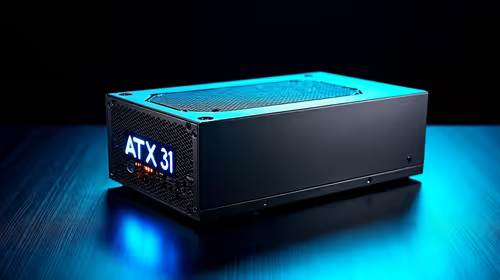
ATX 3.1 vs ATX 3.0 for mMO and live-service games buyers - what changes is mostly about compatibility, budget, upgrade path, and setup fit. SA buyers should check device support and real needs before expecting a clear win from either option.
Read more
LGA 1851 vs LGA 1700 can affect Twitch and YouTube streaming when gaming and encoding share CPU resources. For SA creators, the real-world difference depends on encoder choice, memory support, motherboard cost, thermals, and upgrade plans.
Read more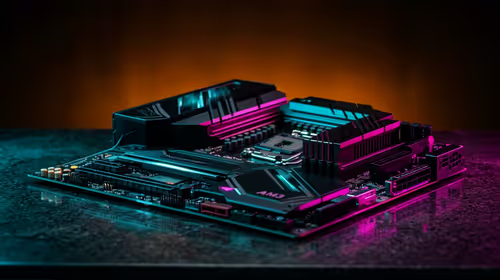
X870E vs X670E for aaa single-player gaming is mainly about fit, features, compatibility, cost, and upgrade path, not one automatic winner. SA buyers should match the choice to the setup.
Read more
Hall Effect switches vs Mechanical switches for mMO and live-service games is mostly about compatibility, budget, upgrade path, and setup fit. SA buyers should check device support and real needs before expecting a clear win from either option.
Read more
A fake 113GB GTA VI ISO reportedly used empty padding around a small malware payload. SA gamers should delete unofficial builds, keep Windows security active and wait for official channels.

Wi-Fi 6E vs Wi-Fi 6 matters for 4K video editing when files move across a network. The real-world difference between Wi-Fi 6E and Wi-Fi 6 for video editing in 4K depends on NAS access, cloud uploads, router range, and SA creator workflows.

The difference between PCIe 5.0 and PCIe 4.0 for SA gamers is mostly bandwidth headroom. Compare GPU slot needs, NVMe speed, motherboard support, and upgrade timing before paying extra for a newer platform.

Gaming PC stuck pixel checks in South Africa should confirm the monitor fault first. Use colour tests, screenshot comparison, cable swaps, display menu checks, and clear photos before deciding on support.

Shokz OpenFit Air 2 earbuds weigh 7.2g each and use a redesigned dual-driver open-ear layout. SA buyers should choose them for comfort and awareness, not maximum isolation.

AMD's current driver now lists a Radeon RX 9050 4GB, while product coverage details a narrowed memory system. SA buyers should weigh the low VRAM ceiling against current local Radeon options.

Samsung Display has demonstrated a 16-inch 2.5K OLED laptop panel running at 300Hz. SA buyers should wait for a named notebook, full panel specifications and a local price before planning an upgrade.

Microsoft says some Windows 11 game crashes after recent updates are linked to RGB-related drivers. Affected SA gamers should confirm the update and driver before using the published registry workaround.

RTX 5090 on a 650W PSU is a tight pairing with very limited headroom. For SA gaming PCs, focus on total system draw, PSU quality, connector support, CPU choice, and avoid OC plans unless the full build is carefully power-limited.
PCIe 5.0 vs PCIe 4.0 for video editing in 4k is mainly about fit, features, compatibility, cost, and upgrade path, not one automatic winner. SA buyers should match the choice to the setup.
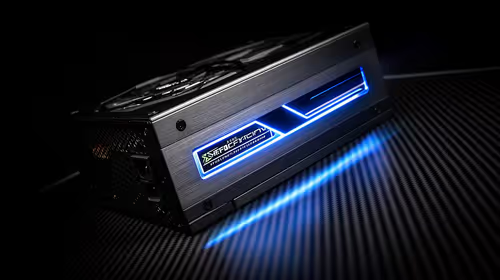
850W PSU safety for RTX 5090 is plausible with a quality unit and balanced parts. In SA, confirm connector support, CPU power draw, case airflow, PSU age, and spare capacity before building around 850W.
Wi-Fi 7 vs Wi-Fi 6e for competitive esports comes down to router support, latency goals, device compatibility, and coverage. SA buyers should match the choice to the real network setup.