Quick Answer
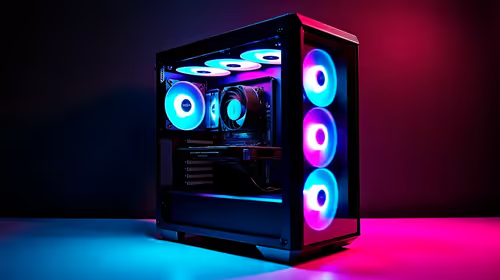
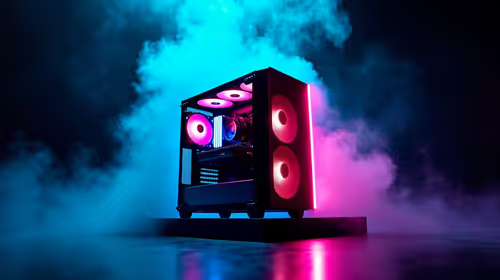
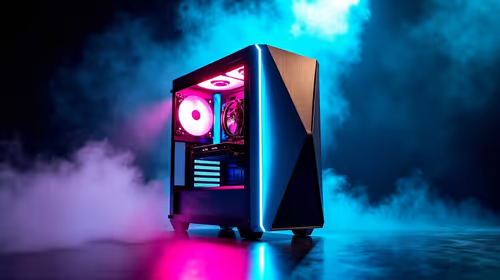
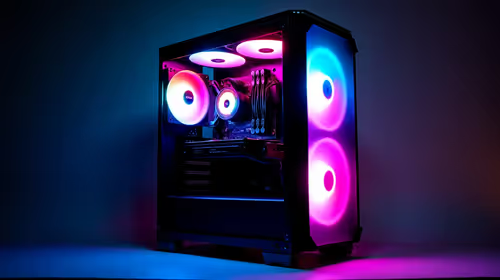
For a first-time builder, a case with preinstalled ARGB fans is almost always the better starting point. You get confirmed compatibility, a matched aesthetic, and one fewer purchasing decision to make.
What Preinstalled Fans Give You 🔧
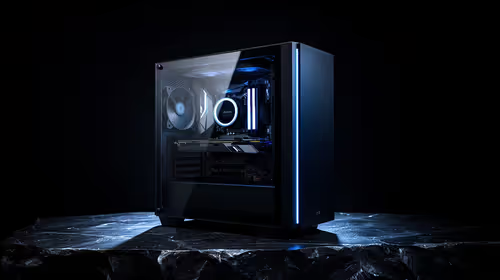
Cases that ship with three or four preinstalled ARGB fans from the same manufacturer have already solved the compatibility problem for you. The fans are sized to fit the case's specific mounting positions, their cable lengths are routed to reach the case's hub or controller, and their ARGB connectors are matched to the hub included in the case.
Adding Fans Later: Flexibility vs Complexity 💨
Starting with a fanless or single-fan case and adding fans after the initial build is a legitimate approach if you know exactly what you want. You can select premium fans from brands like Noctua, be quiet!, or Lian Li that outperform the bundled fans typically included with cases, and you can buy only the fans you need for your specific airflow layout rather than paying for four fans when three suffice. The risk is the mismatch problem: buying fans from different brands or generations that use different RGB software ecosystems forces you to run two or three separate lighting applications simultaneously. On a first build, this level of complexity adds unnecessary friction when you just want the PC to work.
Cost Comparison for SA Builders 💰
A case with three preinstalled 120mm ARGB fans typically costs R300 to R600 more than the equivalent case with no fans. Buying three quality 120mm ARGB fans separately runs R250 to R500 per fan, totalling R750 to R1,500 for the equivalent fan count. The preinstalled option is almost always cheaper when you factor in the complete cost, and the fans included in quality branded cases are not the cheap afterthoughts they used to be. For a first-time builder working within a R12,000 to R18,000 total build budget, choosing a preinstalled-fan case saves money and reduces decision fatigue at the same time.
Check the Hub Connector Type Before Adding Fans ⚡
If you later add fans to a case that uses a proprietary hub connector, new fans may not connect to that hub directly. Check the case manual for whether the hub uses standard 4-pin PWM and 3-pin ARGB connectors or a proprietary daisy-chain system. Standard connectors mean any aftermarket fan will work, while proprietary systems may require purchasing fans from the same brand to maintain lighting integration.
FAQ
Do preinstalled fans in cases perform as well as premium aftermarket fans?
Typically not. Fans bundled with mid-range cases perform adequately for general gaming but fall short of dedicated premium fans from Noctua or be quiet! in noise levels and static pressure. For most gaming builds the difference is minor in practice, but if you are building a near-silent workstation, replacing bundled fans with premium units is worthwhile.
Can I mix different brands of ARGB fans in one build?
Yes, but controlling them uniformly becomes complicated. Fans from different brands often use different RGB software (iCUE, Mystic Light, Aura Sync, etc.) and may not sync to the same lighting effect without a third-party controller like OpenRGB. For a cohesive, easy-to-control RGB setup, sticking to one brand ecosystem within a build is strongly recommended for first-time builders.
What happens if one of the preinstalled fans fails within warranty?
The case warranty typically covers the included fans. Contact the retailer (Evetech, in this case) with the proof of purchase and the case model. Most major brands handle warranty replacements for preinstalled fans under the same RMA process as the case itself, meaning you do not need to purchase a replacement fan out of pocket within the warranty period.
First build? Start with the right case.
Browse mid-tower ATX cases at Evetech with preinstalled ARGB fans from top brands, chosen to make first-time builds simpler and better-looking.