Quick Answer
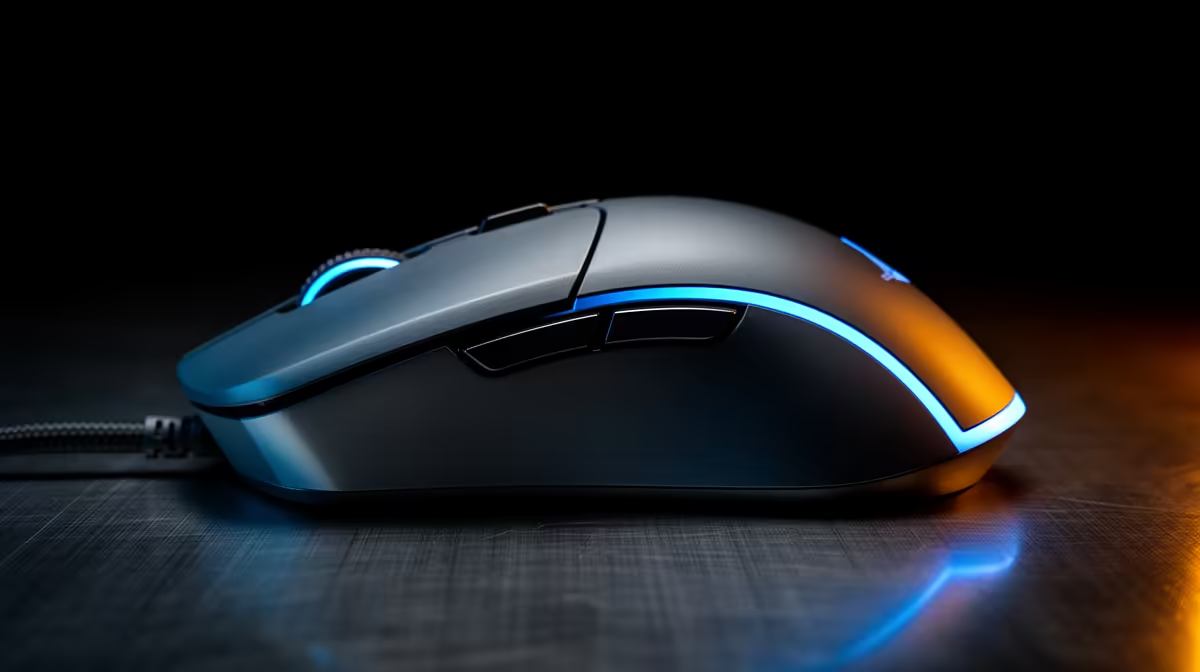
For competitive gaming in South Africa, prioritise a wireless polling rate of at least 1,000 Hz and a sensor rated for zero-smoothing at your target DPI. Mice with 4,000 Hz or 8,000 Hz polling deliver sub-1 ms report times that genuinely affect aim consistency in fast-paced FPS titles.
What Low Latency Actually Means in a Gaming Mouse 🎯
Latency in a gaming mouse has two components: the sensor-to-MCU pipeline and the wireless transmission delay. A wired USB mouse at 1,000 Hz reports every 1 ms. Modern 4,000 Hz wireless mice close that gap to 0.25 ms per report, which is imperceptible even to professional players. The sensor itself matters too: optical sensors like the Focus Pro 30K and Hero 25K track at up to 500 IPS without prediction, meaning your crosshair moves exactly where your hand moves. Look for zero-smoothing and zero-filtering language in spec sheets; mice without these guarantees add artificial smoothing that creates lag at high-speed swipes.
Wireless vs Wired Latency for SA Players 📡
The persistent myth that wireless mice lag behind wired ones is outdated. Current-generation 2.4 GHz LIGHTSPEED, HyperSpeed, and Slipstream wireless technologies measure at or below 1 ms system latency in controlled tests. The real ZAR trade-off is battery and price: a competitive wireless mouse sits around R1,200 to R1,800, while flagship wireless options with 4,000 Hz polling push toward R2,500 to R3,500. For South African tournament players competing on local Vumatel or Openserve fibre setups, the bottleneck is almost never the mouse; it is monitor refresh rate and in-game settings. That said, if your budget is tight, a 1,000 Hz wired mouse with a quality optical sensor still beats a cheap wireless mouse at every polling frequency.
DPI, Polling Rate and ZAR Budget Tiers 💰
Below R800 you get reliable 1,000 Hz polling and sensors accurate to around 6,400 DPI, which covers casual and semi-competitive play. Between R800 and R1,600 the field opens up to 26,000 DPI sensors, zero-smoothing certification, and lightweight shells under 70 g. Above R1,600 you are paying for 4,000 Hz or 8,000 Hz polling, premium wireless chipsets, and ultra-light builds. For most South African FPS players on 144 Hz or 165 Hz monitors, the R800 to R1,600 tier delivers more than enough low-latency performance to compete at a high level.
Match Polling Rate to Your Monitor Hz ⚡
an 8,000 Hz mouse on a 60 Hz monitor wastes battery and CPU overhead without any perceivable benefit. Set your polling rate to at least 4x your monitor refresh rate: 1,000 Hz for 144 Hz panels, 4,000 Hz if you have upgraded to a 360 Hz display. Most drivers like Razer Synapse and Logitech G HUB let you set this per game profile.
FAQ
Does a higher polling rate always reduce latency?
Higher polling rates reduce the worst-case report interval but can increase CPU usage on older rigs. On a modern Ryzen 5 or Core i5 system, 4,000 Hz adds negligible CPU load. On a budget build with an older CPU, stick to 1,000 Hz to avoid micro-stutters that would negate the latency benefit.
Is a wireless gaming mouse reliable for ranked competitive play in SA?
Yes, provided you use a quality 2.4 GHz dongle placed within 30 cm of the mouse and avoid crowded Wi-Fi channels. USB extensions for the dongle are included with most flagship wireless mice and are worth using at LAN events or densely connected home setups.
What ZAR range gets me a genuinely low-latency optical sensor?
Mice in the R600 to R900 range from established brands already include sensors with zero-smoothing and 1,000 Hz polling. Spending over R1,500 adds faster polling and wireless, but the sensor quality jump above R900 is marginal for most players.
Ready to cut your click-to-screen time?
Evetech stocks a full range of gaming mice from entry-level 1,000 Hz wired options to flagship 4,000 Hz wireless models. Browse the gaming mouse category to filter by polling rate and connectivity.