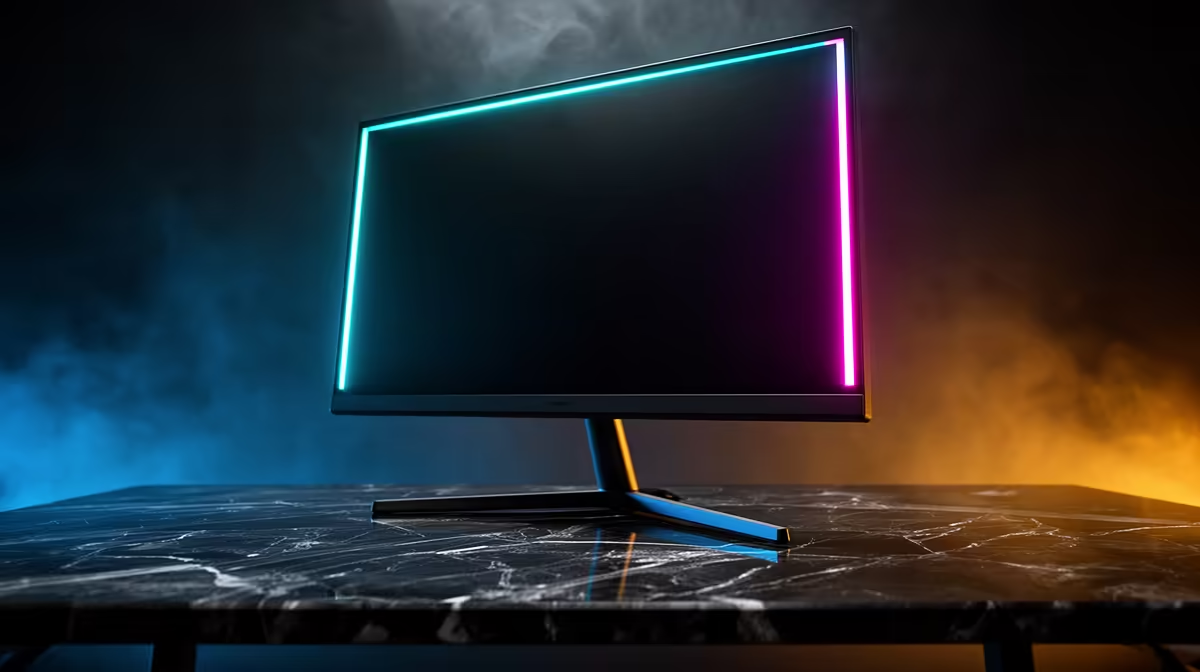
Put a QD-OLED and a WOLED monitor side by side in a dark game and both deliver the thing people buy OLED for: black pixels that actually switch off, bright objects without LCD blooming and wonderfully clean motion. The differences emerge in bright colour, room lighting, text and the way each model controls brightness. A useful QD-OLED vs WOLED choice begins with those visible details rather than the panel acronym.
Quick Answer
QD-OLED often holds richer colour in bright highlights, while WOLED can keep black levels looking darker under strong ambient light. Brightness has no automatic winner because panel generation, cooling and firmware matter. Both can show colour fringing on fine desktop text, and both carry some uneven-wear risk. Choose the exact monitor from your room and workload. For dated market context, the midpoint of Evetech's available gaming-monitor set was R4,499 in July 2026, before OLED pushes the budget above mainstream LCD territory.
🎨 See how each panel makes colour
QD-OLED uses an OLED light source with quantum-dot conversion for red and green. It does not rely on the white subpixel found in common WOLED designs, which helps it maintain saturated colour as highlights become brighter.
WOLED produces light through an OLED stack and colour-filter system, with a white subpixel used in many monitor panels to lift brightness. In very bright coloured content, that white contribution can reduce saturation compared with a strong QD-OLED implementation.
You are most likely to notice the difference in neon signs, spell effects and richly coloured HDR highlights. In ordinary SDR play, calibration and the monitor's mode can matter more than the panel family.
Browse Evetech's OLED monitor range to see the current sizes and formats, then confirm the panel type on the exact product specification.
☀️ Judge brightness in the scene, not one number
Peak-brightness figures are usually measured in a small window. A monitor can flash a tiny highlight brightly and then dim a large white page to control heat and power. Compare small-window brightness, sustained full-screen brightness and automatic limiting behaviour.
Neither QD-OLED nor WOLED wins every version of this test. A newer panel with effective cooling and restrained firmware may outperform an older example from the other family. Read measurements for the model you can actually buy.
If your room has strong daylight, look at black level as well. Some QD-OLED panels can take on a raised or purplish appearance under ambient light because they lack the same polarising approach used by other displays. A WOLED may keep dark areas looking darker, though its coating can still reflect a bright window.
🪟 Put the monitor where your room can help it
OLED looks at its best when direct light is controlled. Place the screen across from a wall rather than a sunny window, and use a blind during dark games. This improves either technology without asking the monitor to fight the room at maximum brightness.
Coating varies between glossy and matte implementations. Glossy surfaces can preserve a clear, rich image in controlled light while showing sharper reflections. Matte treatment spreads a reflection over a larger patch and may look calmer in a bright office. The panel acronym does not decide the coating.
🔤 Read a page of text before committing
Windows text rendering grew up around familiar RGB subpixel stripes. QD-OLED and WOLED gaming monitors can use different arrangements, so small letters may show coloured edges or a slightly fuzzy outline. Pixel density and viewing distance strongly affect how visible it becomes.
Open the browser, File Explorer and the application that fills your workday. Test the scaling level you intend to keep. Some users stop noticing the fringe within minutes; others find it tiring in code and spreadsheets. Their eyes are giving different but equally useful answers.
Higher-resolution OLED screens reduce the issue by packing the subpixels more tightly. ClearType tuning or greyscale text rendering can help particular applications, but software cannot rearrange the physical panel.
🎮 Compare motion and HDR where both are already strong
Both panel types switch pixels very quickly and can deliver crisp high-refresh motion. Input lag depends on the monitor electronics and mode rather than QD-OLED or WOLED alone. Use measured model results if competitive play leads.
For HDR, inspect near-black detail, highlight colour and any brightness change across large scenes. Avoid choosing from a vivid showroom loop. A familiar night level and a bright outdoor area reveal far more about the monitor's tone mapping.
Evetech's full gaming-monitor category gives OLED some useful LCD context when brightness, price or work habits pull the decision away from emissive panels.
🛡️ Treat care and warranty as model questions
QD-OLED and WOLED pixels both age as they emit light. Uneven content can create uneven wear over time. Panel generation, cooling, brightness and daily content all contribute, so a technology label cannot promise which individual monitor lasts longer.
Leave pixel shifting and automatic protection enabled, allow the scheduled compensation cycle to finish and use a sensible SDR brightness. A short screen-off timer handles idle periods without disrupting work.
Read the written warranty for the exact model and South African sale. Coverage for image retention or burn-in may differ by brand, region and use case. Evetech's monitor best-sellers can supply a current shortlist; the warranty document should finish the risk comparison.
Frequently Asked Questions
Which has wider colour volume: QD-OLED or WOLED?
QD-OLED often preserves more saturated colour at high brightness. Calibration and the individual model still shape the visible result.
Does WOLED get brighter than QD-OLED?
Sometimes in particular measurements, but there is no panel-wide rule. Compare small highlights and sustained bright scenes on the exact monitors.
Which panel handles glare better in a bright room?
WOLED can retain darker-looking blacks under ambient light, while coating and room placement decide how reflections appear.
Is text clarity different between QD-OLED and WOLED?
Yes. Both can use subpixel layouts that differ from a standard RGB stripe, producing different colour-fringing patterns on fine text.
Does burn-in risk differ between QD-OLED and WOLED?
Both can develop uneven wear. Model generation, heat control, brightness and content habits matter more than a simple universal ranking.
Which OLED type is more common in 2026 gaming monitors?
Both appear across current sizes and formats. Shop the model and warranty rather than assuming availability from the panel family.
Choosing between two OLEDs that look equally spectacular in the dark?
Compare QD-OLED and WOLED monitors at Evetech, then read text, open a bright HDR scene and check the written warranty for each exact model.