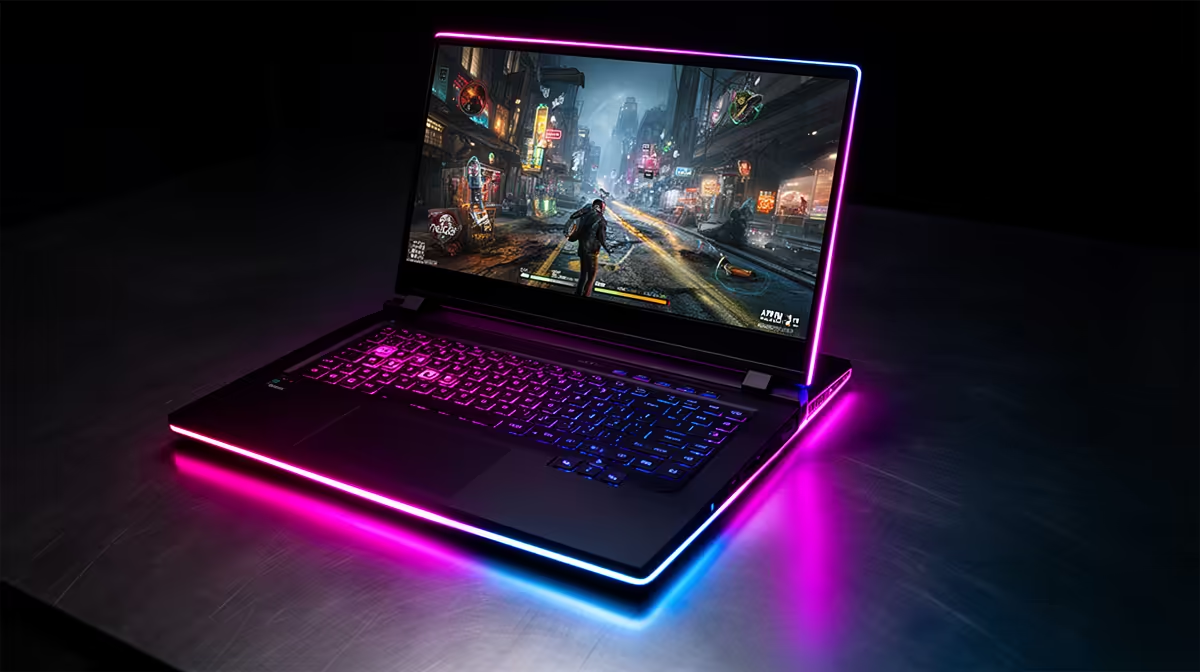
A QHD laptop screen is worth it for gaming when the GPU can feed the extra pixels and you value sharper detail. FHD is easier to drive, can hold higher frame rates and often gives longer battery runtime. The best choice changes with screen size, game type and graphics power.
Quick Answer
Choose QHD or 2560 x 1600 for a 15- to 18-inch laptop used for detailed games, creation and desktop work. Choose FHD or 1920 x 1200 when esports frame rate, entry-level graphics performance or battery efficiency sits first.
Compare the exact resolution and GPU pairing among current laptop best sellers, then inspect the broader gaming laptop deal selection. Avoid assuming a GPU tier is matched well because the panel appears in the same listing.
Count the Pixels the GPU Must Render
Standard 2560 x 1440 QHD contains about 78 percent more pixels than 1920 x 1080 FHD. The common laptop formats 2560 x 1600 and 1920 x 1200 carry a similar relationship.
That extra information sharpens thin geometry, distant objects and text. It also increases graphics work at the same game settings. Frame rate can fall substantially when the GPU is already the limit.
Laptop GPU names cover different power configurations. Use benchmarks for the exact chassis at both native resolution and a matched test resolution. Desktop-card results do not describe mobile cooling and power.
The Sharpness Is Visible Beyond Games
QHD gives fonts smoother edges and creates more working space. A video timeline can show more tracks, an image can stay larger beside its tools and code can fit more lines.
Operating-system scaling controls the physical size of text and icons. On a 15- or 16-inch QHD screen, many people use 125 or 150 percent. You keep sharper edges while avoiding tiny controls.
Older applications can handle scaling poorly. Test the specialist software used for work or study. A blurry legacy tool may reduce the benefit until it is updated.
Esports Favours FHD for Practical Reasons
Competitive games reward high, stable frame rates and clear motion. FHD lowers GPU load, letting a modest laptop reach 144Hz or 240Hz more often. The lower resolution can also keep the processor as the main limit at reduced settings.
Screen size helps. FHD remains usable on a 15-inch panel at normal laptop distance. QHD looks cleaner, but the difference may matter less during fast play than panel response and latency.
Do not chase frame rate by making targets hard to read. Use a competitive preset with clear textures and effects, then measure busy-match lows. A consistent 144fps experience can be better than a rough 200fps peak.
Upscaling Changes the Pairing
DLSS, FSR or XeSS can render supported games below native resolution and reconstruct the final image. QHD gives these tools more output pixels to work with than FHD, which can improve the reconstructed result.
Quality mode is a good starting point. Lower modes may soften fine detail or show instability, especially from a low internal resolution. Compare motion, foliage, text and particle effects in the game you play.
Frame generation is a separate feature. It can add displayed frames but does not reduce the memory needed for high-resolution assets or give each generated image a new input sample.
VRAM Can Set a Second Limit
QHD uses larger frame buffers and often encourages higher texture settings. An 8GB laptop GPU may need care in memory-heavy games. Watch frame times, texture loading and VRAM use during a demanding scene.
Reducing texture quality one step can solve pressure with a modest visual change. Ray tracing can increase both processing and memory demand. Tune it separately from resolution.
A higher-capacity GPU is not automatically faster. Architecture, graphics power and cooling still determine the pace. Compare complete laptop results.
Panel Quality Can Overturn the Resolution Choice
Resolution does not tell you colour, brightness, contrast or response. A poor QHD panel can smear motion or look dull. A strong FHD screen with fast response and useful gamut can be the better gaming display.
Read panel measurements for the exact regional model where possible. Check adaptive sync, refresh range and overdrive behaviour. OLED, IPS and mini-LED each bring their own black-level, brightness and text considerations.
Creators should prioritise suitable gamut coverage and accuracy. A high-resolution panel showing the wrong colours is not a complete creative upgrade.
Battery and Everyday Use
More pixels can increase panel and graphics workload. The battery difference varies by screen technology, brightness and laptop design. QHD does not guarantee poor runtime, and FHD does not guarantee good runtime.
Use independent battery testing for the exact model. Some laptops can lower refresh rate on battery. Dropping game resolution does not reduce the number of physical pixels the panel refreshes during light desktop work.
If most gaming happens on an external monitor, the internal resolution has a different value. A sharp QHD laptop screen still helps travel and work, while a cheaper FHD model may be enough between desks.
Compare Two Complete Configurations
Choose one FHD and one QHD laptop with similar CPU, GPU power, memory and cooling. Record named prices as of July 2026. Then compare native gaming, screen measurements, battery and total storage.
The QHD model may include a stronger GPU and cost more for the whole configuration. Avoid attributing that entire gap to the panel. A cheaper QHD laptop may also cut brightness or colour to reach its price.
Check ports and charger size. A laptop is a package, and the screen will stay with it long after one benchmark stops mattering.
Test Full-Screen and Borderless Modes
Some games expose different resolution and refresh choices in exclusive full-screen and borderless modes. Confirm the operating system is set to the panel's native resolution and top refresh, then inspect the in-game mode. A hidden 60Hz default can make a strong QHD panel feel wrong.
If you run a game at FHD on a QHD screen, scaling may look softer than native FHD because the pixel grids do not divide evenly. GPU scaling, sharpening and windowed modes can change the result. Use native QHD with quality upscaling where supported before deciding the panel is too demanding.
FAQ
Does QHD need a stronger laptop GPU than FHD?
Yes, at native resolution and matching settings. The GPU renders substantially more pixels.
Is QHD visible on a 15-inch laptop?
Yes, especially in text and fine detail, though scaling and viewing distance shape the benefit.
Should esports players choose FHD?
FHD often makes high frame rates easier. Panel response and the laptop's actual performance still need checking.
Benchmark your games at both resolutions, compare panel quality and choose QHD only when the complete laptop sustains the image and frame rate you want.