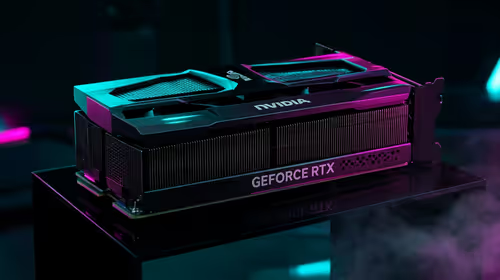
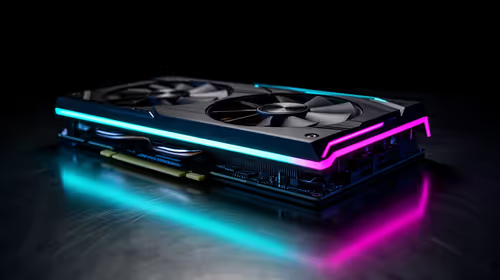
Radeon for Stable Diffusion used to mean a weekend of driver wrangling for half the speed. In 2026 the answer is more interesting: yes, AMD cards run local diffusion, and on standard models a high-end Radeon like the RX 7900 XTX sits surprisingly close to NVIDIA on image generation. The catch is everything around the raw generation, the tooling, the bleeding-edge model support, and the training side, where GeForce's CUDA stack still sets the pace.
Quick Answer
Yes, AMD Radeon runs Stable Diffusion in 2026, through ROCm on Linux or DirectML on Windows, and on SDXL and SD 1.5 a card like the RX 7900 XTX lands roughly comparable to similarly specced NVIDIA cards. The gaps show on newer models like FLUX that lean on tuned CUDA kernels, and in training, where NVIDIA is faster and far more reliable. For pure inference value with 24GB of VRAM, Radeon is now a real option.
How AMD actually runs diffusion now
AMD has two paths. On Linux, ROCm is the serious route, and ROCm 7.x now genuinely supports consumer Radeon cards for PyTorch-based workloads, which covers most diffusion front-ends. On Windows, DirectML offers a more plug-and-play option that trades some speed for not having to touch Linux. The practical upshot is that getting Stable Diffusion running on a Radeon card no longer requires arcane knowledge, though Linux plus ROCm still extracts the best performance. If you are spec-shopping a card for this, the AI-oriented machines in the AI PC range at Evetech are a useful gauge of what a capable local-generation rig looks like.
Where Radeon holds its own
For everyday image generation on established models, the gap has narrowed sharply. On SDXL and SD 1.5, the RX 7900 XTX produces images at a rate broadly comparable to similarly priced NVIDIA cards, and it does so with 24GB of VRAM, which is the unsung hero of local generation. That memory headroom lets you run larger batches, higher resolutions and bigger models without spilling over, often at a notably lower price than the NVIDIA card with equivalent VRAM. For someone whose main job is churning out images on standard models, that value case is genuinely strong.
Where GeForce still pulls ahead
Two areas keep NVIDIA in front. The first is cutting-edge models: newer architectures like FLUX heavily exploit optimised CUDA kernels, OptiX and Tensor cores, and AMD tends to lag there until ROCm catches up, though the gap keeps shrinking. The second, and bigger, is training. LoRA and fine-tuning workflows run materially faster on NVIDIA, and ROCm's incomplete support for the latest PyTorch features means AMD training can crash or stall where a GeForce card just works. For reliability under a heavy custom-training load, NVIDIA remains the safer pick.
Choosing between them in practice
The decision splits cleanly. If you generate images on mainstream models, want maximum VRAM per Rand, and are comfortable on Linux, the RX 7900 XTX is excellent value. If you fine-tune models, chase the newest architectures, or simply want it to work without debugging, GeForce earns its premium. Both camps are well represented in the GPU best sellers, so the real question is your workload, not the brand.
What the Tensor Core Gap Means in Real Numbers
The performance difference between the RX 7900 XTX and a comparable NVIDIA card comes down to silicon architecture, not drivers. The 7900 XTX has no dedicated tensor cores; the RTX 4090 has 512, which effectively double FP16 throughput with sparsity on ML workloads. In side-by-side Stable Diffusion benchmarks the 7900 XTX lands roughly 25 to 40 percent slower than the 4090 at equal driver and software conditions. However, that gap is not fixed. Using an optimised inference stack tuned for AMD the 7900 XTX can close to within a few percent of the 4090 on some benchmarks, which makes the implementation matter almost as much as the hardware.
For SDXL at standard resolutions the practical feel is that AMD is a bit slower, but not dramatically so. For newer architectures like FLUX that lean on CUDA-specific acceleration paths, the gap reopens and AMD waits for ROCm to catch up.
The Value Case: VRAM Per Rand on AMD
The 7900 XTX's strongest argument is memory-per-Rand. With 24GB it matches the RTX 4090's VRAM at a substantially lower price point. For workflows that are memory-bound but not compute-intensive - running large batches, loading heavy models, stacking multiple LoRAs - that VRAM lead can produce better practical results than a faster card with less memory. If your bottleneck is whether a model fits rather than how quickly it generates, AMD's value proposition sharpens considerably.
DirectML on Windows: What to Expect
Most South African builders run Windows rather than Linux, and that means DirectML rather than ROCm for AMD generation. DirectML works without a Linux install and is actively developed by Microsoft, but it is generally slower than ROCm on Linux and lacks some of the optimisation paths that make ROCm competitive on benchmarks. For casual generation it is perfectly usable. For someone squeezing every iteration-per-second out of the card, the Linux plus ROCm route remains the better choice and is worth setting up if throughput matters.
Frequently Asked Questions
Can AMD run Stable Diffusion on Windows without Linux?
Yes, through DirectML, which works out of the box on Windows. It is generally slower than ROCm on Linux, so enthusiasts chasing peak speed often move to Linux, but for casual generation DirectML is perfectly usable.
Is the RX 7900 XTX as fast as an RTX 4090 for image generation?
On standard models it lands in the region of three-quarters to four-fifths of the 4090's throughput, while costing far less. For SDXL and SD 1.5 generation that makes it strong value, though the 4090 stays ahead outright.
Why does AMD struggle with FLUX and newer models?
Those models lean on heavily optimised CUDA-specific kernels that NVIDIA hardware runs natively. AMD support arrives later through ROCm updates, so there is usually a lag before newer architectures run as smoothly on Radeon.
Should I buy AMD for training my own models?
Generally no. Training and LoRA fine-tuning run faster and far more reliably on NVIDIA, and ROCm's gaps in the latest PyTorch features can cause crashes. Choose Radeon mainly for inference and generation, not heavy training.
Building a rig for local image generation? Compare VRAM, value and stack support across the cards in the GPU best sellers and pick the GPU that matches whether you generate or train.