A R10,000 hardware budget is not small, but it disappears fast if you spread it evenly across every item on the list. The camera, the microphone, the lighting, the capture path: each one pulls in a different direction, and the temptation is to compromise on all of them equally. That approach rarely works. Allocating your Rand budget across a 40X zoom webcam and peripherals requires a deliberate priority order, not a uniform spread, because one component determines what every other piece can contribute.
Quick Answer
Put roughly 60 to 70 percent of your total budget into the camera. The sensor and zoom range set a quality ceiling that no peripheral can raise. After the camera, prioritise audio over lighting. A R500 key light earns its place, but a weak mic undermines a strong image more than dim light does.
🎯 Why the Camera Comes First
Video quality is the one variable that flows entirely from the sensor and optics. A powerful mic cannot rescue a soft, grainy image. Better lighting helps but reaches a hard ceiling when the sensor cannot resolve fine detail regardless of how much lux you aim at it. A capture device adds nothing if the source feed is already poor.
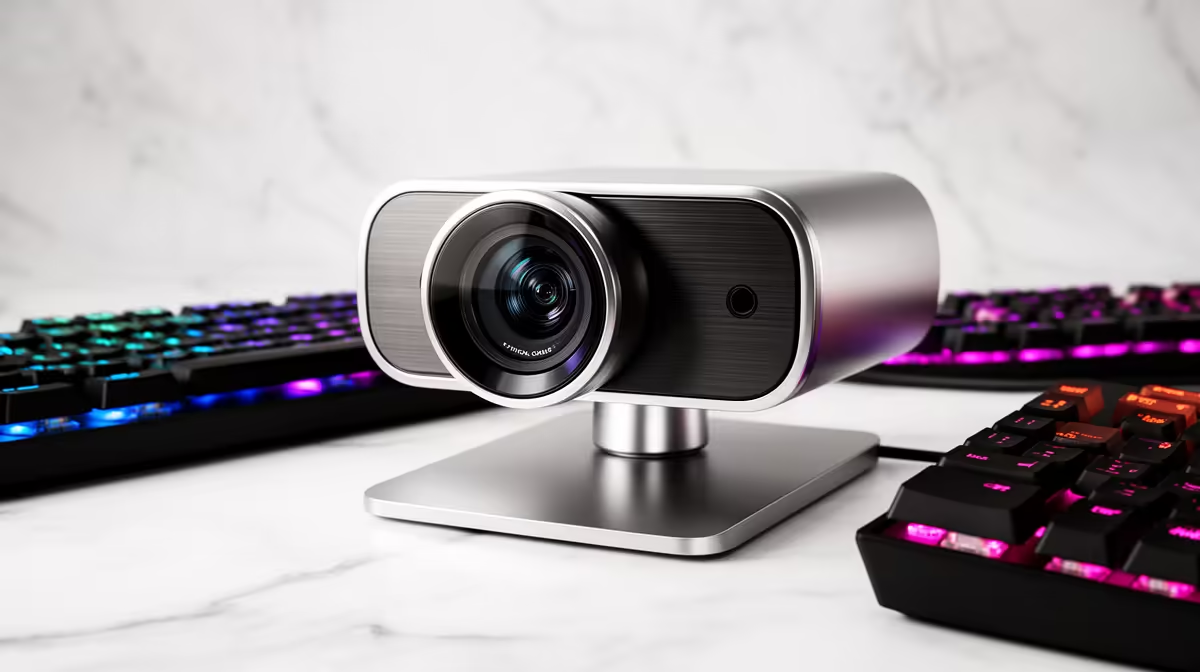
The 40X zoom webcam with a back-illuminated sensor is the core of the setup because it sets the baseline. At a total budget around R10,000, that means putting roughly R6,000 to R7,000 into the camera itself. It sounds like a large proportion, but the alternative, buying a R3,000 webcam and spending the difference on accessories, gives you a better-equipped weak image rather than a strong one.
High-end streaming webcams at that price point consolidate several capabilities that would otherwise require separate hardware. An 8-element MEMS microphone array built into the chassis handles voice pickup well enough to remove the urgent need for a separate mic stand and interface. Companion app overlays can substitute for basic scene work in broadcast software. That consolidation is what makes the camera-first strategy viable, not just philosophical.
Thinking About the Camera as Infrastructure
Unlike a tripod or a light panel, the camera does not become obsolete if you upgrade your studio. A quality sensor and zoom range serve you whether you are streaming from a spare room in Joburg now or from a purpose-built studio two years from now. That durability matters when justifying the larger initial spend.
🔧 Sequencing the Rest of the Budget
After the camera, the next meaningful variable is audio. Research consistently shows that viewers tolerate imperfect video far longer than they tolerate bad audio. A voice that cuts out, hisses, or lacks definition breaks concentration in a way that a slightly underlit frame does not.
A dedicated microphone arm adds meaningful value even if you are relying on the webcam's built-in array. The arm positions the mic closer to your mouth than the camera can be placed, and proximity is what delivers the full, present vocal character that a far-field array cannot capture on its own. Budget around R1,200 to R1,800 for a solid boom-style arm and a compact condenser microphone at this tier.
Lighting is the third line item, not because it is unimportant but because the STARVIS-class sensor on a high-end webcam already operates well down to quite low light. A compact key light costing around R400 to R700 adds enough ambient lift for the sensor to hold clean detail without pushing gain high. Spend above that only once you have confirmed the basic setup works.
💡 What the Camera Replaces
Part of the budget calculation is understanding what the integrated features eliminate. A webcam with a high-quality 8-MEMS array can stand in for a USB microphone in the short term, saving R800 to R1,500 on that line item. Built-in zoom and framing controls replace a separate PTZ controller. Companion app presets substitute for an external scene-switcher for single-camera setups.
That substitution power is what makes R6,500 on a camera look different from R6,500 on a camera that does nothing except capture video. You are not buying a sensor, you are buying a consolidated production unit that handles several jobs well enough to defer peripheral purchases until the budget allows proper upgrades.
Pro Tip ⚡
Before buying a separate microphone, run a quick recording test with the webcam's built-in array in your actual room. Record two minutes of normal speech and listen back on headphones. Many creators discover the integrated mic is genuinely adequate for streaming at this tier, freeing the mic budget for a better key light or a second camera position.
📊 Sample Budget Splits Across Different Totals
At R8,000 total: approximately R5,500 to R6,000 on the camera, R1,000 on a key light and diffuser, R500 to R800 on a small tabletop tripod that positions the camera correctly. Hold the remaining R200 to R500 as a reserve for a cable or mount you discover you need.
At R10,000 total: R6,500 on the camera, R1,500 on a compact condenser microphone and arm, R600 on a key light, R400 on a tripod or wall-mount plate.
At R14,000: R8,000 to R9,000 on the camera, R2,000 on a proper XLR microphone and preamp, R1,000 on a two-panel lighting kit, R600 to R800 on a stable platform mount.
In each case the camera absorbs the dominant share. The ratios shift slightly as the total grows, but the priority order stays consistent.
Frequently Asked Questions
How much of a total budget should the camera take?
Around 60 to 70 percent of the hardware total. At a R10,000 build that means roughly R6,000 to R7,000 on the camera. The sensor and zoom range set a quality ceiling that no peripheral can compensate for, so concentrating spend there gives the rest of the build a strong base to support rather than a weak one to patch.
Which peripheral earns spend soonest after the camera?
Audio. A dedicated microphone, even a compact condenser at R800 to R1,200, improves vocal clarity more noticeably than better lighting at the same spend. Viewers are significantly more sensitive to audio quality than to image brightness, so getting the voice right is the second priority after the core camera investment.
Does a cheaper webcam free up more budget for accessories?
Not productively. Saving R3,000 on a weaker sensor to spend it on accessories gives you a collection of well-supported mediocre footage rather than strong footage with modest support. The camera sets the ceiling. Spend on accessories once the core capture is good, not as a substitute for getting the core right first.
Can an integrated webcam mic replace a separate microphone?
On high-end cameras with multi-element MEMS arrays, often yes for streaming. The near-field proximity advantage of a dedicated desk mic is real, but a quality integrated array at normal speaking distance captures a usable, professional-sounding voice. Test your actual setup before adding a separate mic to the budget, especially if you are operating within a tight R8,000 to R10,000 total.
What total Rand budget builds a polished single-camera stream?
A complete setup covering camera, audio, and lighting lands between R10,000 and R14,000 at current SA pricing. The lower end covers a quality 40X webcam, a compact key light, and a tabletop mic. The upper end adds a dedicated XLR microphone path and a two-panel light kit. Either range is well short of equivalent traditional broadcast hardware.
Ready to build a polished streaming setup around the right camera first?
Browse the 4K and high-end webcam range at Evetech and start with the sensor that justifies the rest of your investment.