


PCIe 5.0 vs PCIe 4.0 for Video editing in 4k in SA
PCIe 5.0 vs PCIe 4.0 for video editing in 4k is mainly about fit, features, compatibility, cost, and upgrade path, not one automatic winner. SA buyers should match the choice to the setup.
Read moreRand-conscious display value comes from choosing the right screen for the source, room and workload, not from chasing every specification. The R5,999 UColor J5 earns its place when 17.3-inch 4K detail, 400cd/m2, dual inputs or VESA support resolves a real need.
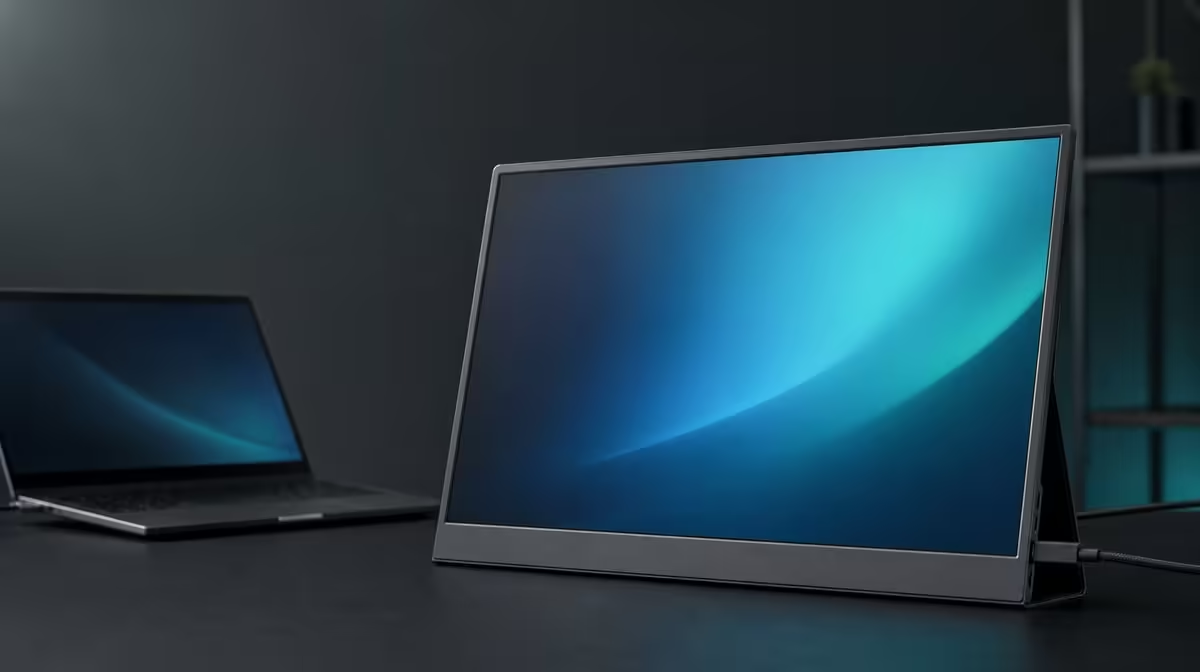
Value is not the number of specifications divided by the price. Rand-conscious portable monitor value comes from paying for the screen, connections, brightness, and positioning options that solve repeated work while leaving unused headroom out of the score.
Judge value by confirmed source compatibility, useful viewing area, room-appropriate brightness, and how often portability or mounting reduces friction. At R5,999, the UPERFECT UColor J5 earns its place when its 17.3-inch IPS canvas at 3840 x 2160, 400cd/m2 output, connection choices, mounting support, comfort mode, adaptive synchronisation, or 10ms response characteristic serves a real task.
Begin with the source devices and work. A portable monitor that lacks the correct video path is poor value at any price. Confirm whether each host will use HDMI or send video from a capable USB-C port, which cables are required, and how power will be provided.
Next, separate must-haves from occasional preferences. Native 4K may be essential for detailed images or dense documents, while a reference window may not need it. A 17.3-inch canvas can improve viewing comfort but demand more bag and desk space.
The R5,999 price is the comparison anchor. Confirm current figures and availability through Evetech's portable monitor range, then score only the features used weekly.
The J5's 3840 x 2160 resolution can retain fine detail, while system scaling makes interface elements readable. Buyers who lower resolution immediately may lose part of the value they paid to receive. Test native output with real applications before deciding.
The IPS panel's 400cd/m2 rating adds bright-room headroom. That is valuable when the monitor moves between indoor environments with different light, but less important in a controlled dim room. Glare control can solve problems that extra luminance cannot.
A 1000:1 contrast figure describes measured bright-to-dark separation, not guaranteed colour accuracy. A Rand score should not credit it for work the specification does not prove. Evetech's broader monitor category helps compare portable and fixed-panel value.
HDMI and USB-C can let the display serve different source types. This protects value when buyers genuinely move between devices. If every task uses one fixed HDMI source, the second input remains a useful fallback but should receive less weight.
VESA support can offset the need for another desktop screen by moving the J5 onto a compatible arm. Confirm pattern, load, fasteners, and cable slack. The mount may improve height and clear the surface, yet the arm itself is a separate part of the plan.
FreeSync targets tearing on a compatible gaming route, while the 10ms response figure describes panel behaviour. Low Blue Light adds a warmer viewing choice. Each feature earns value through a named scenario, not by adding another line to the comparison.
Place compatibility, core work, physical fit, brightness, connections, mounting, and entertainment in rows. Mark each as daily, weekly, occasional, or unused. A daily function should outweigh several occasional extras.
Run one setup rehearsal. Connect from a cold start, open the main workload, check native 4K scaling, move to the intended room, and pack or mount the panel as planned. This proves whether the value exists outside a product page.
Evetech's monitor best sellers offer another current comparison. A dearer model should add a result the J5 cannot deliver; a cheaper model should retain all must-haves. Stop when the screen passes the required routine and the Rands align with actual use.
Add a replacement test to the score. Ask whether the J5 can serve both the portable trip and the home second-screen role without creating an awkward compromise. If VESA and the removable routine work, one panel may solve two needs. If travel becomes rare, a fixed display could offer a simpler value path.
Compare the source workload as well as screen output. Native 4K detail is valuable only when the laptop, desktop, or console can deliver the intended content suitably. A buyer who must reduce every important task may be paying for pixels that are not used in practice.
Room movement can justify the 400cd/m2 headroom. Test the same document under two indoor lighting conditions and record the comfortable output. If the upper range repeatedly protects visibility after glare control, assign it a high frequency score. If it stays unused, lower the weight.
Connection flexibility should be evaluated through recovery. Move from the USB-C host to the HDMI source and back, using documented cables and power. A dual-input display provides lasting value when switching is repeatable rather than when both ports are tested once.
Finally, review the score after a month. Features that became central deserve more credit in the next purchase decision. Features that remained idle reveal where a cheaper or differently focused panel might have delivered better Rand value.
Separate the purchase price from the cost of solving the wrong problem. If the source cannot provide the intended video signal, or the panel does not fit the work surface, even a discounted display is expensive. Confirm those fundamentals before assigning value to 4K, FreeSync, Low Blue Light, or mounting. Compatibility and physical fit protect every Rand because they determine whether the screen can enter the routine at all.
Then calculate use in ordinary weeks. A researcher who keeps references visible, an editor who needs a larger preview, or a fixed-desk user who values VESA may use different parts of the same J5 package. Give each relevant benefit a realistic frequency: daily, weekly, occasional, or never. A feature used daily should carry more weight than one admired during shopping but rarely enabled.
Use the R5,999 price as a concrete decision point. Ask what currently consumes time, creates window switching, or prevents comfortable viewing, then test whether the 17.3-inch 4K canvas, 400cd/m2 headroom, or connection choice addresses it. Compare that result with live portable-monitor options rather than with a vague ideal. Rand-conscious value is an evidence-based fit between need and use, not the automatic selection of the lowest number.
Add a replacement test before finalising the score. Imagine one headline feature disappeared from the J5: first 4K, then 17.3 inches, then 400cd/m2, one input route, and VESA. For each removal, write what recurring activity becomes slower, less comfortable, or impossible. A feature with no consequence is not adding much value to this buyer. One whose absence breaks a daily layout deserves more weight than a rarely used extra, even if both occupy the same line in a comparison table.
Confirmed compatibility with the source and a workable power plan come first.
It is valuable when fine detail or dense workspace is used often and the source can drive it suitably.
No. The 17.3-inch area must earn the additional desk and carrying space.
They can serve different proven source routes, reducing friction when the display moves between compatible devices.
It buys the J5's large native-4K IPS canvas, 400cd/m2 brightness range, two connection routes, mounting support, adaptive synchronisation, warmer viewing mode, stated contrast, and 10ms characteristic.
Ready to make every monitor feature answer for its Rand cost? Compare Evetech's portable displays by required tasks, usage frequency, and current price before giving optional headroom a place in the score.
Confirmed compatibility with the source and a workable power plan come first.
It is valuable when fine detail or dense workspace is used often and the source can drive it suitably.
No. The 17.3-inch area must earn the additional desk and carrying space.
They can serve different proven source routes, reducing friction when the display moves between compatible devices.
It buys the J5's large native-4K IPS canvas, 400cd/m2 brightness range, two connection routes, mounting support, adaptive synchronisation, warmer viewing mode, stated contrast, and 10ms characteristic.
PCIe 5.0 vs PCIe 4.0 for video editing in 4k is mainly about fit, features, compatibility, cost, and upgrade path, not one automatic winner. SA buyers should match the choice to the setup.
Read more
Wi-Fi 7 vs Wi-Fi 6e for competitive esports comes down to router support, latency goals, device compatibility, and coverage. SA buyers should match the choice to the real network setup.
Read more
ATX 3.1 vs ATX 3.0 for mMO and live-service games buyers - what changes is mostly about compatibility, budget, upgrade path, and setup fit. SA buyers should check device support and real needs before expecting a clear win from either option.
Read more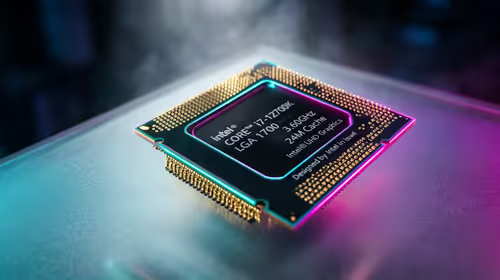
LGA 1851 vs LGA 1700 can affect Twitch and YouTube streaming when gaming and encoding share CPU resources. For SA creators, the real-world difference depends on encoder choice, memory support, motherboard cost, thermals, and upgrade plans.
Read more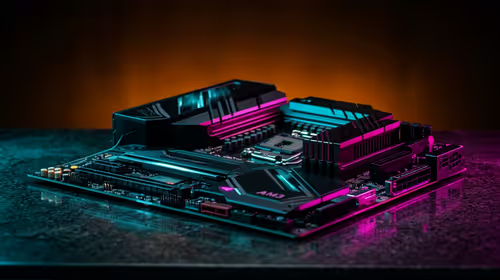
X870E vs X670E for aaa single-player gaming is mainly about fit, features, compatibility, cost, and upgrade path, not one automatic winner. SA buyers should match the choice to the setup.
Read more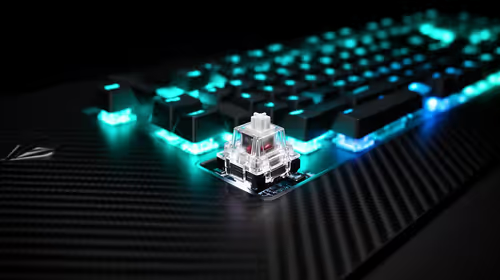
Hall Effect switches vs Mechanical switches for mMO and live-service games is mostly about compatibility, budget, upgrade path, and setup fit. SA buyers should check device support and real needs before expecting a clear win from either option.
Read more
A fake 113GB GTA VI ISO reportedly used empty padding around a small malware payload. SA gamers should delete unofficial builds, keep Windows security active and wait for official channels.

Wi-Fi 6E vs Wi-Fi 6 matters for 4K video editing when files move across a network. The real-world difference between Wi-Fi 6E and Wi-Fi 6 for video editing in 4K depends on NAS access, cloud uploads, router range, and SA creator workflows.

The difference between PCIe 5.0 and PCIe 4.0 for SA gamers is mostly bandwidth headroom. Compare GPU slot needs, NVMe speed, motherboard support, and upgrade timing before paying extra for a newer platform.

Gaming PC stuck pixel checks in South Africa should confirm the monitor fault first. Use colour tests, screenshot comparison, cable swaps, display menu checks, and clear photos before deciding on support.

Shokz OpenFit Air 2 earbuds weigh 7.2g each and use a redesigned dual-driver open-ear layout. SA buyers should choose them for comfort and awareness, not maximum isolation.

AMD's current driver now lists a Radeon RX 9050 4GB, while product coverage details a narrowed memory system. SA buyers should weigh the low VRAM ceiling against current local Radeon options.

Samsung Display has demonstrated a 16-inch 2.5K OLED laptop panel running at 300Hz. SA buyers should wait for a named notebook, full panel specifications and a local price before planning an upgrade.

Microsoft says some Windows 11 game crashes after recent updates are linked to RGB-related drivers. Affected SA gamers should confirm the update and driver before using the published registry workaround.
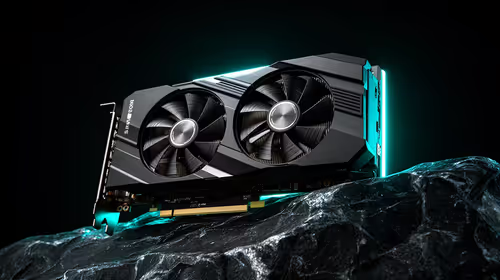
RTX 5090 on a 650W PSU is a tight pairing with very limited headroom. For SA gaming PCs, focus on total system draw, PSU quality, connector support, CPU choice, and avoid OC plans unless the full build is carefully power-limited.
PCIe 5.0 vs PCIe 4.0 for video editing in 4k is mainly about fit, features, compatibility, cost, and upgrade path, not one automatic winner. SA buyers should match the choice to the setup.
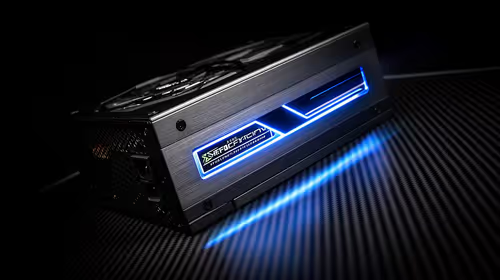
850W PSU safety for RTX 5090 is plausible with a quality unit and balanced parts. In SA, confirm connector support, CPU power draw, case airflow, PSU age, and spare capacity before building around 850W.
Wi-Fi 7 vs Wi-Fi 6e for competitive esports comes down to router support, latency goals, device compatibility, and coverage. SA buyers should match the choice to the real network setup.