Quick Answer
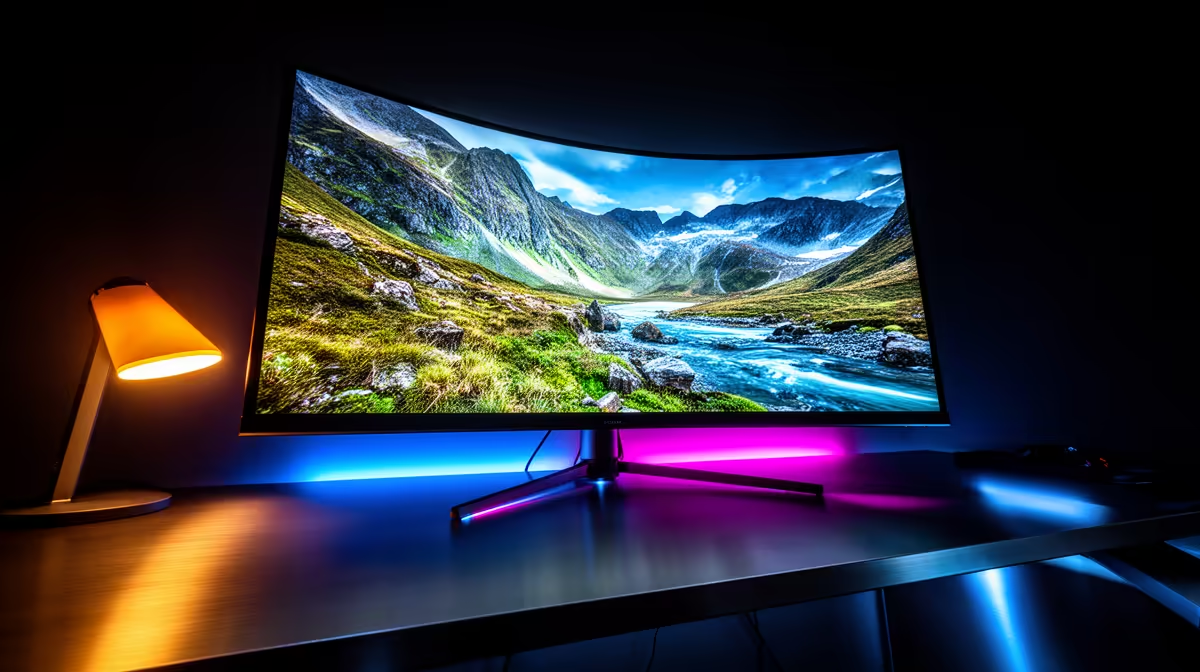
Paying for 5K, HDR, and 180Hz together makes sense only when your GPU, content, and use pattern genuinely exploit all three features simultaneously. If you play competitive esports at 1080p, or run a mid-range GPU, a R5,000 to R8,000 QHD 165Hz panel delivers far better rand-for-rand value. The premium spec combination earns its cost for content creators who also game on RTX 5080 or RTX 5090 hardware.
Mapping Features to Actual Use Cases 💰
Each premium feature carries a cost premium. 5K resolution adds roughly R8,000 to R15,000 over equivalent 4K panels. True HDR (FALD backlighting or OLED, 1,000 nits or higher) adds R3,000 to R8,000. A 180Hz panel over 144Hz in the same size and resolution tier costs R1,000 to R3,000 extra. The combined premium for all three together versus a competent base model can reach R20,000 or more. That spend delivers genuine returns for a DaVinci Resolve colourist or 3D animator who games in the evening, because 5K resolution improves precision work and HDR makes colour grading accurate. For someone who only plays FIFA and watches YouTube, the same R25,000 spent on a premium monitor, a better GPU, or a faster storage setup would produce more tangible daily benefit.
When 180Hz Justifies the Uplift Over 144Hz 🎮
The perceptible difference between 144Hz and 180Hz is smaller than the jump from 60Hz to 144Hz. Competitive FPS players at a high level, particularly those who play Valorant or CS2 ranked at 300 fps plus, notice the additional smoothness and slightly reduced input latency. For casual gamers and those playing slower-paced RPGs or strategy titles, 144Hz is indistinguishable from 180Hz in practice. The more meaningful refresh upgrade for most SA buyers is from 144Hz to 240Hz, which is perceptibly smoother and widely available in the R7,000 to R12,000 range.
HDR: Real HDR Versus Marketing HDR 🔬
HDR400 certification, the entry level, delivers modest contrast improvements with no local dimming and a 400 nit peak, barely exceeding some non-HDR panels. True HDR requires full-array local dimming (FALD) with 512 dimming zones or more, or OLED self-emissive pixels. HDR1000 and HDR1400 ratings on FALD monitors in the R12,000 to R22,000 range deliver the blinding highlights and deep blacks that make HDR gaming genuinely impressive in titles like Returnal or Horizon Forbidden West. Before paying a premium for HDR, verify the dimming zone count and peak brightness in the spec sheet, not just the HDR400 or HDR600 badge.
The Right Order to Upgrade ⚡
Before spending on a 5K HDR 180Hz monitor, confirm your GPU can sustain at least 120 fps at 5K with upscaling, your content pipeline actually uses DCI-P3 or HDR, and your desk has DisplayPort 2.1 routing. Upgrading the panel without matching GPU and cable bandwidth wastes the premium entirely.
FAQ
Is there a meaningful gaming benefit to 5K over 4K at 27 inches?
At 27 inches, 5K adds visible pixel density and sharper fine text, but game assets are often not authored at 5K native. The benefit is more practical for desktop productivity and creative work than for the rendering of in-game environments.
What GPU do I need to fully use a 5K 180Hz HDR monitor?
An RTX 5090 with DLSS 4 Multi Frame Generation enabled is the current practical minimum for 5K above 120Hz in demanding titles. More affordable GPUs like the RTX 5070 Ti can sustain 5K at 60 to 90 fps natively in AAA games.
Are locally warrantied high-end monitors available in South Africa?
Yes. Premium display brands stocked at Evetech carry local warranty coverage, with service support accessible without international shipping.
Not sure which monitor tier matches your GPU and budget?
Browse Evetech's full gaming monitor range, from competitively priced 144Hz panels to premium HDR and high-resolution displays, with local stock and support.