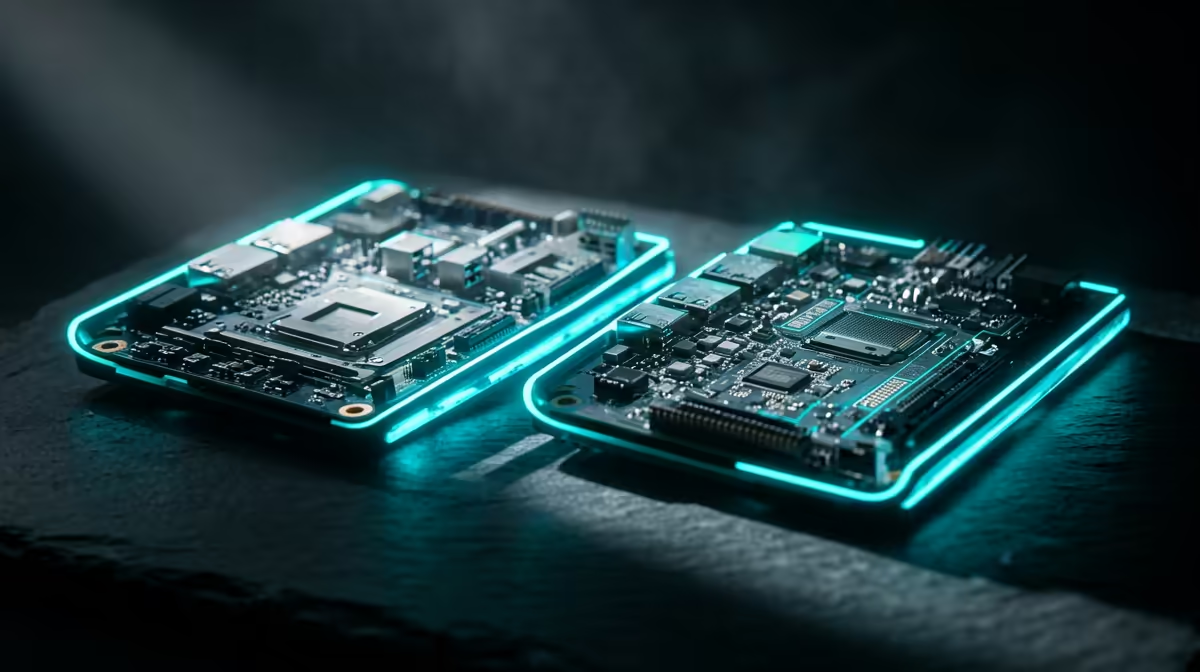
Sitting on a working Raspberry Pi 4 and wondering whether the newer board justifies the spend is a fair question, because the Pi 4 still handles plenty of projects. The honest answer is that the Raspberry Pi 5 is not a minor refresh. Its new processor is roughly two to three times faster, and it finally adds a PCIe lane for proper NVMe storage, a feature the Pi 4 simply does not have. For anything you actually push hard, the jump is real.
Quick Answer
The Raspberry Pi 5 is worth the upgrade for server, desktop, and storage-heavy projects. Its BCM2712 with Cortex-A76 cores at 2.4GHz delivers around 2 to 3 times the CPU performance of the Pi 4's Cortex-A72, and it adds a PCIe 2.0 interface for fast NVMe SSDs that the Pi 4 lacks entirely. For simple, lightweight projects the Pi 4 is still fine, but the Pi 5 is the future-proof choice.
What Actually Changed Under the Hood
The headline is the processor. The Pi 4 runs a Broadcom BCM2711 with quad-core Cortex-A72 cores, while the Pi 5 moves to the BCM2712 with quad-core Cortex-A76 cores at 2.4GHz. That is not just a clock bump. The A76 is a much more modern core design, and the combined effect is roughly 2 to 3 times the real-world CPU performance, which you feel in everything from compiling code to running a busy server.
Memory got faster too, moving from LPDDR4 on the Pi 4 to quicker LPDDR4X on the Pi 5, with more memory bandwidth feeding the chip. The graphics side jumped from a VideoCore VI to a VideoCore VII, lifting raw GPU throughput from around 4.4 GFLOPS to over 10 GFLOPS, which helps with desktop use and light media tasks.
The Storage Story: PCIe and NVMe
This is the single biggest practical difference, and it is easy to overlook on a spec sheet. The Pi 5 exposes a PCIe 2.0 interface, which lets you attach a real NVMe SSD through an add-on board. The Pi 4 has no equivalent, so it lives and dies on microSD cards or USB storage, both of which are slow and, in the case of SD cards, prone to wearing out on a machine that writes constantly.
For any project that touches storage hard, a home server, a network file share, a database, or a self-hosted application, NVMe transforms responsiveness and reliability. With the official M.2 HAT+, sequential reads reach 400 to 500 MB/s at PCIe Gen 2 and can push past 800 MB/s at Gen 3, against roughly 20 to 90 MB/s on microSD. The Pi 5 also gained a faster microSD interface, so even SD-card setups read and write quicker than on the Pi 4. If storage speed is part of your project, this alone can justify the upgrade.
Thermal Management: The Pi 5 Runs Hotter
The faster cores come with a trade-off: the Pi 5 runs significantly warmer under sustained load than the Pi 4. Without cooling it throttles at 80 degrees Celsius after as little as four minutes of heavy work, dropping from its full 2.4GHz to around 1.8GHz. With the official Active Cooler fitted, temperatures stay below 55 degrees at 24 degrees ambient and the board sustains its full clock speed indefinitely. The Pi 4 managed without active cooling more easily; the Pi 5 is different, and you should budget for proper cooling from the start if you intend to run it hard.
Where Each Board Still Makes Sense
Stick with the Pi 4 when
Lightweight, always-on tasks do not need the extra muscle. A Pi-hole ad blocker, a simple sensor logger, a basic retro-gaming box, or a small learning project runs comfortably on a Pi 4, and the board is cheaper and draws less power. If you already own one and it does the job, there is no urgency to replace it.
Step up to the Pi 5 when
Anything that pushes the CPU or storage benefits immediately. A desktop replacement, a multi-service home server, a NAS, container workloads, or local code compilation all feel dramatically better on the Pi 5. The PCIe NVMe option and the faster cores make it the board to choose if you want headroom and a setup you will not outgrow quickly.
For small-footprint computing beyond the Pi itself, it is worth exploring how single-board machines compare to compact desktops by browsing Evetech's mini PC category, and checking what compact systems top SA buyers are choosing right now helps frame where the value sits if a project has outgrown a Pi entirely.
Is the Price Premium Worth It?
The Pi 5 carries only a modest price increase over the Pi 4, and against a 2 to 3 times performance gain plus PCIe storage, that premium is easy to justify for most new builds. The exception is a genuinely light, fixed-purpose project where the Pi 4 already has plenty of headroom and saving a few Rand matters. For everything else, buying the Pi 5 now means you are far less likely to hit a wall and re-buy later.
Frequently Asked Questions
How much faster is the Pi 5 than the Pi 4?
Roughly 2 to 3 times faster in CPU performance, thanks to the move from Cortex-A72 cores to faster, more modern Cortex-A76 cores at 2.4GHz. The graphics also more than doubled in raw throughput, so desktop use feels noticeably snappier.
Can the Raspberry Pi 4 use NVMe SSDs?
No. The Pi 4 has no PCIe interface, so it relies on microSD or USB storage. The Pi 5 adds a PCIe 2.0 lane that lets you attach a fast NVMe SSD through an add-on board, which is a major reliability and speed improvement.
Is the Pi 4 still worth buying in 2026?
Yes, for lightweight, fixed-purpose projects like a Pi-hole, a sensor logger, or basic learning. It is cheaper and uses less power. For servers, desktops, or storage-heavy work, the Pi 5 is the better buy.
Will my Pi 4 accessories work with the Pi 5?
Many will, but check carefully. The Pi 5 changed its power requirements and physical layout in places, so some cases, coolers, and power supplies from the Pi 4 may not fit or supply enough power. Plan for a Pi 5-rated power supply and active cooling.
Does the Pi 5 need active cooling?
For sustained heavy workloads, yes. The faster cores generate more heat, and active cooling keeps the Pi 5 running at full speed without throttling. For light, intermittent use a good heatsink may be enough, but a fan or active cooler is recommended for servers and desktop use.
Outgrowing your Raspberry Pi or weighing a compact build? Explore the mini PC range at Evetech to compare small-footprint computing options and find the right tier for your project.