Quick Answer
FSR is a gaming upscaler and does not accelerate 4K video editing or export, so for an editing PC the difference between FSR 4 and FSR 3.1 is largely irrelevant to your timeline performance. What matters for 4K editing is GPU encode/decode, VRAM, and CPU cores. An RX 9070 XT build at Evetech sits around R40,000 and pairs 16GB of VRAM with strong AV1 encoding for smooth 4K editing.
Why FSR Does Not Help Your Edit
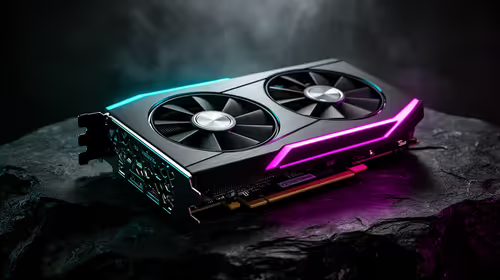
FSR 4 and FSR 3.1 are real-time game upscalers; they reconstruct frames inside games and have no role in a video editor's render or playback engine. If you saw FSR mentioned for an editing card, the relevant takeaway is that the RX 9000-series hardware behind FSR 4, the same cards, brings improved media engines for editing. Those cards offer better AV1 and H.265 encode and decode, which is what actually speeds up 4K timeline scrubbing and export. So choose the card for its VRAM and media engine, not its FSR version.
What a 4K Editing Build Actually Needs
For smooth 4K editing, target at least 16GB of VRAM so high-resolution timelines and effects stay responsive, plus 32GB or ideally 64GB of system RAM for heavy projects. A multi-core CPU like a Ryzen 9 9950X3D handles encode-heavy exports and background rendering well. Fast Gen 5 NVMe storage keeps 4K footage scrubbing without stutter, and a 1440p or 4K monitor with good colour coverage lets you grade accurately. These components decide your editing experience far more than any upscaling label.
Choosing the Right Card for Editing
If you only edit and never game, the FSR version on the box does not affect you, so compare cards on VRAM, encode support, and driver stability instead. An RX 9070 XT with 16GB of VRAM and modern AV1 encoding is a strong 4K editing choice. If you both game and edit, the RX 9000-series gives you FSR 4 for play and a capable media engine for work, a sensible all-rounder.
FAQ
Does FSR speed up video exports?
No. FSR is a real-time game upscaler with no role in video rendering or export. Export speed depends on your GPU's media encoder, CPU cores, and storage, not on the FSR version.
How much VRAM do I need for 4K editing?
Aim for at least 16GB of VRAM so 4K timelines, effects, and colour grading stay smooth. Heavier projects with many effect layers benefit from the headroom, especially with high-bitrate footage.
What matters most in an editing PC?
VRAM, a strong media engine for AV1 and H.265, plenty of RAM, fast Gen 5 NVMe storage, and a multi-core CPU. These decide 4K editing performance far more than any gaming upscaler feature.
Edit 4K without the wait
Explore Evetech's editing workstations with 16GB-plus VRAM, fast NVMe storage, and modern media engines for smooth 4K timelines.