Quick Answer
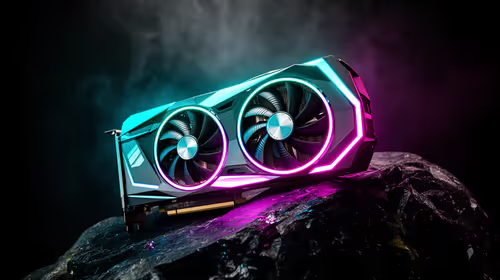
For smooth iRacing at 4K, shortlist RTX 4060, RTX 5070, or RTX 5070 Ti depending on screens and aim for about 90-180 fps with sensible settings. In SA, plan roughly R7,000-R25,000 for the relevant GPU tier, then check live Evetech stock before choosing the exact card. The right choice is the cheapest card that holds stable 1% lows at your screen target without forcing noisy cooling.
Recommended GPU Tier
For 4K, RTX 4060, RTX 5070, or RTX 5070 Ti depending on screens is the practical shortlist. If you use high texture packs, heavy mods, or a 144Hz display, move one tier up before chasing ultra settings. If your monitor is 60Hz, stable frame pacing matters more than a huge fps number.
Settings To Check First
Start with native resolution, then tune shadows, anti-aliasing, draw distance, and upscaling. iRacing can feel worse from uneven frame pacing than from a slightly lower quality preset. Keep VRAM headroom in mind: 8GB is fine for lighter targets, while 12GB or 16GB is more comfortable for modded or 4K play.
SA Build Fit
Match the card with a quality 550W-750W PSU depending on tier, 16GB to 32GB RAM, and a case with clear airflow. A R25,000-class spend should also include checking card length and power connectors, especially in older mid-tower cases.
FAQ
What GPU is enough for iRacing at 4K?
Use RTX 4060, RTX 5070, or RTX 5070 Ti depending on screens as the shortlist, then step down only if you play at 60Hz or use modest settings. Step up for 144Hz, heavy mods, or 4K quality targets.
Should I prioritise GPU or CPU for this game?
Prioritise GPU for higher resolution and visual settings. Prioritise CPU if the game shows stutter, simulation load, or poor 1% lows while the GPU is not fully used.
Is 8GB VRAM still acceptable?
Yes for lighter games and 1080p or some 1440p settings. For 4K, ultrawide, or modded texture packs, 12GB to 16GB is the safer target.
Practical check
Set the resolution first, cap fps to your monitor refresh rate, then compare GPU tiers by 1% lows rather than peak numbers.