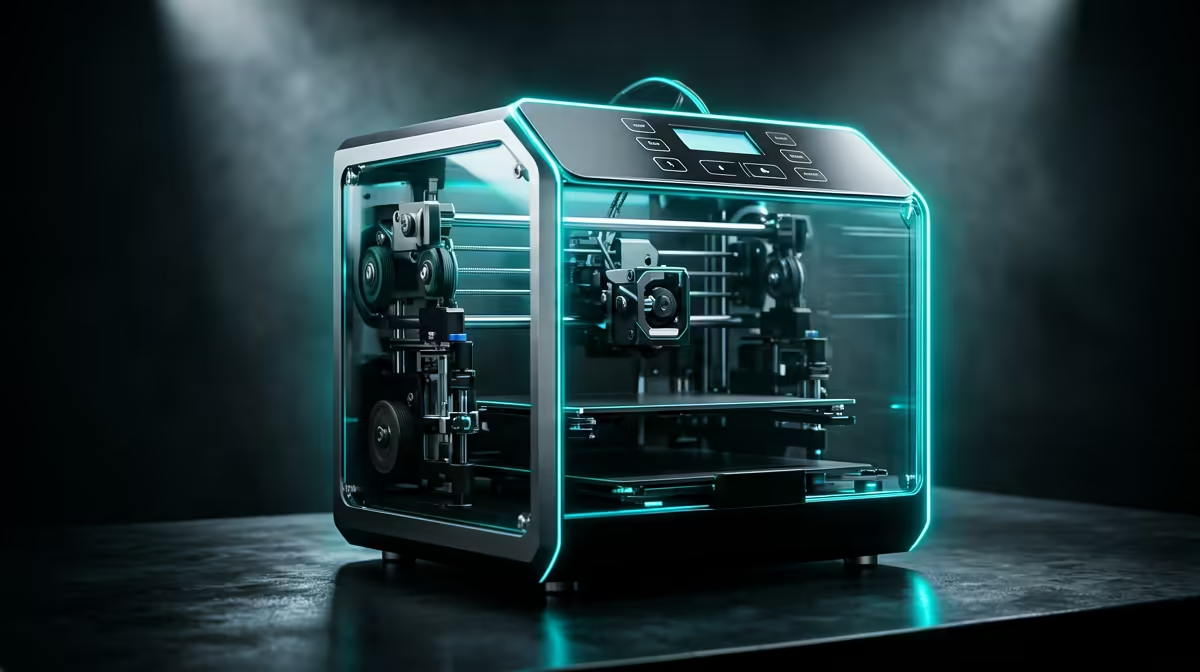
A single printed miniature with crisp scales, clean rivets and readable text on a base no wider than a coin is what pulls most people toward resin 3D printers. Masked stereolithography, or MSLA, cures liquid photopolymer one thin layer at a time using a UV LCD panel, and the detail it captures leaves filament printing far behind. The catch sits off the print bed entirely: washing, curing and ventilation turn a finished print into a multi-step job.
Quick Answer
Resin MSLA printers resolve detail down to roughly 0.01mm to 0.05mm per layer, far finer than the 0.1mm to 0.2mm typical of FDM, which is why they own miniatures, dental and jewellery work. Budget the resin and consumables too: a 1L bottle plus isopropyl alcohol, gloves and filters can add R600 to R1,200 of running cost before you count electricity.
How MSLA Resin Printing Actually Works
An MSLA printer holds a vat of liquid photopolymer over a UV light source. A monochrome LCD panel sits between the two and acts as a mask, blocking light everywhere except the exact pixels that form the current layer. The build plate dips into the resin, the panel lights up for a few seconds, and that whole layer cures at once. The plate lifts a fraction of a millimetre, the resin flows back under it, and the cycle repeats.
Because the entire layer cures simultaneously rather than being traced by a moving nozzle, print time depends on height, not the number of parts on the plate. Twenty miniatures take roughly the same time as one, which is why tabletop hobbyists print in batches.
The printers themselves are compact and live happily on a desk, and the broader catalogue of 3D printers and consumables at Evetech shows how small the resin machines run compared with large-format filament rigs.
Where Resin Beats FDM, and Where It Does Not
Resin wins on fine detail, smooth surfaces and small parts. A face, a coat of arms, a filigree ring or a chess piece comes off the plate with edges sharp enough that minimal sanding is needed. FDM, by contrast, lays down visible layer lines and struggles with overhangs and tiny features.
What FDM still does better
For anything large, structural or functional, FDM remains the sensible choice. A bracket, a tool holder, a phone stand or a cosplay helmet shell prints faster, cheaper and tougher in PLA or PETG than in resin, which tends to be more brittle and far more expensive per gram. Resin parts also degrade under prolonged sunlight unless coated, so outdoor or load-bearing use favours filament.
The detail trade-off in numbers
A 4K or 8K monochrome LCD gives an XY pixel size in the 18 to 35 micron range. That pixel grid is the real limit on horizontal detail, while layer height controls the vertical. Pushing layer height down to 0.02mm sharpens curved surfaces but multiplies print time, so most hobbyists settle around 0.03mm to 0.05mm as a balance.
The Hidden Running Costs Nobody Mentions First
The printer price is the smallest part of the story. Liquid resin is consumed by every print, and a standard bottle covers a modest number of detailed miniatures before it runs dry. On top of resin you buy isopropyl alcohol for washing, nitrile gloves for every session, a respirator or mask, paper towels and FEP film that wears out and needs replacing periodically.
There is also the post-processing hardware. A wash-and-cure station automates the two steps that otherwise demand buckets of alcohol and a UV nail lamp. Factoring resin, consumables and the odd FEP replacement, a busy hobbyist can spend more on supplies over a year than on the printer itself.
The Workflow: Print Is Only Step One
A finished resin print emerges coated in sticky uncured resin and must be handled with gloves. The standard sequence runs: remove the print, wash it in isopropyl alcohol to strip uncured resin, let it dry, then post-cure it under UV light so the photopolymer reaches full hardness. Skip the cure and the part stays slightly tacky and weak.
Ventilation matters throughout. Resin and IPA fumes are unpleasant and should not be breathed in a closed room, so a window, an extractor or a dedicated enclosure is part of the real setup, not an optional extra. Gloves, eye protection and a sensible disposal routine for waste resin and contaminated alcohol round out a safe workflow. For the masks, gloves and cleaning kit, the best-selling accessories at Evetech cover most of the protective gear a resin station needs.
Who Should Buy a Resin Printer in South Africa
Resin earns its place if your output is small and detail-led: tabletop armies, display figures, jewellery masters, dental or dollhouse work. If you mostly print brackets, enclosures, replacement parts and large props, FDM is cheaper to run and easier to live with. Plenty of SA makers own both and pick the tool to suit the job.
Frequently Asked Questions
Is resin printing more detailed than FDM?
Yes. MSLA resolves layers and fine features far finer than filament printing, typically 0.01mm to 0.05mm layers against 0.1mm or more on FDM. That gap is why miniatures, jewellery and dental models are printed in resin.
Do I really need ventilation for a resin printer?
Yes. Uncured resin and isopropyl alcohol give off fumes you should not breathe in an enclosed space. A ventilated room, an extractor or a sealed enclosure with filtration is part of a safe setup, not an optional add-on.
What are the ongoing costs of resin printing?
Resin itself, isopropyl alcohol for washing, gloves, masks and periodic FEP film replacement. These consumables often add up to more over a year than the printer cost, so factor them into any budget.
Can resin prints be used outdoors?
Not without protection. Standard resin is brittle and degrades under prolonged UV exposure, so outdoor parts need a protective coating or are better printed in PLA or PETG on an FDM machine.
How long does a resin print take?
Print time scales with height, not the number of objects, because each layer cures all at once. A full plate of short miniatures finishes in roughly the same time as a single one of the same height.