Photopolymer resin smells sweet, almost harmless, and that is exactly the trap. Every layer a resin printer cures, and every print sitting wet on the build plate afterward, releases volatile organic compounds you should not be breathing in a bedroom or a closed garage. Resin printing ventilation done properly means pulling those fumes out of the room and pushing them outdoors, not just running them through a filter and hoping. A carbon canister on its own quietly saturates and stops working, and you rarely notice until the headaches start.
Quick Answer
The only setup that is genuinely safe extracts fumes outdoors with an inline or exhaust fan, ideally drawing through an enclosure under negative pressure, with activated carbon used as a secondary trap rather than the primary defence. Carbon filtration alone does not remove all VOCs and saturates within months. Budget roughly R1,500 to R4,000 for a fan, ducting and enclosure depending on how permanent you want it.
Why Carbon Filtration Alone Is Not Enough
Activated carbon adsorbs many VOCs, but it has a finite capacity and no indicator to tell you when it is full. Once the carbon bed saturates, contaminated air passes straight through and recirculates back into the room. HEPA media, often bundled with carbon, captures particulates but does nothing for gaseous VOCs, so a HEPA-and-carbon combo still leaks vapour once the carbon is spent.
Controlled testing of resin printers found VOC concentrations dropped by roughly 71 to 84 percent only when the printer was either moved well away from the user or fitted with an extraction hood ducting outdoors. Distance and extraction, not filtration, did the heavy lifting. That is the core principle to design around.
The Setups, Ranked by Safety
Direct outdoor extraction (the gold standard)
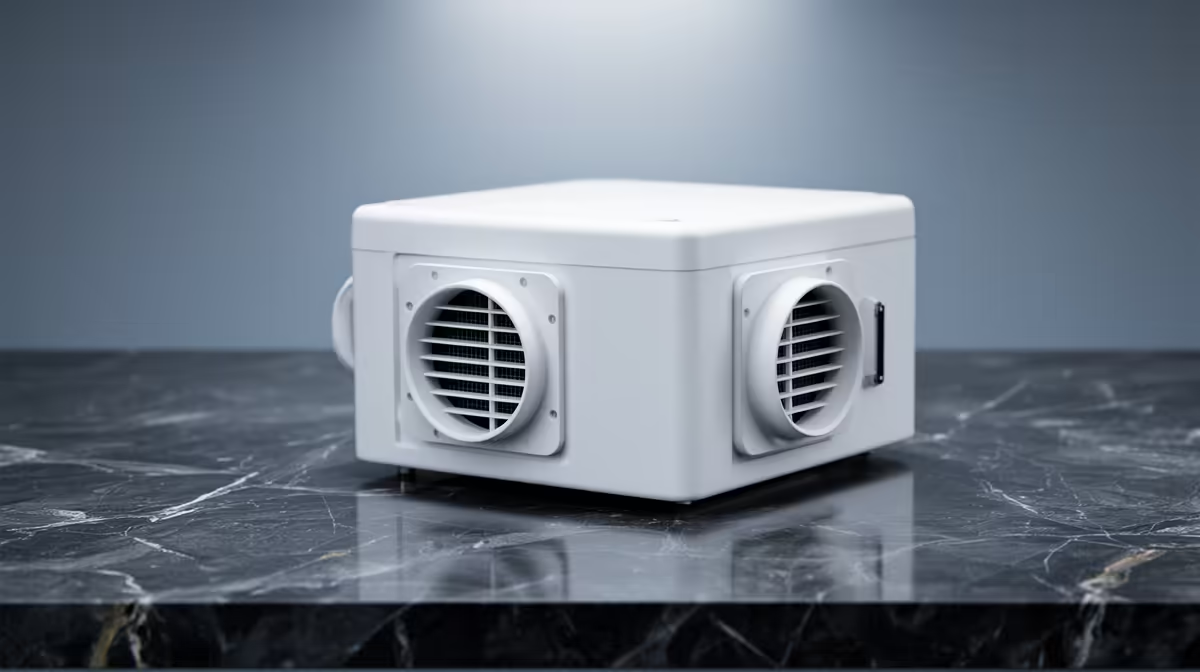
Build or buy an enclosure around the printer, seal it reasonably well, and connect a high-airflow inline fan that ducts through a window panel or a vent drilled into an exterior wall. The fan pulls air out, which keeps the enclosure under negative pressure, so air only ever flows inward through the gaps. Fumes never escape into the room because the lowest-pressure path is the duct heading outside.
This is the setup serious hobbyists and small studios use. The running cost is almost nothing beyond the fan's modest power draw, and there is no filter media to replace on a schedule.
Extraction with carbon as a backstop
If you cannot duct directly outdoors, route extracted air through an activated carbon stage before it exits or recirculates. Treat the carbon as a courtesy layer that reduces residual odour, not as the thing keeping you safe, and replace the media on a schedule rather than waiting for symptoms.
Carbon-only filter box (the setup to avoid relying on)
A sealed box with a fan blowing through carbon and back into the room is the most common mistake. It smells better for a while, then silently stops working. Use it only as a stopgap in a well-aired space, never as your sole protection in a closed room.
Practical Considerations for a Home Workshop
In a South African home, whether that is a townhouse in Pretoria or a flat near the Johannesburg CBD, a tilting window with a sealed insert panel for the duct is the simplest legitimate route outdoors. Run the printer in a room you can keep closed off from living and sleeping areas, and keep the door shut while curing finishes. A spare bathroom or a garage with an exterior wall both work well.
What to do when you cannot duct outdoors
Some apartment setups genuinely have no accessible exterior wall or window route. In that case, the practical minimum is a sealed enclosure running through a high-grade activated carbon block, combined with opening the windows in adjacent rooms and keeping the print room door closed during and for at least an hour after printing. This does not reach the safety level of outdoor extraction, but it substantially reduces peak exposure compared to an open-air printer on a desk. Budget for shorter carbon replacement intervals, roughly every three to four months rather than six, since the media is carrying the full load without an assist from outdoor airflow.
Sizing the Fan and Ducting
Match the fan's airflow to the enclosure volume so air turns over several times a minute. A small resin printer in a compact enclosure is well served by a 100mm to 150mm inline fan rated for a few hundred cubic metres per hour. Oversizing slightly is better than undersizing, since a stronger pull guarantees the enclosure stays under negative pressure even with imperfect seals. Keep duct runs short and avoid sharp bends, both of which choke airflow.
Maintenance is non-negotiable: replace carbon media every six to twelve months depending on how often you print, wear nitrile gloves when handling uncured resin, and keep no food or drink in the print space. A small benchtop fan inside the enclosure helps move stagnant air toward the extraction duct. For the right exhaust fans, ducting clamps and inline blowers, the accessories best sellers at Evetech carries the components most makers come back to order after setting up their first extraction run, saving you a guessing game on airflow ratings and fitting sizes.
Frequently Asked Questions
Does carbon filtration remove resin VOCs completely?
No. Carbon adsorbs many VOCs but has limited capacity and saturates over time, after which fumes pass through untreated. It works as a secondary stage behind outdoor extraction, never as the only line of defence.
Can I run a resin printer indoors without ducting outside?
Not safely as a permanent setup. Uncured resin keeps off-gassing even after the print finishes, so a closed room without extraction accumulates VOCs. If outdoor ducting is impossible, isolate the room, keep it aired, and minimise time spent inside it.
How often should I replace the activated carbon?
Roughly every six to twelve months depending on print frequency, because saturation gives no obvious warning. Err on the side of replacing early since a spent filter offers no protection.
What fan size do I need for a resin printer enclosure?
A 100mm to 150mm inline fan turning over the enclosure air several times a minute is enough for a typical desktop resin printer. Prioritise enough pull to maintain negative pressure over absolute quietness.
Is a HEPA filter useful for resin fumes?
HEPA captures particulates but does nothing for gaseous VOCs. It complements carbon and extraction but cannot replace either when the concern is vapour rather than fine dust.
Planning a resin setup that you can actually run safely at home? Start with the printer and the extraction gear together, and browse the current 3D printer range at Evetech to match a machine to an enclosure you can vent outdoors.