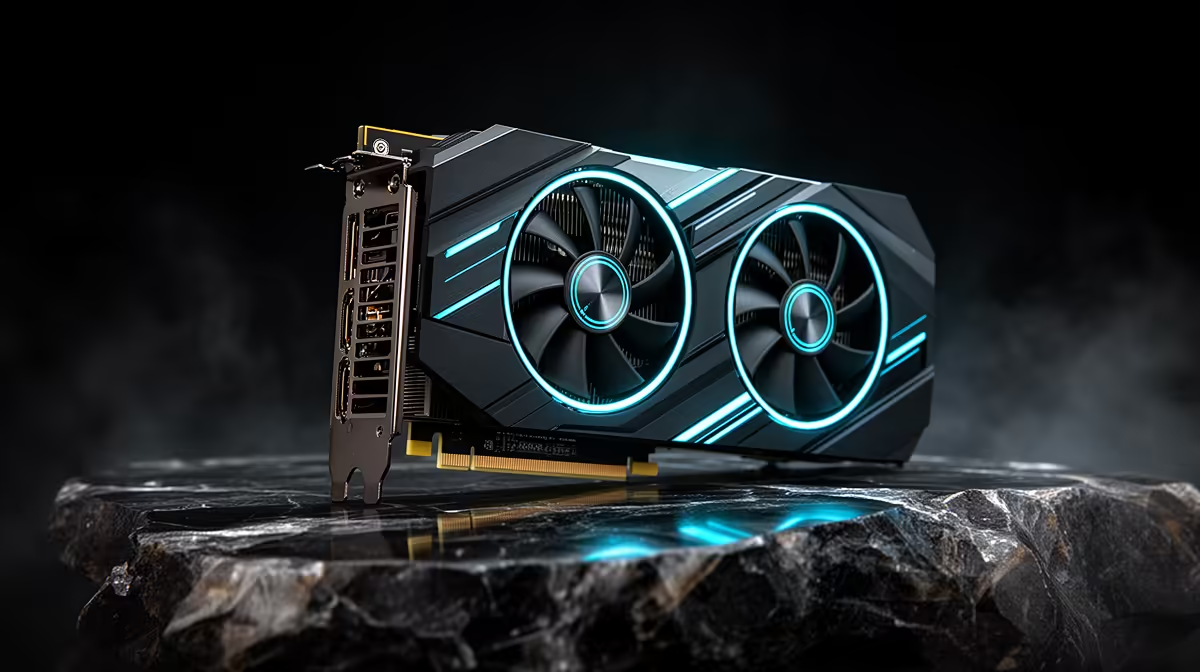
The RTX 4080 Super remains a serious 4K card with 16GB memory and strong Ada performance. The RTX 5080 brings Blackwell ray-tracing and AI hardware, faster GDDR7, Multi Frame Generation and more creator capability. Price decides whether the older card is clearance value.
Quick Answer
Buy the RTX 4080 Super when a named new card carries full support and costs far enough below the RTX 5080 to fund another meaningful system improvement. Buy the RTX 5080 when the gap is modest, you want newer rendering features, or your ray-tracing and creator workloads reward Blackwell.
No named July price for either model appears in the price pack, so this article will not invent a Rand threshold. Compare current models in the GeForce graphics card selection, then check GPU best sellers for the broader market before deciding.
The Specifications Are Closer Than the Generation Names
NVIDIA specifies 10,240 CUDA cores for the RTX 4080 Super and 10,752 for the RTX 5080. Core counts across Ada and Blackwell do not translate directly into an equal performance percentage, but they show that the 5080 is an architectural step rather than a doubling of basic shader count.
Both cards carry 16GB on a 256-bit interface. The 4080 Super uses GDDR6X, while the 5080 uses GDDR7. NVIDIA lists 960GB/s bandwidth for the 5080, giving the newer card a large memory-throughput advantage.
The RTX 4080 Super has a 320W total graphics power rating. The RTX 5080 is rated at 360W. Board-partner cards can change clocks, cooler size and power limits, so confirm the named product.
Raster Performance Needs Game Benchmarks
Rasterised games render without heavy ray-traced effects. The 5080 is faster overall, but the size of the gap changes with game engine, resolution, processor and settings.
At 4K, the GPU has more opportunity to show a difference. At 1440p high refresh, the processor can limit both cards in some titles. Use current benchmarks that include your games and frame-time lows.
Calculate the performance gain against the price gain. If the 5080 costs 25 percent more and your chosen raster games improve by a much smaller amount, the 4080 Super has a value case. If the live price gap narrows, the newer card becomes easier to justify.
Avoid averages that mix settings you will never use. A ten-game 4K ultra suite may hide the competitive title or simulator that drives your purchase.
Ray Tracing Favours the New Architecture
The RTX 5080 uses fourth-generation ray-tracing cores and newer Tensor hardware. The 4080 Super uses third-generation RT cores and fourth-generation Tensor cores.
Heavy ray tracing, path tracing and neural rendering can widen the practical gap beyond ordinary raster. The result still depends on game support and chosen DLSS settings.
Test ray-traced reflections, global illumination and path tracing separately where the game allows it. Maximum presets can combine several effects and hide which one costs the performance.
If ray tracing is central to your library, weight those results more heavily than a broad raster average. If you turn it off in every competitive game, do not pay for a workload you avoid.
Multi Frame Generation Is a 50-Series Difference
The RTX 4080 Super supports DLSS Frame Generation. The RTX 5080 adds Multi Frame Generation in supported titles, allowing more generated frames between rendered frames.
Generated frames improve displayed smoothness. They do not replace the responsiveness of a strong base frame rate or make every frame a newly simulated game state. Use Reflex where supported and compare input feel.
Look at native performance, DLSS Super Resolution and frame-generation modes on separate charts. A marketing multiplier that uses different generation modes on each card is not a direct raw-performance comparison.
The feature has value on a high-refresh 4K display when the base frame rate is already playable. It is less persuasive when you dislike generated-frame artefacts or play games without support.
Both Have 16GB
The memory capacity is the same. That is good news for an older 4080 Super buyer because the card does not start with a capacity deficit against the 5080.
The 5080's GDDR7 provides more bandwidth, which helps feed the GPU. Capacity and bandwidth solve different problems. A 16GB project that fits on both can run faster on the newer system; a workload exceeding 16GB can challenge both.
For 4K games, 16GB provides useful room for high-resolution textures. Keep watching per-game behaviour, since ray tracing and modded assets can raise demand.
Creators should check application support, project size and benchmark results. A workload needing more than 16GB may point to another class of card rather than choosing between these two.
Creator Features Can Tip the Balance
NVIDIA specifies two eighth-generation NVENC encoders on the RTX 4080 Super. The RTX 5080 uses two ninth-generation encoders and newer decoder hardware.
That can matter for video production, streaming formats and supported creator software. Verify which codec, bit depth and acceleration path your application uses. Hardware features create no gain when the software cannot access them.
Blackwell's newer Tensor support can also help AI workloads, including reduced-precision formats in supported tools. Compare your model and framework rather than applying gaming results to AI.
For an occasional stream, the 4080 Super remains capable with dual AV1 encoders. A professional workflow can justify the 5080 from time saved.
Power and Cooling Change the Total Cost
The 40W reference TGP difference is only a starting point. Factory-overclocked cards can raise limits, and real game draw varies.
Check the exact card's PSU recommendation, connector and dimensions. Both classes can use large multi-slot coolers. Measure case length, height, thickness and side-panel clearance around the power cable.
Use a quality PSU with the documented native cable or supplied adapter arrangement. Seat the connector fully and avoid a tight bend near the plug. Do not mix modular PSU cables between models.
A clearance card that forces a new case or PSU has a higher effective price. Add those costs before comparing it with a more compact 5080 model.
Clearance Must Mean a Real Saving
An older model deserves a clear discount because it has a shorter period as the current generation, may receive fewer new hardware-only features, and can have limited model choice.
Compare like with like. A premium quiet 4080 Super should not be priced against the cheapest compact 5080 without accounting for noise, warranty and cooler quality.
Set a required saving before browsing. The amount should buy a concrete improvement: a 2TB SSD, stronger monitor, better CPU, safe PSU or money left in the budget. A vague discount has no job.
Check that the item is new, sealed as described and covered under the stated warranty. Leftover stock is different from used, repaired or open-box hardware.
The Monitor Decides How Much You See
A 4K high-refresh display can use the 5080's extra performance and Multi Frame Generation in supported games. A 1440p 165Hz monitor can be served well by a 4080 Super, with the CPU becoming important at high frame rates.
At 60Hz, both cards may provide headroom you cannot display in lighter games. That headroom can still support ray tracing, silent operation or future titles, but it needs a reason.
Consider whether the saved money upgrades the display. A strong HDR monitor, higher refresh rate or adaptive-sync range can change the experience more than moving between two already fast GPUs.
Driver and Feature Support
Both remain supported GeForce RTX cards in July 2026. Ada receives current Game Ready and Studio drivers, while Blackwell gets hardware features tied to its newer architecture.
Do not assume every DLSS improvement is exclusive to 50 Series. NVIDIA can bring software model updates to several RTX generations, while Multi Frame Generation remains a key Blackwell feature.
Read the support table for the specific technology and game. Keep drivers current through the official NVIDIA app and preserve a stable version for critical production work.
A Simple Decision Method
Pick five games and two creator tasks you use. Record RTX 4080 Super and RTX 5080 results at your resolution, separating native, upscaled and generated-frame modes.
Work out the percentage performance difference in each. Weight the results by your hours, not by a reviewer's test suite. Add PSU, case and monitor changes to the purchase cost.
Then apply the live price gap. Choose the 4080 Super when its saving is larger than the value you place on the 5080's extra performance and features. Choose the 5080 when the top-up is smaller or the new workload earns it back.
FAQ
Does the RTX 5080 have more VRAM than the RTX 4080 Super?
No. Both have 16GB on a 256-bit interface. The 5080 uses faster GDDR7 memory.
Can the RTX 4080 Super still handle 4K?
Yes. It remains a powerful 4K card. Settings, ray tracing and the target frame rate determine how much upscaling you use.
How cheap must the RTX 4080 Super be?
There is no fixed honest Rand answer without live named prices. Require a saving that funds a useful system improvement and compare warranties and model quality.
Compare named RTX 4080 Super and RTX 5080 cards at live prices, then make the older card earn its place with a saving you can use elsewhere.