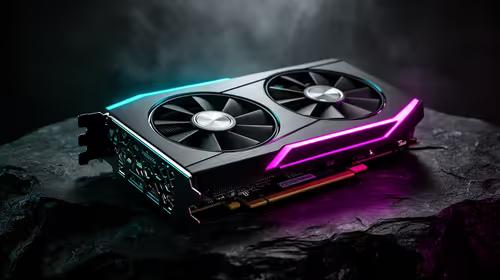
Two laptop GPU names can hide meaningful differences in cores, memory and allowed power. The RTX 5070 Ti laptop vs 5070 decision needs exact model performance at your resolution, not desktop-card assumptions.
Quick Answer
An RTX 5070 Ti laptop is worth the jump over an RTX 5070 model when the complete machines have comparable cooling and power, you play at 1600p or external 1440p, and the Ti's larger 12GB memory buffer or stronger GPU clears a measured limit. The 8GB RTX 5070 can still suit 1080p and lighter high-refresh play. Laptop GPU names do not fix performance: wattage, CPU, memory, MUX path and chassis cooling can shrink or widen the gap. Compare exact laptops in sustained tests. As a separate dated laptop reference, the Ninkear A15 Pro 16GB/512GB Ryzen 5-5500U cost R9,499 as of July 2026; it is not a gaming-GPU substitute.
Start with the complete laptop, not the GPU row
The RTX 5070 Ti Laptop GPU and RTX 5070 Laptop GPU have different core and memory configurations, but manufacturers can run them within supported power ranges. A well-cooled 5070 at a strong power target can close part of the gap to a constrained Ti model.
Record the exact laptop product code, GPU power specification, charger, CPU, memory channels and display resolution. Review the same configuration where possible. A global model name can hide regional panel or memory differences.
Laptop cooling also changes after heat soak. Use a thirty-minute game loop or creation workload, not one short benchmark. Watch clock, GPU power, temperature, fan noise and frame times after the chassis warms.
The memory difference matters by workload
The laptop RTX 5070's 8GB buffer can be enough for many games at 1080p and sensible settings. Higher-resolution textures, ray tracing and creation work can expose that capacity. The 5070 Ti's 12GB gives more room, though capacity cannot guarantee performance.
Watch for texture reductions, traversal stutter and memory allocation in the games you play. Drop textures one step before cutting every quality setting. Upscaling can reduce some rendering load, but it does not remove every asset from VRAM.
For 3D, video or local GPU work, verify application support and project memory use. A workload that fails at 8GB can justify 12GB more clearly than a game that allocates memory without needing it.
Resolution changes the value
At 1080p esports settings, the CPU and display refresh can limit both GPUs. The Ti premium earns less when the base model already stays above the panel's useful range.
At 1600p or external 1440p, higher pixel load can expose the Ti's compute and memory advantage. Compare the same image quality and upscaling mode. A Ti result using a lower render resolution is not a clean win.
For external 4K, both may need upscaling and selective settings. Decide whether the target is 60fps single-player, high-refresh competitive play or creation. One label cannot cover all three.
MUX, Advanced Optimus and display routing matter
An internal display can route frames through integrated graphics or connect the discrete GPU more directly. A MUX switch or Advanced Optimus implementation can change performance and battery behaviour. Support varies by laptop.
External ports may connect to the integrated or discrete GPU. Read the manual for HDMI and USB-C display routing, maximum refresh, VRR and colour depth. An external monitor test through the wrong port can misrepresent the GPU.
Set the intended mode before benchmarking and reboot if the laptop requires it. Keep the same route across 5070 and Ti comparisons.
CPU and memory can reshape the gap
Laptop models often pair the Ti GPU with a faster CPU or more memory. That can improve low-resolution game results and production work, but it means the comparison is no longer GPU-only.
Check whether system memory is dual-channel and upgradeable. Soldered memory capacity affects the whole ownership plan. A fast GPU beside 16GB that cannot be expanded may be a poor creator fit.
At high resolution, GPU differences become clearer. At 1080p competitive settings, a stronger CPU can make the Ti chassis look faster even when the GPU is not the main cause.
Cooling and noise are part of performance
The Ti can produce more heat at a higher supported power. A larger chassis may sustain it with acceptable noise, while a slim model may reach its fan or temperature limits.
Listen through a long session. Record keyboard-deck and palm-rest comfort, not only core temperature. A laptop that posts a strong benchmark while making the keyboard unpleasant has a real trade-off.
Check performance, balanced and quiet modes. The model you enjoy using on balanced mode may matter more than a maximum profile you avoid because of noise.
Battery use is a separate mode
Gaming performance on battery is reduced by design on most machines, and running a discrete GPU shortens runtime. Compare ordinary work battery life with the dGPU sleeping, screen at matched brightness and the same test method.
The Ti does not automatically mean poor office battery life if switching works well, but a high-resolution display, CPU and battery size also count. Read complete-laptop testing.
Keep the approved charger for demanding work. USB-C charging may support office use and still lack the power needed for full GPU performance.
Price the features you cannot add later
Storage and some memory can be upgraded on selected laptops. GPU, CPU, display, cooling and ports are fixed. Put the Ti premium beside the 12GB buffer, panel quality, battery, build and support, not only average frame rate.
As of July 2026, the Ninkear A15 Pro 16GB/512GB Ryzen 5-5500U at R9,499 provides a named dated laptop reference from the approved snapshot. It sits in a different class, so use live exact 5070 and 5070 Ti prices for this decision rather than treating that figure as a gaming entry point.
Browse laptop best sellers and gaming laptop deals for exact mobile configurations. The required RTX 5070 Ti graphics card page covers the graphics-card family and cannot substantiate laptop wattage, cooling or stock.
Choose with three same-chassis tests
When one laptop family offers both GPUs, compare them in the same game, power mode and room. Use a 1080p competitive title, a native-panel single-player game and the creation task you repeat.
Record frame-time lows, VRAM behaviour, fan noise, surface comfort and task time. The Ti wins when those results clear a limit you care about. The 5070 wins when both meet the target and the lower total buys capacity, memory or a better display.
FAQ
Is every RTX 5070 Ti laptop faster than every 5070 laptop?
No. Power, cooling, CPU and memory can narrow the gap. Compare exact sustained laptop results.
Does 12GB VRAM matter at 1440p?
It can for demanding textures, ray tracing and creation work. Check the games and projects you use.
Should I choose the Ti for 1080p esports?
Only when it improves your measured lows or refresh target. CPU, panel and frame pacing may matter more.
Compare exact RTX 5070 and 5070 Ti laptops at the same power mode, resolution and sustained workload.