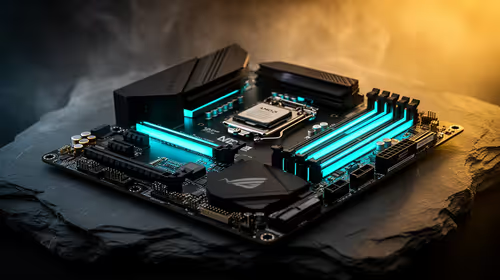
An x86 AI laptop pairs an Intel or AMD processor with a discrete NVIDIA GPU, runs Windows the way it always has, and runs every application without a second thought. The RTX Spark rewrites that formula: a 20-core Arm-based Grace CPU and a Blackwell GPU sharing unified memory, running Windows on Arm. That single architectural switch brings real upside and one caveat that simply does not exist on x86, and it is worth understanding before you choose between them.
Quick Answer
RTX Spark, announced by NVIDIA and Microsoft on 31 May 2026, puts a 20-core Arm Grace CPU and a Blackwell RTX GPU on Windows on Arm with shared unified memory. An x86 AI laptop keeps an Intel or AMD CPU and a separate NVIDIA GPU on standard Windows. The trade-off is compatibility: x86 runs everything natively, while Arm leans on Microsoft's Prism emulator for older x86 apps, which works well but is not flawless, particularly for games with kernel-level anti-cheat.
What the Arm switch actually changes
On a conventional x86 laptop the CPU and GPU are separate silicon with separate memory pools, and the operating system runs natively on an instruction set that decades of software were compiled for. RTX Spark changes three things at once, and they are linked.
A unified architecture instead of two separate chips
The Grace CPU and Blackwell GPU on RTX Spark share a single pool of unified memory rather than copying data back and forth between system RAM and dedicated VRAM. For AI workloads that move large models and large contexts around, removing that copy step is a genuine efficiency win and lets bigger models stay resident than a discrete GPU's VRAM alone would allow.
Windows running on Arm, not x86
This is the headline shift. Windows on Arm has matured over several years, with Qualcomm and Microsoft doing much of the early groundwork before NVIDIA arrived. NVIDIA's pitch is bold: at the Computex 2026 keynote the company framed RTX Spark as running every application Windows has ever run, meticulously optimised. That is an ambition more than a guarantee, and the mechanism behind it is where the caveat lives.
Power and efficiency characteristics
Arm cores in a big.LITTLE layout, mixing high-performance and efficiency cores, generally deliver strong performance per watt. For a laptop that translates to potential battery and thermal advantages over a power-hungry discrete-GPU x86 design, though real-world figures depend on the specific machine.
The compatibility caveat in plain terms
Here is the part that does not exist on x86. Because RTX Spark runs on Arm, any application compiled for x86 has to go through Microsoft's Prism emulator to run. Prism translates 32-bit and 64-bit x86 instructions on the fly, and it has improved a great deal, even adding support for AVX and AVX2 instruction extensions that many demanding apps rely on. For the bulk of productivity and creative software, emulated performance is now good enough that most users will not notice.
The friction shows up at the edges. Emulation is never completely free, so the most performance-sensitive x86 software can run slower than it would natively. More pointedly, games that use deeply embedded, kernel-level anti-cheat can refuse to launch entirely, because those systems treat a non-x86 processor as a security anomaly and block it. An x86 AI laptop never faces either issue, because everything is already native. If your work or play depends on a specific anti-cheat-protected title or a niche legacy tool, that is the question to settle before buying.
Which one fits which buyer
Choose an x86 AI laptop if guaranteed, no-asterisks compatibility matters most: every game, every legacy application, every plugin, running native with a discrete NVIDIA GPU you already understand. It is the safe, known quantity. NVIDIA's own GPUs remain the heart of these machines, and the best-selling graphics cards show the discrete silicon that pairs with x86 builds today.
Lean toward RTX Spark if local AI is your priority and you value the unified-memory efficiency and the Arm power profile, provided your core applications either run native on Arm or sit comfortably within Prism's range. As Arm-native versions of major creative and AI tools keep arriving, that range widens. For machines built specifically around on-device AI, the AI PC range at Evetech covers the local options worth looking at.
What the Arm switch means for local AI
It is worth separating the AI story from the compatibility story, because they pull in opposite directions. For on-device AI workloads, the Arm switch is mostly upside. The unified memory shared between the Grace CPU and Blackwell GPU lets larger models stay resident than a discrete GPU's VRAM alone would manage, and the Blackwell GPU brings NVIDIA's AI acceleration to a Windows-on-Arm machine for the first time. If your priority is running local language models, image generation, or AI-assisted creative tools, RTX Spark's architecture is built for exactly that. The compatibility caveat lives almost entirely on the legacy-x86-app side, not the AI side, so a buyer focused on modern AI tooling feels the benefits more than the friction.
The direction of travel
The wider story is that Arm is no longer a phone-only architecture in the Windows world. With NVIDIA bringing Grace-Blackwell power to Windows on Arm, and Microsoft continuing to harden Prism, the compatibility gap that defined Arm laptops for years is narrowing. The groundwork that Qualcomm and Microsoft laid over previous Arm laptop generations means RTX Spark does not arrive to an empty ecosystem; a growing catalogue of major apps already ships Arm-native builds that skip emulation entirely. It has not closed completely, and for now the safe assumption is that mainstream apps work while a handful of anti-cheat games and legacy tools may not. That caveat is the single clearest practical difference between the two paths in 2026, and it is one that shrinks with every Arm-native release.
Frequently Asked Questions
Can RTX Spark run normal x86 Windows programs?
Yes, through Microsoft's Prism emulator, which translates x86 apps to run on the Arm CPU. Most productivity and creative software runs well this way, though emulation can add overhead for the most demanding titles.
Why might some games not run on RTX Spark?
Games with kernel-level anti-cheat can refuse to launch under emulation because the anti-cheat system flags the non-x86 processor as a security risk. This is the clearest compatibility limitation versus an x86 laptop, where everything runs native.
What is the advantage of unified memory on RTX Spark?
The Grace CPU and Blackwell GPU share one memory pool instead of copying data between separate system RAM and VRAM. That removes a step for large AI models and can keep bigger models resident than a discrete GPU's VRAM alone would allow.
Is an x86 AI laptop now obsolete?
Not at all. x86 laptops still offer guaranteed native compatibility with every Windows application and game, which remains the deciding factor for many buyers. RTX Spark is an alternative path, not a replacement for everyone.
Will my creative software work natively on RTX Spark?
Increasingly, yes. Major creative and AI tools are shipping Arm-native versions, which run without emulation overhead. Anything still x86-only falls back to Prism, which handles most of it well.
Weighing an Arm-based AI machine against a proven x86 build? Compare your options in the AI PC range at Evetech and match the architecture to the apps you actually run.