Quick Answer
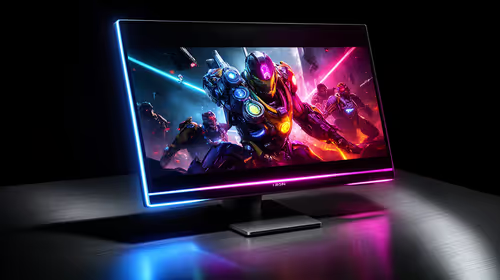
For competitive gaming specifically, choose FHD 320Hz. The doubled refresh ceiling (3.1ms per frame versus 6.25ms) produces crisper target movement during fast flicks, and the lower GPU workload at FHD means you can sustain 250fps or above in CS2 or Valorant on an RTX 5070, which is genuinely difficult to achieve at native 4K.
Why Refresh Rate Beats Resolution in Competitive Gaming 🏆
Competitive gaming is about reaction time and target acquisition. At 320Hz the monitor delivers a new frame every 3.1ms. At 160Hz it delivers one every 6.25ms. When an opponent crosses your field of view at competitive movement speed, the additional 3.1ms of frame information means you see a more current snapshot of their position during the critical tracking window. Over hundreds of hours of ranked play this translates to marginally more accurate reads of opponent positions during fast movements. Professional CS2 players have migrated toward 240Hz and 360Hz displays for this reason; 320Hz on a dual-mode 4K panel is the consumer-accessible step in that direction. At FHD on a 32-inch panel the 69 PPI is soft for document work but perfectly readable for competitive UI elements at 60 to 80cm desk distance.
GPU Frame Rate Requirements at Each Mode 🖥️
The GPU budget required to utilise each mode differs. For 4K 160Hz, a GPU delivering 140 to 160fps at 4K fills the panel well; achieving this in demanding titles requires an RTX 5080 at native resolution or an RTX 5070 with DLSS Quality. For FHD 320Hz, the target is 280fps or above, which an RTX 5070 or RX 9070 XT can achieve in optimised competitive titles (CS2, Valorant, Rocket League) at FHD with competitive settings. The FHD 320Hz mode is therefore accessible at a lower GPU price point, relevant in South Africa where GPUs above R20,000 represent a significant spend relative to typical incomes.
Making the Practical Decision for SA Competitive Players 💰
For SA players who compete in ranked modes and want every hardware advantage at the display level, FHD 320Hz is the correct mode on a dual-mode panel. The smoothness benefit is real and the GPU requirement is achievable at the R12,000 to R16,000 GPU tier. If the same player also spends significant time in story-driven single-player titles, a dual-mode 4K panel (R13,000 to R18,000) allows 4K 160Hz for those sessions and FHD 320Hz for ranked. Owning one dual-mode panel at R15,000 is more cost-effective than owning a separate competitive FHD monitor and a separate 4K display, which combined would exceed R20,000.
Cap Frames Below Panel Maximum for Stability ⚡
When running FHD 320Hz mode, cap your in-game frame rate at 315fps rather than uncapped. At exactly the panel's maximum rate, frame delivery timing becomes unpredictable in some titles. A 5fps buffer below the ceiling keeps frame pacing smooth and adaptive sync functioning optimally.
FAQ
Is 320Hz better than 240Hz for competitive gaming?
320Hz delivers a further reduction in the frame window compared to 240Hz (3.1ms versus 4.17ms), providing a marginal additional sharpness benefit during fast target tracking. The difference is smaller than the 160Hz to 240Hz jump but still present.
Do I see screen tearing at 320Hz if G-Sync or FreeSync is enabled?
No. With G-Sync Compatible or FreeSync Premium active, the monitor syncs to your GPU's frame rate up to the panel maximum. If you sustain above 320fps, tearing can appear above the VRR ceiling; an in-game frame cap prevents this.
Can South African internet speeds affect competitive gaming at 320Hz?
Internet latency and packet loss affect online play but are independent of monitor refresh rate.
Serious about your competitive gaming setup?
Evetech stocks high-refresh gaming monitors with FHD 320Hz dual-mode capability, locally stocked for South African gamers with full warranty support.