Quick Answer
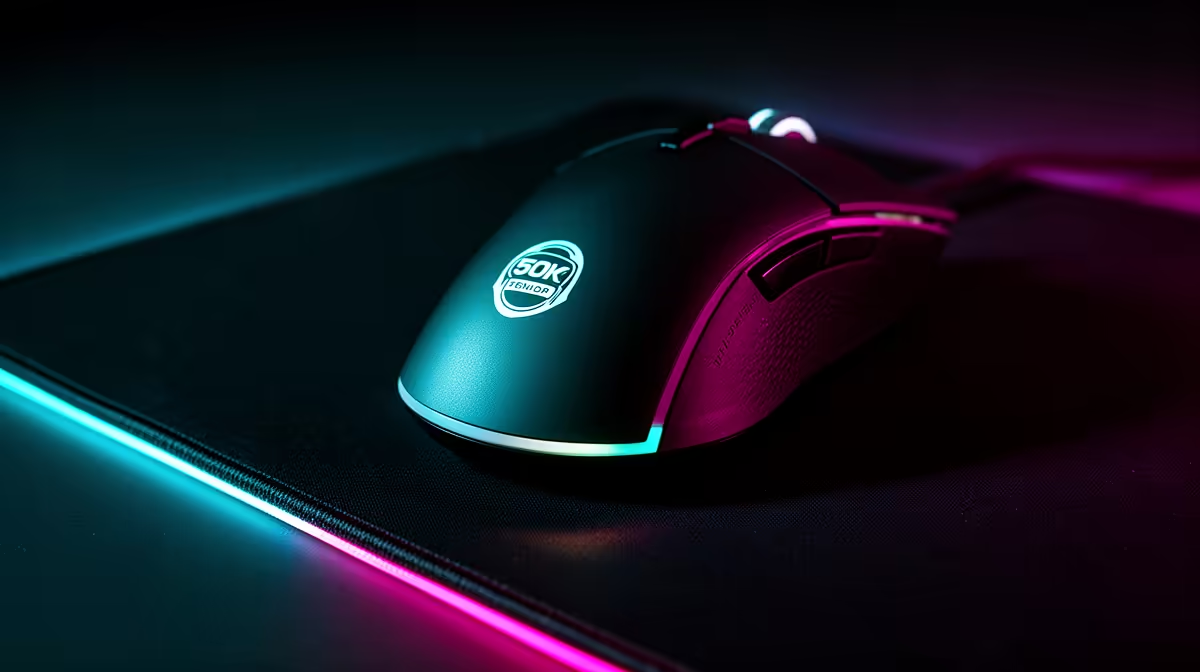
Tracking inconsistencies across mousepad surfaces with a 50K DPI sensor are almost always caused by incorrect lift-off distance settings, surface calibration profiles that do not match your specific pad, or using the sensor at interpolated DPI steps above its native ceiling. Fixing these in your mouse software resolves most issues without any hardware changes.
Why Surface Type Affects High-DPI Sensors 🔬
A 50,000 DPI sensor captures thousands of surface micro-texture data points per inch of movement by comparing sequential photos of the surface and calculating displacement. Different surfaces present completely different texture profiles: a fine-weave cloth pad shows consistent fibre patterns; a hard-surface pad reflects light differently at each angle; a hybrid pad uses a coated surface that can confuse sensors calibrated for cloth.
When the sensor's firmware is optimised for one surface type and you switch to another, two problems emerge. First, the prediction algorithm extrapolates cursor movement using assumptions from the previous surface, causing micro-jitter during slow tracking. Second, lift-off distance varies by surface: a thick foam-backed cloth pad raises the mouse slightly compared to a thin hard pad, and some sensors continue registering movement briefly after the mouse leaves the surface if LOD is set too high.
Fixing Surface Calibration in Mouse Software 🖱️
Most premium gaming mice include a surface calibration tool in their companion software. Razer Synapse includes a Surface Tuning feature that samples your specific mousepad and builds an optimised sensor profile; Logitech G Hub offers similar calibration. Running this for each pad you own takes about 60 seconds and is the single most effective fix for cross-surface inconsistency.
For lift-off distance, set it to the lowest value in your mouse software that does not cause cursor drift on re-plant. On cloth this is typically the lowest setting; on a hard surface you may need one step higher.
Native vs Interpolated DPI: The Hidden Factor 📊
Many sensors rated at 50,000 DPI have a native optical resolution of around 25,600 DPI and achieve higher numbers through interpolation. Running interpolated DPI amplifies tracking noise from surface texture. Drop your DPI to the sensor's confirmed native ceiling and use in-game sensitivity to compensate. For the PixArt PAW3950, confirmed native operation is at 30,000 DPI. Running at 800 DPI native versus 800 DPI via interpolated 50K DPI produces no difference, but running at 25,000 DPI native versus interpolated shows measurable jitter on texture-rich surfaces.
One Pad, One Profile ⚡
Create a named profile in your mouse software for each mousepad you own and label it by pad name. Switch profiles when you change surfaces rather than re-running calibration each time. This takes five seconds and eliminates all software-side surface inconsistency instantly.
FAQ
Does a hard or cloth pad work better with 50K DPI sensors?
Top-tier cloth pads like the Razer Gigantus V2 or SteelSeries QcK Heavy perform most consistently because their uniform fibre weave gives the sensor a rich and predictable texture to sample. Hard pads are faster but require more careful LOD tuning to avoid lift-off tracking artefacts.
Why does my cursor stutter at very slow movement speeds on a hard pad?
This is low-speed jitter, occurring because hard surfaces have very low texture variation at the micro level. Some high-DPI sensors handle this better than others. Switching to a hybrid or cloth pad reduces this significantly.
Can a cheap mousepad damage the sensor?
No, but abrasive or contaminated pad surfaces can wear PTFE glide pads faster and cause the mouse shell to drag, affecting the sensor's vertical position. Replacement glide pads cost R80 to R200 locally.
Get the right pad for your sensor.
Evetech stocks a wide range of gaming mousepads matched to the performance requirements of high-DPI sensors. Browse the full mousepad range at Evetech.