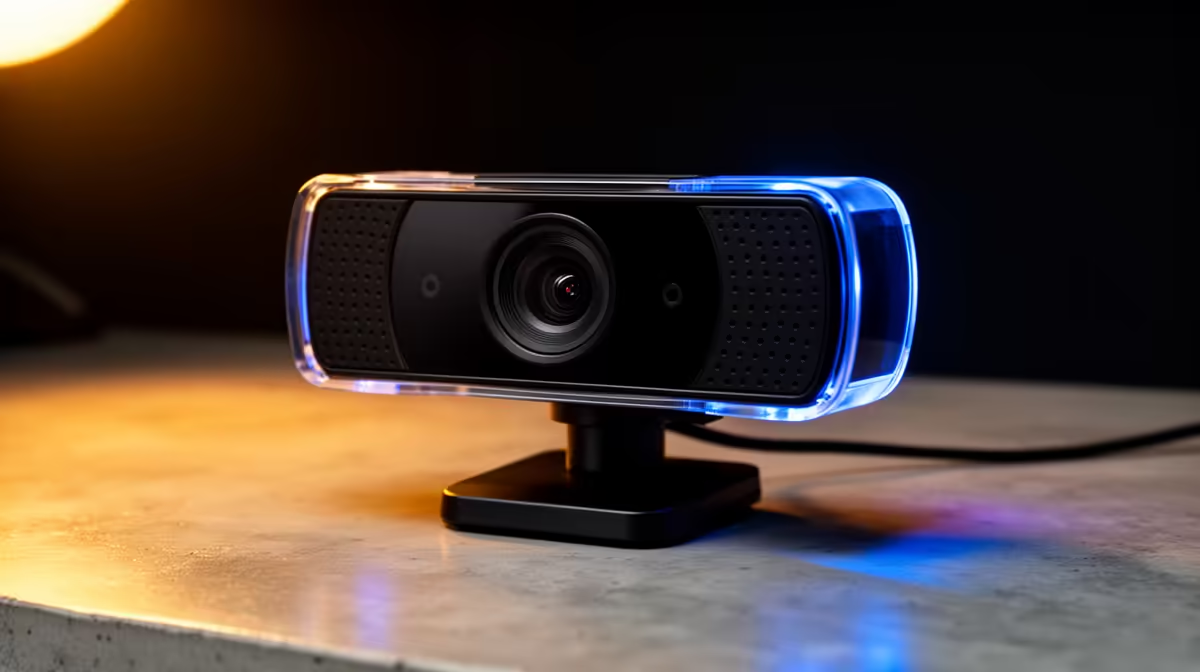
The resolution race convinced a lot of creators that 4K is always better. On paper, four times the pixel count sounds like a clear upgrade. In practice, South African streamers who have tested both formats side by side are mostly settling on 1080p 60fps webcams instead, and the reasons are practical rather than ideological. Upload constraints, platform compression, and the way human eyes perceive motion all point the same direction.
Quick Answer
At 60fps, a 1080p stream renders movement with twice the temporal detail of 4K at 30fps, while using roughly half the upload bandwidth. Platforms compress 4K feeds before viewers see them anyway, so the extra resolution rarely survives. For live streaming on standard SA fibre, 1080p 60fps is the sharper result in practice.
📺 What Frame Rate Does That Resolution Cannot
Resolution describes how many pixels fill the frame at any given instant. Frame rate describes how many times per second that picture updates. A 4K 30fps frame is packed with detail, but it is still only refreshing thirty times a second. A 1080p 60fps frame updates sixty times, which means any fast movement, a hand gesture, a head turn, a mouse drag across a screen share, is captured at twice the frequency.
The human visual system is particularly good at detecting motion inconsistency. A jerky or smeared movement reads as lower quality even when the underlying resolution is high. When a presenter's lips move or hands gesture rapidly, 60fps captures each intermediate position the body passes through. At 30fps, those intermediate positions are skipped, and the brain fills in the gap with a slight sense of blur or stutter.
For gaming content, the difference compounds. Fast gameplay reflected on a streamer's face, or a screen share of actual gameplay, moves at speeds that 30fps simply cannot resolve clearly. The 60fps feed renders those moments without the motion blur that 30fps adds at the same scene.
Resolution Versus Perceived Sharpness
There is a gap between measured resolution and perceived sharpness in a viewer's experience. At typical viewing distances and screen sizes, a well-exposed, sharp 1080p60 image often reads as cleaner than a noisy or soft 4K30 one. Sensor size, lens quality, and the lighting situation in front of the camera contribute more to perceived sharpness than raw pixel count beyond 1080p.
🌐 What SA Fibre Connections Actually Support
Most standard South African residential fibre packages are 50 to 100 Mbps symmetrical, with real-world peak-hour upload sitting closer to 60 to 80 percent of the advertised rate. A 4K 30fps stream with proper bitrate settings needs between 12,000 and 20,000 kbps of sustained upload to stay clean. A 1080p 60fps stream with the same quality ceiling runs comfortably at around 6,000 kbps.
That difference matters in practice. At 6 Mbps, a 50 Mbps fibre line has 44 Mbps left over for household activity, background services, and the chat and alert infrastructure a live stream depends on. At 20 Mbps video, the headroom compresses, and any competing upload traffic creates visible degradation.
Streaming platforms also set their own ceilings. Twitch's ingest system does not natively accept 4K input. Feeds sent at 4K are transcoded or downscaled at the server, which means the upload bandwidth spent on the extra resolution is absorbed by the platform's compression pipeline before any viewer sees it. YouTube supports 4K live streaming, but the 15 to 20 Mbps upload it requires is beyond what many SA residential lines can sustain without sacrificing stability.
Pro Tip ⚡
Test your actual upload speed at your usual streaming hour, not at midday. SA fibre lines often slow at peak evening hours. If your tested upload is below 15 Mbps, a 1080p 60fps stream at 6,000 kbps will consistently outperform a 4K attempt fighting for bandwidth.
🔧 Why 1080p 60fps Works Better for Talking-Head Content
Most streaming and conference content is a person talking on camera. The frame is largely static: a face, a background, maybe a second monitor. In that scenario, the motion that matters most is lips, hands, and subtle expression. Those details resolve clearly at 1080p. The areas of the frame that would benefit most from 4K, fine texture on clothing, detail in a bookshelf background, are the areas the viewer's eye spends the least time on.
The areas that 60fps improves most are exactly those details that talking-head content contains: the rapid movement of lips forming words, the gesture of hands explaining a concept, the quick eye movement a speaker makes. These are temporal details, not spatial ones, and frame rate is the only spec that captures them properly.
For screen-sharing content, the case is even stronger. Text and interface elements at 1080p are fully legible on viewer screens. The smooth redraws at 60fps make scrolling and navigation look professional. Trying to push 4K for screen content on a constrained upload just introduces compression artifacting on the very text edges that need to stay sharp.
💰 Hardware Cost and Practicality
4K 60fps webcams exist but sit in a significantly higher price bracket. The processing overhead for 4K60 requires USB 3.0 bandwidth, more capable encoding, and a host PC with enough throughput to handle the data. 1080p 60fps cameras are widely available, supported cleanly by USB 3.0 ports, and work without special driver configuration on both Windows 10 and 11.
The price difference between a capable 1080p 60fps webcam and an entry 4K webcam in the South African market is typically several hundred rand that could go toward lighting, which will improve video quality more visibly than the resolution step between 1080p and 4K at streaming bitrates.
Frequently Asked Questions
Why does 60fps look smoother than 4K 30fps on a stream?
Frame count determines how often the image refreshes per second. At 60fps, fast movements are captured at twice the sampling rate of 30fps, so gestures, head turns, and lip movement reproduce without the blur or stutter that 30fps introduces on quick motion. The smoothness is perceptible to viewers even on smaller screens.
Does 1080p 60fps use significantly less upload bandwidth than 4K?
Yes. A well-configured 1080p 60fps stream runs comfortably at 6,000 kbps, while a clean 4K stream needs 12,000 to 20,000 kbps. That difference is meaningful on a standard SA fibre line, leaving far more headroom for other activity and reducing the risk of stream drops during peak hours.
Will viewers notice the difference between 4K and 1080p after platform compression?
Rarely. Both Twitch and YouTube apply their own compression to live streams. Twitch does not natively support 4K input, so 4K feeds are downscaled before viewers see them. YouTube preserves 4K but applies compression that narrows the perceptible gap. In practice, a sharp 1080p 60fps stream looks comparable to a 4K 30fps feed after the platform has processed both.
Which webcam specification matters most for live talking-head streams?
Frame rate. Talking-head content is dominated by facial movement, lip sync, and hand gestures. These are temporal details that frame rate resolves. A 1080p 60fps camera captures those moments more accurately than a 4K 30fps camera, which skips half the update intervals while delivering extra pixel density in areas the viewer barely scrutinises.
Is a native 1080p 60fps sensor better than a 4K sensor downscaled to 1080p?
For live streaming, a native 1080p 60fps sensor typically outperforms a downscaled 4K 30fps one because it captures at 60fps natively. Some 4K webcams can output 1080p at 60fps by binning pixels from the larger sensor, which can look very good, but cameras sold specifically around the 4K resolution spec often prioritise pixel count over frame rate, making the native 1080p 60fps option the more relevant choice for live use.
Should a new SA creator invest in a 4K webcam for Twitch?
The budget is better spent elsewhere. Twitch's ingest infrastructure does not pass 4K to viewers. A 1080p 60fps webcam under R2,000 covers everything Twitch requires, and allocating the remainder of the budget to lighting will produce a more noticeable improvement to the stream's professional appearance than any resolution upgrade above 1080p.
Ready to upgrade to a smoother, more reliable live stream?
Browse the 1080p 60fps webcam range designed for South African streamers who want fluid motion and stable output on standard fibre connections.