


80+ Gold vs 80+ Platinum for Couch co-op gaming in SA
80+ Gold vs 80+ Platinum for couch co-op gaming is about PSU efficiency, heat, fan behaviour, quality, and wattage headroom, not direct FPS. SA buyers should compare the whole build.
Read moreAround R40,000 in SA, a music production stream deck choice should be judged by how well it supports repeated studio commands beside existing gear. Use the listed Evetech peripheral range as context, from GAMDIAS Hermes P2A R130 through Logitech G305 R525 and Promate Baton R280.
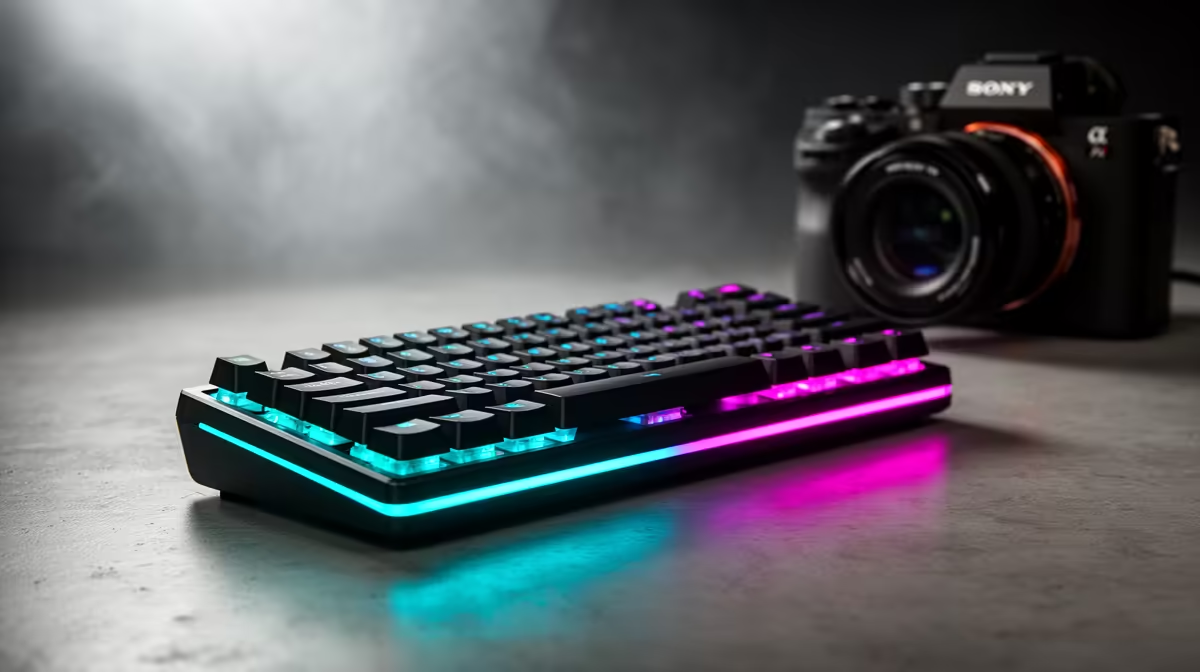
Choose a stream deck for music production by the shortcuts and feedback it adds to the studio, not by the total workstation allowance. It can launch applications, switch views, mute channels or trigger macros, but it does not replace a proper audio interface or a tactile music controller where velocity and continuous movement matter.
Write down every action repeated during recording, editing and exporting. Note which commands need visual labels and which already have comfortable keyboard shortcuts. Check support for the DAW, operating system and plug-ins. A control deck is most useful when one labelled button replaces a reliable multi-step process, not when it duplicates keys within easy reach.
No verified stream-deck SKU or price appears in the supplied facts. The Logitech MX Keys S keyboard has a verified R1,759 price as a shortcut-input comparison. The NearStream AM10X-P USB/XLR microphone carries a verified R730 price as a studio recording reference. Neither performs dedicated control-deck functions, so select each by its actual role.
Map only the ten or twelve actions used most often, then produce a short session without looking away from the main display. Check whether labels remain clear, macros fail safely and the device reconnects after sleep. Avoid assigning destructive delete or overwrite commands without confirmation. Keep an exported copy of profiles so a computer rebuild does not erase the layout.
Buy a deck when it saves measurable time and reduces navigation errors. Spend the wider workstation allowance first on compute, storage, monitoring and audio quality.
Streamlining a music desk? > Ask Evetech to compare productivity keyboards and recording microphones for the workflow.
Yes, for music production it fits when buttons handle repeated studio controls without interrupting the creative session.
Start with the named ladder: GAMDIAS Hermes P2A R130, Logitech G305 R525 and Promate Baton R280, then check current stock.
Map the controls to your existing music setup first, so the peripheral supports real shortcuts rather than unused buttons.
Choose the budget option only if basic controls cover the studio tasks you repeat most during production.
For music production, smooth control during recording, editing or playback matters more than broad gaming extras.
Upgrade the main machine instead when production problems come from slow software response rather than missing shortcut controls.
80+ Gold vs 80+ Platinum for couch co-op gaming is about PSU efficiency, heat, fan behaviour, quality, and wattage headroom, not direct FPS. SA buyers should compare the whole build.
Read more
80+ Platinum or 80+ Titanium for competitive should be shortlisted around the job it must do. South African buyers should compare fit, performance, compatibility, and upgrade room, warranty path, and upgrade room before treating any pick as best.
Read more
The real world difference between IPS and OLED for AAA single-player gaming is immersion versus versatility. OLED lifts contrast and dark scenes, while IPS can suit bright rooms, mixed PC use, and SA buyers watching total setup cost.
Read more
HDMI 2.1 vs HDMI 2.0 for SA MMO needs a workload-first comparison. For SA buyers, judge real performance, platform fit, warranty path, power needs, and upgrade timing before choosing either side.
Read more
USB4 and Thunderbolt 4 differ for competitive esports through dock, display, and capture consistency. Use this real world difference between usb4 and thunderbolt 4 for competitive guide to keep SA tournament desks tidy without assuming better ping.
Read more
Magnetic switches vs Mechanical switches depends on Competitive esports needs, platform limits, and budget fit. Compare compatibility, latency, upgrade path, and real setup constraints before choosing for an SA build.
Read more
B850 motherboard FPS drops needs a methodical troubleshooting pass. Review drivers, thermals, power settings, background apps, cables and game settings before replacing parts in an SA gaming setup.

Gaming PC FPS drops in South Africa often come from drivers, thermals, background apps, power plans, or in-game settings. Check one change at a time and use the same scene before buying upgrades for your local setup.

Difference between PCIe 5.0 and PCIe 4.0 explained for PC builders starts with bandwidth, lanes, and support. SA builders should match the motherboard, GPU, NVMe drive, and budget before choosing a platform.
Windows 11 mechanical keyboard setups rarely cause display banding directly. Fix color banding by checking HDR, colour depth, GPU range, monitor profiles, and any new RGB utility conflicts.

Steam Big Art Mode enlarges library artwork in Big Picture Mode and on Steam Deck, while the same beta adds configurable screensavers. Both features are optional and currently require the Steam beta client.
Diablo 4 HDR settings work best after Windows and the display are calibrated, then the game's black point, brightness and white point are adjusted in that order. Use visible shadow detail and controlled highlights, not copied values from another screen.

The best HOTAS for Elite Dangerous is a separate stick-and-throttle set with enough analogue axes for pitch, roll, yaw and thrust, plus local support. Evetech's captured flight-simulation sample lists the complete Logitech X56 at R4,999.
Nintendo Switch 2 docked VRR arrives with system version 23.0.0 and also requires a dock update. The connected TV or monitor and the running software must support VRR before the output can follow changing frame rates.
750W for RTX 5080 Super needs a full-build check, not a simple yes. Review GPU guidance, CPU draw, transient load, connectors, PSU quality, and upgrade plans before deciding.
80+ Gold vs 80+ Platinum for couch co-op gaming is about PSU efficiency, heat, fan behaviour, quality, and wattage headroom, not direct FPS. SA buyers should compare the whole build.
ultrawide monitor FPS drops needs a methodical troubleshooting pass. Review drivers, thermals, power settings, background apps, cables and game settings before replacing parts in an SA gaming setup.
80+ Platinum or 80+ Titanium for competitive should be shortlisted around the job it must do. South African buyers should compare fit, performance, compatibility, and upgrade room, warranty path, and upgrade room before treating any pick as best.