Two flavours of 5G get talked about as if they were the same product, and they could not be more different where it counts: whether the signal reaches your living room at all. The sub-6 versus mmWave split decides range, wall penetration and real-world speed, and for South African home internet the answer is far less balanced than the global debate suggests.
Quick Answer
Sub-6GHz 5G travels several kilometres and passes through walls and foliage well, making it the band that actually reaches homes. mmWave delivers far higher peak speeds but its range is under a kilometre and almost any obstruction blocks it. In South Africa, providers like Rain and Vodacom run home internet on sub-6 mid-band spectrum (around 3.5 to 3.6GHz), so sub-6 is what your home actually uses.
The physics that decides everything
The whole comparison comes down to frequency, and frequency dictates how a radio wave behaves. Sub-6GHz means spectrum below 6GHz, and these lower frequencies travel long distances and slip through obstacles like walls and trees comparatively well. That is why a single sub-6 tower can blanket several kilometres and still deliver a usable signal inside a house.
mmWave (millimetre wave) sits much higher up the spectrum, and that height is both its strength and its weakness. The very short wavelengths carry enormous data capacity, which is where the headline gigabit speeds come from, but they barely travel. mmWave range is typically under a kilometre, and walls, windows, foliage, even heavy rain can attenuate or block it. Step behind almost any obstruction and the signal collapses.
Why South African home internet is a sub-6 story
This is where the global hype and the local reality part ways. South African fixed-wireless home internet runs on sub-6 mid-band spectrum, not mmWave. Rain's 5G service, the first commercially available 5G in the country as a fixed-line alternative, uses its licensed 3.6GHz spectrum to deliver downstream speeds up to around 700Mbps. Vodacom added 5G on band N78 at 3500MHz in 2024, also squarely in the sub-6 mid-band.
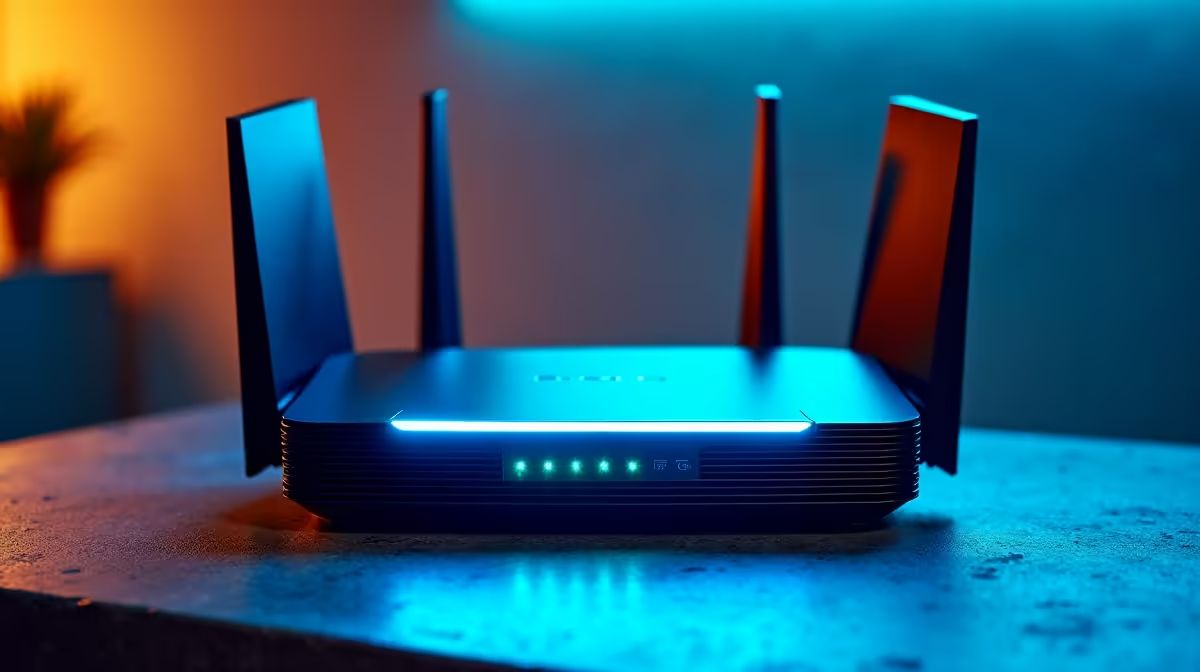
So for the typical home connecting via 5G, the choice is effectively already made by the network. You are on sub-6, because that is what reaches your house reliably. mmWave's wall-blocking range makes it impractical as the primary delivery method for home internet across a country with the coverage demands South Africa has, which is why it is not the band feeding your router. The current crop of home routers in the networking range at Evetech is built around exactly this sub-6 mid-band reality.
Mid-band is the sweet spot
There is a reason mid-band sub-6 became the workhorse of home 5G. It balances the two extremes: noticeably faster than the old low-band frequencies, while still covering useful area and penetrating buildings. Pure low-band reaches far but is slow; mmWave is blistering but barely reaches. Mid-band, the 3.5GHz neighbourhood, is the practical middle that delivers strong speeds with the coverage homes actually need.
Speed expectations: marketing versus reality
The mmWave gigabit headlines colour what people expect from 5G, so it helps to reset that against sub-6 reality. mmWave's enormous peak speeds are real but only achievable standing almost in line of sight of the tower with nothing in the way, conditions that essentially never describe a home with walls and a roof. Quoting those numbers for home internet is selling a peak the band cannot sustain indoors.
Sub-6 mid-band tells a more honest story. Rain's service reaching up to around 700Mbps over its 3.6GHz spectrum is a strong, usable figure delivered through walls to a real home, which matters far more than a lab peak you will never see. Your actual speed depends on distance to the tower, how many walls sit between, network congestion at peak times, and your router's placement. Treat any single advertised peak as a best case and judge a connection by its steady real-world performance instead.
Fixed wireless versus fibre, briefly
It is worth setting 5G in context against fibre, since the band discussion only matters once you have chosen wireless. Sub-6 fixed wireless shines where fibre has not reached, or where you want to be up and running without a trench dug to your home. Fibre still wins on raw consistency and latency when it is available, but sub-6 5G has become a genuine alternative for plenty of South African homes, which is exactly why Rain and Vodacom built their home offerings on it. The band choice, sub-6, is what makes that alternative practical in the first place.
What this means for your setup
Because your connection is sub-6 mid-band, the things that improve it are the things that help mid-band signals. Position your router for the clearest line toward the nearest tower, since even sub-6 prefers fewer walls between you and the mast. A window-facing spot on the side of the house facing the tower often lifts speeds. Where the signal is marginal, an external antenna aimed at the tower can make a real difference, and the cabling and small extras in the accessories best sellers help tidy that kind of setup. One more local note: heavy rain can briefly soften higher-frequency 5G, so a dip during a storm is normal rather than a fault.
Frequently Asked Questions
Does South African 5G home internet use mmWave?
No. Providers like Rain and Vodacom deliver home internet on sub-6 mid-band spectrum, around 3.5 to 3.6GHz. mmWave's sub-kilometre range and poor wall penetration make it impractical as the main delivery band, so your home connection is sub-6.
Why does sub-6 reach my house when mmWave would not?
Lower frequencies travel further and pass through walls and foliage far better. Sub-6 covers several kilometres and penetrates buildings, while mmWave's range is under a kilometre and almost any obstruction blocks it.
Is mmWave faster than sub-6?
In raw peak speed, yes, because its very high frequency carries more data. But that speed is useless if the signal cannot reach you, and mmWave barely penetrates walls. Sub-6 mid-band delivers strong real-world speeds that actually arrive indoors.
What is mid-band 5G and why does it matter?
Mid-band is the sub-6 range around 3.5GHz that balances speed and coverage. It is much faster than low-band while still covering useful area and reaching inside buildings, which is why it became the workhorse for home 5G.
Can weather affect my 5G home internet?
Higher-frequency 5G can be softened by heavy rain, which may briefly attenuate the signal. A short dip during a storm is normal rather than a hardware fault, and the connection typically recovers once the weather clears.
How can I improve a weak sub-6 signal at home?
Position the router with the clearest path toward the nearest tower, ideally near a window on the tower-facing side. Where signal is marginal, an external antenna aimed at the mast can lift speeds noticeably.
Setting up 5G home internet that actually reaches every room? Match your sub-6 connection with the right gear from the networking range at Evetech and position it for the strongest signal to your nearest tower.