An under-R8,000 shortlist is useful only when every candidate can run on the existing board and still leaves a complete cooling and graphics plan. Best AM4 CPU upgrade options under R8,000 should solve a measured processor limit rather than win on price alone. The Ryzen 7 5800X3D qualifies at R7,199, leaving exactly R801 below the CPU ceiling.
Quick Answer
The Ryzen 7 5800X3D fits under R8,000 at R7,199 and provides eight Zen 3 cores, 16 threads and 100MB cache. The R801 difference must not be assumed to cover cooling, because the 105W CPU includes no cooler. Confirm the exact AM4 motherboard and BIOS, retain a discrete GPU, and compare other qualifying processors against the same game and total-cost criteria.
🎯 Define what the upgrade must improve
Begin with the current problem. A low average in a processor-sensitive game, uneven frame delivery or a parallel workload that lacks CPU resources can justify a processor shortlist. A system whose graphics card is already the active limit may need the budget allocated elsewhere.
Choose representative tests and record their conditions. Keep the game version, scene, settings, resolution and background activity stable. Check averages and frame times, and use changes in graphics load to help distinguish a CPU ceiling from a GPU ceiling. One unexplained utilisation number is not enough.
The target also sets the minimum candidate. A less expensive AM4 processor can be better value if it already meets the required experience, while a larger-cache model can justify more spend when relevant games use it. Define success before comparing product names.
Evetech's AMD processor range provides the appropriate place to build a current shortlist rather than relying on assumed options or stale prices.
🧩 Apply motherboard support as the first filter
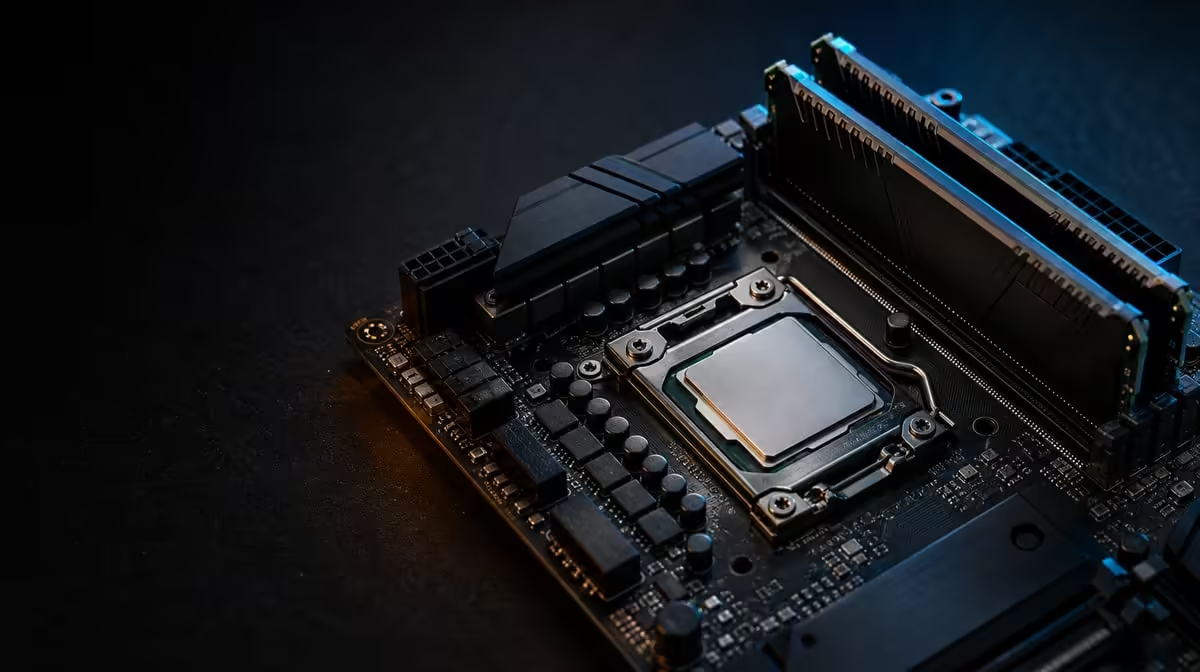
Every shortlist entry needs documented support on the exact motherboard model and revision. AM4 identifies the socket family, but BIOS support determines whether the board recognises the CPU. Find the processor entry and required firmware release before treating a model as an upgrade option.
If the BIOS needs an update, plan it while the existing CPU can still start the system. Record the current version and stable settings, follow the board maker's instructions and confirm completion. Keep the old processor protected until the replacement has passed validation.
Memory and graphics can often be retained, but each still needs checking. A screen depends on a discrete graphics card because the 5800X3D cannot provide its own display signal. Reused memory should be detected and tested after the CPU change rather than assumed stable under every new configuration.
The platform filter can remove a processor that looks attractive on price. That is better than discovering an unsupported board after purchase. If several supporting parts also need replacement, compare the AM4 total with a broader platform route.
💰 Expand R7,199 into an installed total
Subtracting R7,199 from R8,000 leaves R801. That is a mathematical balance, not a cooler budget promise. The processor is rated at 105W and includes no CPU cooler, so an appropriate AM4 solution must be selected by actual capability, case fit and airflow.
Evetech's CPU cooler category helps price the thermal requirement after measuring air-tower height, radiator positions, memory clearance and surrounding space. Add any mounting or airflow work the system genuinely needs.
A complete system also needs discrete graphics, suitable power and physical room for the card. Existing owners may already have these components, but the under-R8,000 ceiling applies to the CPU shortlist, not automatically to the finished gaming machine.
Installation time or labour can matter as well. A prepared drop-in change differs from a job that needs firmware recovery, cooler replacement and extensive cable work. Use the same cost boundaries for every candidate so one route is not made to look cheaper by omitting necessary items.
🧠 Judge what the 5800X3D brings
The processor offers eight cores and 16 threads on the Zen 3 architecture. Its 100MB cache can help games whose working data benefits from remaining near the cores. Results vary with the engine, scene and graphics load, so the cache figure cannot be turned into one guaranteed FPS improvement.
Its base frequency is 3.5GHz, and boost can reach a 4.5GHz maximum. That upper number is not a constant all-core speed. Workload, cooling, active cores, power and firmware affect the frequency visible during a particular test.
Compare the 5800X3D with other exact processors using a matched GPU, memory configuration and settings. Evetech's broader CPU selection helps frame alternatives, while representative benchmarks show whether the additional resources matter to the buyer.
The R7,199 model is a strong candidate when the board supports it, serviceable AM4 parts can remain and the existing CPU is the proven limitation. A cheaper CPU can still be the better option when it reaches the target or preserves money for a more urgent GPU upgrade.
After choosing a candidate, plan a controlled installation and validation. Record the working BIOS, memory layout and test result before changing hardware. Once the new CPU is fitted, begin from stable settings, confirm cooling operation and repeat the same workload. That closes the loop between the under-R8,000 shortlist and the outcome it was meant to buy.
Do not discard the previous processor immediately. If the motherboard needed a firmware change, the known working CPU may help with troubleshooting. Keep it protected until the new configuration has passed startup, memory, temperature and gaming checks.
Current availability should be checked when the buyer is ready to order, but the comparison method remains stable. Use the live R7,199 price, confirm the cooler actually chosen, and preserve the same cost boundary across every alternative. Avoid replacing an exact candidate with an assumed equivalent without reviewing support and specifications again.
Frequently Asked Questions
Does the Ryzen 7 5800X3D fit below R8,000?
Yes. Its R7,199 processor price is R801 below that ceiling. Required cooling and any other supporting hardware sit outside that arithmetic.
What should an under-R8,000 CPU improve first?
It should address the measured processor constraint in the intended games or applications. If the system is graphics-limited, CPU spending may not be the first priority.
Why is motherboard support central to this shortlist?
The exact board and BIOS must recognise the candidate. An AM4 socket match alone does not make a processor a usable upgrade.
What performance resources does the 5800X3D offer?
Its Zen 3 resources total eight cores and 16 threads, paired with 100MB cache. Frequency begins from a 3.5GHz base, with boost reaching 4.5GHz.
Can the R801 balance be assumed to cover cooling?
It cannot. Compare an actual AM4 cooler with suitable capability, physical fit and airflow before assigning the remaining money.
What graphics requirement remains outside this CPU ceiling?
A discrete GPU is required for display output. The existing or chosen card, its power and case fit need a separate plan.
How should two qualifying AM4 CPUs be compared?
Confirm support for both, use matched system tests and calculate complete installation costs. Give priority to the option that meets the defined workload at better total value.
Ready to build an under-R8,000 CPU shortlist that survives every compatibility check?
Compare Evetech's AM4 processors, price the required cooler and test whether the R7,199 option solves your real bottleneck.