



PCIe 5.0 vs PCIe 4.0 for Video editing in 4k in SA
PCIe 5.0 vs PCIe 4.0 for video editing in 4k is mainly about fit, features, compatibility, cost, and upgrade path, not one automatic winner. SA buyers should match the choice to the setup.
Read moreA 49-inch DQHD monitor creates one continuous 5120x1440 workspace for multiple windows, timelines or two sources. At R14,999, the LM49 also brings dual-source viewing, precise sRGB colour, 65W USB-C power and wired Ethernet.
A 49-inch DQHD monitor is not simply a larger version of an ordinary screen. It changes where applications live, how far the pointer travels and how laptops share the desk. A complete guide to 49-inch DQHD curved monitors and productivity therefore begins with layout and ergonomics. Dahua's LM49 provides a R14,999 example.
The R14,999 LM49 is a 49-inch curved monitor with 5120 x 1440 DQHD resolution. Choose it when a seamless canvas and PBP dual-source viewing match the workflow. For a compatible laptop, USB-C has a 65W power ceiling and the RJ-45 socket provides Ethernet. Centre the curve, save window zones and test each connection.
Measure desk width and depth with the monitor stand, keyboard, laptop and speakers represented. A 49-inch panel needs a stable surface and enough viewing distance for both edges to remain comfortable. Leave clearance behind the screen for cable loops and swivel movement.
Centre the curved panel on the normal chair rather than on the furniture. Use the LM49's tilt and swivel adjustment to make the outer regions equally accessible. A screen positioned to one side can turn useful width into repeated neck movement.
Evetech's curved monitor selection helps compare this wraparound format with other desks and display shapes.
Put the webcam near the centre to create a natural meeting angle. Keep frequently adjusted controls and the laptop cable within reach, while permanent power and network routes remain behind the stand. Do not route cables so tightly that ergonomic adjustment strains a port.
Test the chair, keyboard and mouse together. A wide screen does not justify moving the keyboard off-centre or losing mouse space needed for gaming.
DQHD provides 5,120 horizontal pixels and 1,440 vertical pixels. It can resemble two QHD-width work regions joined without a centre bezel, but it also supports flexible three-zone or centre-weighted layouts.
Choose native resolution and comfortable operating-system scaling before arranging applications. Start with a large central region for the main task, then put communication and reference tools towards the sides. If outer information is checked constantly, move it inward rather than accepting head movement as the cost of width.
A research layout might keep a browser, notes and communication visible. An editing layout can reserve the centre for a canvas or preview and use the sides for layers, scopes and assets. A meeting layout should put the conferencing window and notes near the webcam.
Name and test these zones after restart and sleep. Window management creates the boundaries that two physical monitors would otherwise provide.
A full 5120-pixel desktop can appear tiny to meeting participants on smaller screens. Share one application or a carefully selected region and preview it before the meeting. Close unrelated content at the far edges.
Picture-By-Picture assigns visible regions to two connected computers at the same time. Confirm both sources full screen first, label their inputs and then enable the split. Configure resolution and scaling independently for each allocated region.
PBP does not move keyboard, mouse or audio control. Define a peripheral-switching routine and confirm the active computer with a harmless action. Choose one audio host during meetings or entertainment so the visible two-device desk does not become a notification mix.
USB-C carries the compatible laptop display route and can deliver as much as 65W. The built-in RJ-45 port provides wired Ethernet within the same monitor-centred setup. Explore the Dahua monitor range for this complete feature context.
Use a suitable full-featured cable and connect directly. Test 5120 x 1440 video first, inspect battery direction during the normal workload, and then disable Wi-Fi briefly to prove the Ethernet path. Restore the intended network policy afterwards.
Let the laptop sleep, wake it, restart it and undock for several minutes. The route is ready when image, charging and network return predictably. Keep the original charger for travel and workloads that use another power plan.
For creative work, the LM49 pairs 99% sRGB coverage with Delta-E under 2 accuracy. Use a neutral picture mode, stable ambient light and colour-managed applications. Keep vivid or game-oriented processing in another profile.
Supported games can use the continuous width without a centre bezel. Confirm aspect behaviour, interface position and graphics performance in the actual titles. A 5120 x 1440 workload asks the graphics system to render a substantial number of pixels.
Evetech's gaming monitor catalogue provides alternative screen and connection packages around the R14,999 reference.
Record native resolution, scaling, picture mode, input labels and PBP arrangement. Photograph the cable map before final cable management. After a graphics or operating-system update, restore these values before changing several settings at once.
Run a weekly acceptance sequence: wake the main computer, restore the work layout, connect the laptop, test Ethernet, switch to PBP and return to full-width use. The wide monitor becomes productive when every transition is routine.
After a week, count how often windows overlap, how much pointer travel occurs between related tools and which outer regions receive little attention. Move frequent work inward and remove zones that exist only because space was available. Width should reduce searching rather than encourage permanent clutter.
Repeat one representative project on the previous display arrangement if possible. Compare time spent arranging windows, changing inputs and reconnecting the laptop. Include comfort notes after several hours, because a spectacular first impression does not measure the value of a full workday.
For shared use, ask another regular user to follow the input and docking labels without explanation. Simplify any step that remains ambiguous. A mature 49-inch setup should be understandable as well as powerful.
Keep a neutral default with one input, readable scaling and ordinary brightness. Advanced source splits and creative profiles can then be restored deliberately without leaving the next user inside an unfamiliar state.
Label that default for quick recovery.
It is a 5120 x 1440 resolution spread across the 49-inch curved panel.
It can provide a continuous workspace similar to two side-by-side QHD-width regions when software zones suit the user's tasks.
Yes. Picture-By-Picture assigns each connected source a separate part of the display.
The USB-C power ceiling is 65W for a compatible laptop.
Yes. The built-in RJ-45 port supports a wired network route in the monitor-centred setup.
The LM49 offers 99% sRGB coverage and Delta-E under 2 accuracy.
The monitor is priced at R14,999.
Ready to turn 49 inches of width into a workstation that remembers where everything belongs? Compare Evetech DQHD monitors, measure the physical desk, and preserve a tested layout for every source, cable and work stage.
It is a 5120 x 1440 resolution spread across the 49-inch curved panel.
It can provide a continuous workspace similar to two side-by-side QHD-width regions when software zones suit the user's tasks.
Yes. Picture-By-Picture assigns each connected source a separate part of the display.
The USB-C power ceiling is 65W for a compatible laptop.
Yes. The built-in RJ-45 port supports a wired network route in the monitor-centred setup.
The LM49 offers 99% sRGB coverage and Delta-E under 2 accuracy.
The monitor is priced at R14,999.
PCIe 5.0 vs PCIe 4.0 for video editing in 4k is mainly about fit, features, compatibility, cost, and upgrade path, not one automatic winner. SA buyers should match the choice to the setup.
Read more
Wi-Fi 7 vs Wi-Fi 6e for competitive esports comes down to router support, latency goals, device compatibility, and coverage. SA buyers should match the choice to the real network setup.
Read more
ATX 3.1 vs ATX 3.0 for mMO and live-service games buyers - what changes is mostly about compatibility, budget, upgrade path, and setup fit. SA buyers should check device support and real needs before expecting a clear win from either option.
Read more
LGA 1851 vs LGA 1700 can affect Twitch and YouTube streaming when gaming and encoding share CPU resources. For SA creators, the real-world difference depends on encoder choice, memory support, motherboard cost, thermals, and upgrade plans.
Read more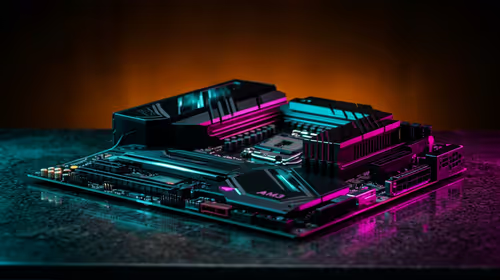
X870E vs X670E for aaa single-player gaming is mainly about fit, features, compatibility, cost, and upgrade path, not one automatic winner. SA buyers should match the choice to the setup.
Read more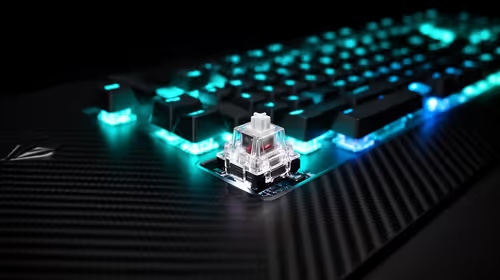
Hall Effect switches vs Mechanical switches for mMO and live-service games is mostly about compatibility, budget, upgrade path, and setup fit. SA buyers should check device support and real needs before expecting a clear win from either option.
Read more
A fake 113GB GTA VI ISO reportedly used empty padding around a small malware payload. SA gamers should delete unofficial builds, keep Windows security active and wait for official channels.

Wi-Fi 6E vs Wi-Fi 6 matters for 4K video editing when files move across a network. The real-world difference between Wi-Fi 6E and Wi-Fi 6 for video editing in 4K depends on NAS access, cloud uploads, router range, and SA creator workflows.

The difference between PCIe 5.0 and PCIe 4.0 for SA gamers is mostly bandwidth headroom. Compare GPU slot needs, NVMe speed, motherboard support, and upgrade timing before paying extra for a newer platform.

Gaming PC stuck pixel checks in South Africa should confirm the monitor fault first. Use colour tests, screenshot comparison, cable swaps, display menu checks, and clear photos before deciding on support.

Shokz OpenFit Air 2 earbuds weigh 7.2g each and use a redesigned dual-driver open-ear layout. SA buyers should choose them for comfort and awareness, not maximum isolation.

AMD's current driver now lists a Radeon RX 9050 4GB, while product coverage details a narrowed memory system. SA buyers should weigh the low VRAM ceiling against current local Radeon options.

Samsung Display has demonstrated a 16-inch 2.5K OLED laptop panel running at 300Hz. SA buyers should wait for a named notebook, full panel specifications and a local price before planning an upgrade.

Microsoft says some Windows 11 game crashes after recent updates are linked to RGB-related drivers. Affected SA gamers should confirm the update and driver before using the published registry workaround.
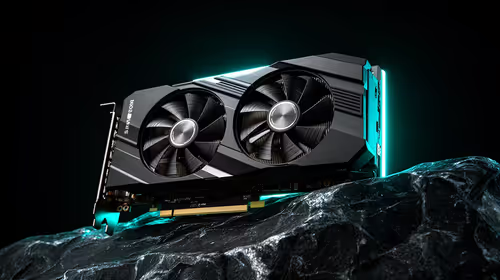
RTX 5090 on a 650W PSU is a tight pairing with very limited headroom. For SA gaming PCs, focus on total system draw, PSU quality, connector support, CPU choice, and avoid OC plans unless the full build is carefully power-limited.
PCIe 5.0 vs PCIe 4.0 for video editing in 4k is mainly about fit, features, compatibility, cost, and upgrade path, not one automatic winner. SA buyers should match the choice to the setup.
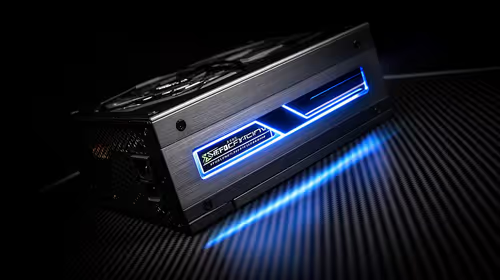
850W PSU safety for RTX 5090 is plausible with a quality unit and balanced parts. In SA, confirm connector support, CPU power draw, case airflow, PSU age, and spare capacity before building around 850W.
Wi-Fi 7 vs Wi-Fi 6e for competitive esports comes down to router support, latency goals, device compatibility, and coverage. SA buyers should match the choice to the real network setup.