


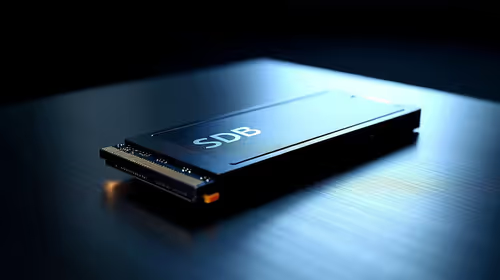
PCIe 5.0 vs PCIe 4.0 for Video editing in 4k in SA
PCIe 5.0 vs PCIe 4.0 for video editing in 4k is mainly about fit, features, compatibility, cost, and upgrade path, not one automatic winner. SA buyers should match the choice to the setup.
Read moreMatch HDMI or DisplayPort to the resolution and refresh your complete device chain can carry. The R8,999 AW3426DWM adds USB-C 15W charging for suitable low-power devices, while its display target is 3440 x 1440 at up to 240Hz.

HDMI 2.1, DisplayPort 1.4 and USB-C describe connector families, but the usable resolution, refresh, video mode and charging power depend on the specific ports implemented by both devices. A cable shape alone never tells the whole story.
For a 3440 x 1440 high-refresh gaming monitor, choose the source path that explicitly supports the native resolution and desired refresh on both the graphics device and display. HDMI 2.1 and DisplayPort 1.4 can carry demanding gaming formats when their full feature sets are implemented, sometimes using compression. USB-C may carry DisplayPort video only when its alternate mode is supported. A 15W USB-C charging port is useful for small devices but is far below typical gaming-laptop power needs.
HDMI 2.1 is a broad specification family with features that can include higher link bandwidth, variable refresh and modern gaming modes. Manufacturers may implement different subsets, so the port's supported timing table matters more than the logo.
Check whether the source and monitor both accept 3440 x 1440 at the target refresh, colour depth and HDR mode. An older graphics output, receiver or adapter in the middle can lower the negotiated format. Use a certified cable suitable for the required data rate and keep the run reasonably short.
Choose an HDMI route only after the source and monitor timing tables both show the required UWQHD refresh, colour depth and sync mode.
DisplayPort is common on desktop graphics cards and PC monitors. Version 1.4 can support high-resolution, high-refresh operation, with Display Stream Compression available in compatible implementations when the uncompressed format would exceed the link budget.
DSC is designed as visually lossless compression, but it must be supported across the active path. Docks, switches and adapters can introduce lower limits. Confirm the refresh in the operating system after connecting rather than assuming the cable label selected it automatically.
Choose DisplayPort only when the exact source output and monitor input support the intended resolution, refresh and picture format.
A USB-C receptacle can carry USB data, charging power and, in some products, DisplayPort Alternate Mode video. Each function is negotiated separately. Some ports charge only; some combine data and modest power; others connect a laptop display and peripherals through one cable.
Use the AW3426DWM's USB-C connection for its stated 15W charging role, such as powering a phone, controller or similarly light device. Route video, hub data and notebook power through connections explicitly equipped for those functions.
For a laptop, compare its normal power-adapter requirement. A performance notebook often expects much more than 15W and may discharge under load even when a low-power charging connection is active.
Resolution, refresh, colour depth and chroma format all consume link capacity. Moving from 8-bit to 10-bit colour increases the data requirement; HDR may depend on that deeper path. A 240Hz UWQHD signal is far more demanding than a 60Hz desktop image.
If the desired option is absent, test the direct connection, remove adapters, update the graphics driver and select the native resolution. Then inspect colour depth and HDR settings. A limitation that appears only after enabling another feature often points to link bandwidth or device negotiation.
The gaming monitor selection provides a place to compare declared inputs and refresh capabilities across displays.
A cable does not improve the image when the digital signal is already error-free, but an unsuitable cable can cause black screens, sparkles, dropouts or fallback to a lower mode. Certification is more useful than marketing language such as ultra-fast or premium gaming.
Avoid unnecessary extension chains. Route signal cables away from damaged power leads, prevent sharp bends and ensure connectors sit fully. If intermittent failure begins at the highest refresh, substitute a known-good short cable before changing graphics settings.
Variable refresh depends on compatible support and configuration. The AW3426DWM offers AMD FreeSync Premium, but the chosen source path still has to handle the required mode. Enable adaptive sync in the display and graphics controls, then verify it with a game whose frame rate changes naturally.
HDR similarly relies on the source, application and monitor mode. A connection that carries the desktop may still negotiate a reduced colour or refresh setting when HDR is enabled. Confirm all active parameters after each change.
A dock may share bandwidth among video outputs, USB devices and network traffic. Its headline port version does not guarantee full capacity at every connector simultaneously. Read the supported display combinations for the exact host connection and dock.
Multiple monitors can also change graphics-output limits. Test the UWQHD display alone if 240Hz is missing, then reconnect secondary screens one at a time. This isolates a shared-link or GPU display-engine constraint.
The curved monitor category helps compare the 34-inch format, while the OLED monitor range gives a separate panel-technology reference. Neither category changes the need to verify each product's inputs.
Write down the source model, output specification, cable certification, adapters, target resolution, refresh, colour depth, HDR requirement and adaptive-sync requirement. Check each link against the manufacturer's supported modes. Connect directly for the first test, then add docks or switches only after the native mode works.
The R8,999 AW3426DWM uses a 34-inch 3440 x 1440 VA panel. Its motion specification combines 240Hz, a 1ms GTG rating and FreeSync Premium. Picture features include 95% DCI-P3 coverage, Dolby Vision and DisplayHDR 400. Use those capabilities as the display target, then select a video connector from the exact supported-input table.
When troubleshooting, read the active signal rather than the requested setting alone. Operating systems and monitor menus often show the negotiated resolution and refresh, while graphics controls can expose colour depth and chroma format. Capture those values after a successful direct connection. If a later dock or switch changes them, the before-and-after comparison identifies the point where capacity was lost.
Power behaviour needs the same discipline. USB-C charging wattage is a maximum capability, not a guarantee that every device will draw the full amount. The connected device negotiates an available profile and may charge slowly while in use. Keep its original charger available for demanding work, and treat the monitor's 15W output as desk convenience rather than a replacement for high-power delivery.
No. Use USB-C video only on a port explicitly equipped with a transport such as DisplayPort Alternate Mode; use a charging-only connection for power.
No. It is appropriate for small devices, while performance notebooks normally require a much higher-power supply.
The combined resolution, refresh and colour-depth requirement may exceed a link or device limit, causing another mode to be negotiated.
Yes. Every adapter, dock or switch has its own bandwidth and feature constraints.
No. Select a video connection from the exact monitor documentation and its supported timing table.
Need a connection plan that reaches the mode you paid for? Map every source, cable and adapter, verify native UWQHD refresh after connection, and treat USB-C power, data and video as separate capabilities.
No. Use USB-C video only on a port explicitly equipped with a transport such as DisplayPort Alternate Mode; use a charging-only connection for power.
No. It is appropriate for small devices, while performance notebooks normally require a much higher-power supply.
The combined resolution, refresh and colour-depth requirement may exceed a link or device limit, causing another mode to be negotiated.
Yes. Every adapter, dock or switch has its own bandwidth and feature constraints.
No. Select a video connection from the exact monitor documentation and its supported timing table.
PCIe 5.0 vs PCIe 4.0 for video editing in 4k is mainly about fit, features, compatibility, cost, and upgrade path, not one automatic winner. SA buyers should match the choice to the setup.
Read more
Wi-Fi 7 vs Wi-Fi 6e for competitive esports comes down to router support, latency goals, device compatibility, and coverage. SA buyers should match the choice to the real network setup.
Read more
ATX 3.1 vs ATX 3.0 for mMO and live-service games buyers - what changes is mostly about compatibility, budget, upgrade path, and setup fit. SA buyers should check device support and real needs before expecting a clear win from either option.
Read more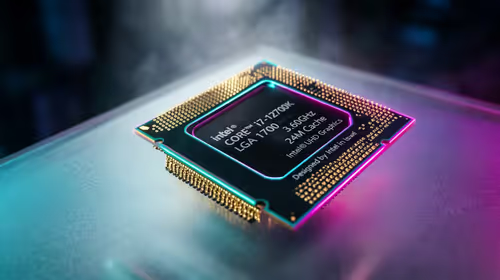
LGA 1851 vs LGA 1700 can affect Twitch and YouTube streaming when gaming and encoding share CPU resources. For SA creators, the real-world difference depends on encoder choice, memory support, motherboard cost, thermals, and upgrade plans.
Read more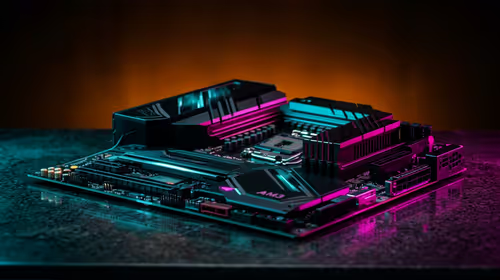
X870E vs X670E for aaa single-player gaming is mainly about fit, features, compatibility, cost, and upgrade path, not one automatic winner. SA buyers should match the choice to the setup.
Read more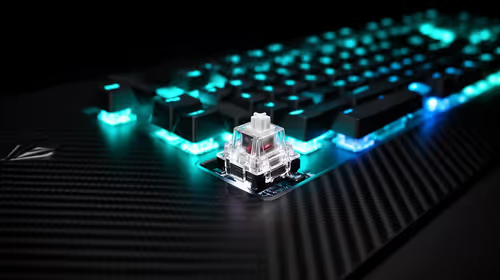
Hall Effect switches vs Mechanical switches for mMO and live-service games is mostly about compatibility, budget, upgrade path, and setup fit. SA buyers should check device support and real needs before expecting a clear win from either option.
Read more
A fake 113GB GTA VI ISO reportedly used empty padding around a small malware payload. SA gamers should delete unofficial builds, keep Windows security active and wait for official channels.

Wi-Fi 6E vs Wi-Fi 6 matters for 4K video editing when files move across a network. The real-world difference between Wi-Fi 6E and Wi-Fi 6 for video editing in 4K depends on NAS access, cloud uploads, router range, and SA creator workflows.

The difference between PCIe 5.0 and PCIe 4.0 for SA gamers is mostly bandwidth headroom. Compare GPU slot needs, NVMe speed, motherboard support, and upgrade timing before paying extra for a newer platform.

Gaming PC stuck pixel checks in South Africa should confirm the monitor fault first. Use colour tests, screenshot comparison, cable swaps, display menu checks, and clear photos before deciding on support.

Shokz OpenFit Air 2 earbuds weigh 7.2g each and use a redesigned dual-driver open-ear layout. SA buyers should choose them for comfort and awareness, not maximum isolation.

AMD's current driver now lists a Radeon RX 9050 4GB, while product coverage details a narrowed memory system. SA buyers should weigh the low VRAM ceiling against current local Radeon options.

Samsung Display has demonstrated a 16-inch 2.5K OLED laptop panel running at 300Hz. SA buyers should wait for a named notebook, full panel specifications and a local price before planning an upgrade.

Microsoft says some Windows 11 game crashes after recent updates are linked to RGB-related drivers. Affected SA gamers should confirm the update and driver before using the published registry workaround.
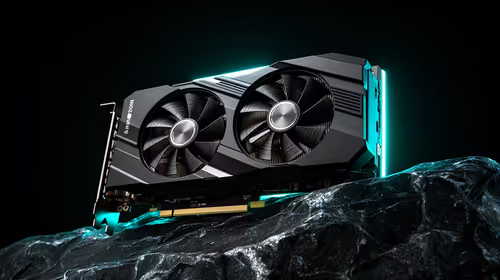
RTX 5090 on a 650W PSU is a tight pairing with very limited headroom. For SA gaming PCs, focus on total system draw, PSU quality, connector support, CPU choice, and avoid OC plans unless the full build is carefully power-limited.
PCIe 5.0 vs PCIe 4.0 for video editing in 4k is mainly about fit, features, compatibility, cost, and upgrade path, not one automatic winner. SA buyers should match the choice to the setup.
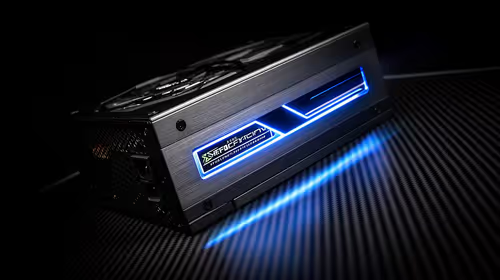
850W PSU safety for RTX 5090 is plausible with a quality unit and balanced parts. In SA, confirm connector support, CPU power draw, case airflow, PSU age, and spare capacity before building around 850W.
Wi-Fi 7 vs Wi-Fi 6e for competitive esports comes down to router support, latency goals, device compatibility, and coverage. SA buyers should match the choice to the real network setup.