Quick Answer
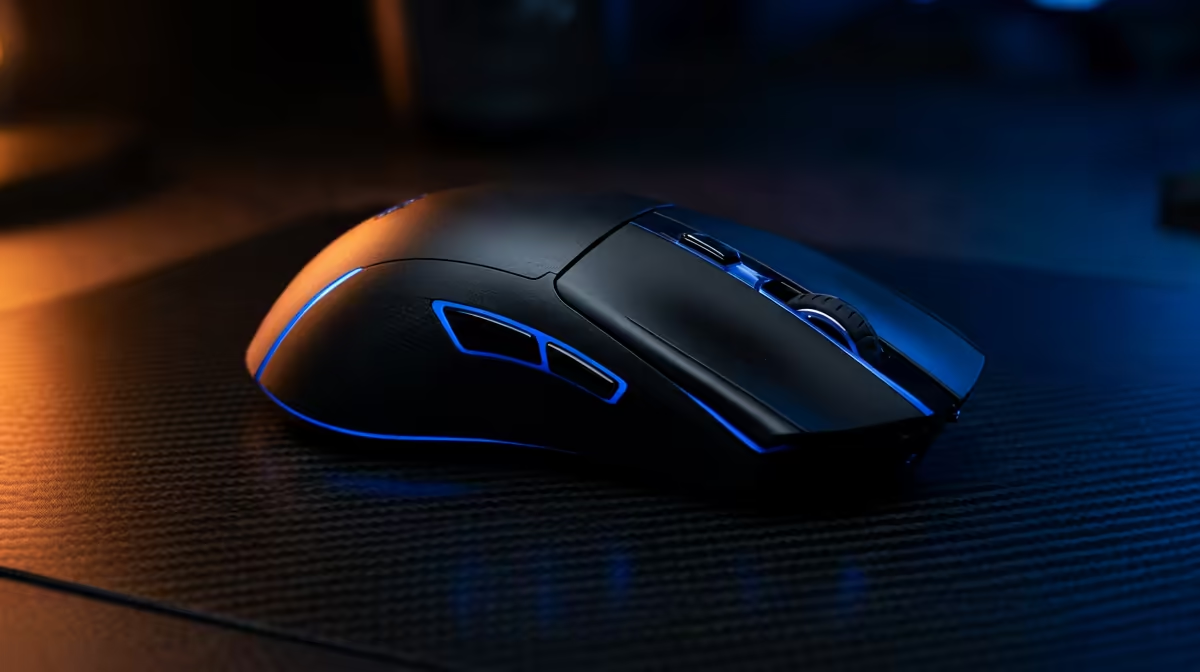
The two wireless modes on dual-wireless gaming mice are 2.4 GHz (via USB dongle) and Bluetooth. Use 2.4 GHz when you are gaming: it delivers 1 ms or sub-1 ms latency. Use Bluetooth when you are working, browsing, or commuting: it saves battery and connects without the dongle.
2.4 GHz Mode: Built for Competitive Play 🎮
The 2.4 GHz wireless channel communicates through a proprietary USB receiver that plugs directly into your PC or laptop. The private channel avoids the congestion found on shared Bluetooth airwaves, delivering latency figures of 0.5 ms to 1 ms, which is on par with wired mice by every measurable standard. Polling rates of 1,000 Hz (and up to 4,000 Hz on premium models like the Razer Basilisk V3 Pro) allow the PC to read mouse position 1,000 to 4,000 times per second, crucial for pixel-level accuracy in CS2, Valorant, or Apex Legends. The trade-off is that it requires the nano-receiver to be physically plugged in and uses slightly more battery than Bluetooth.
Bluetooth Mode: Built for Flexibility 💼
Bluetooth 5.0 or 5.2 mode lets the mouse pair directly to any device without a dongle: a laptop at a coffee shop, a tablet, or even a smart TV. Latency in Bluetooth mode typically ranges from 7 ms to 15 ms depending on the device and Bluetooth implementation, which is unnoticeable for web browsing, spreadsheets, or streaming video but perceptible in fast-paced competitive games. For South African students who commute between campus and home, Bluetooth mode eliminates the risk of losing a nano-receiver in transit. Battery life in Bluetooth mode commonly extends 30 to 50 percent longer than in 2.4 GHz mode.
When to Switch Between Modes in Real Scenarios 🔄
The practical rule is straightforward: if your game session starts, plug in the receiver and switch to 2.4 GHz. When you close the game and move to class notes, emails, or a presentation, switch to Bluetooth and pocket the receiver. Some dual-wireless mice automate this via a dedicated toggle button or side switch; others require a software profile. On Windows 11 laptops the Bluetooth pairing is persistent, so switching back takes under three seconds. Mice currently stocked at Evetech supporting dual wireless modes range from around R800 to R3,500 depending on sensor and battery capacity.
Store the Receiver Inside the Mouse ⚡
Many dual-wireless mice, including the Razer Orochi V2, feature a nano-receiver compartment in the battery bay. Always store the receiver there when switching to Bluetooth mode. SA travellers heading to inter-university LAN events have reported arriving without their receiver after losing it loose in a bag, which is an avoidable disaster when the event requires wired-quality performance.
FAQ
Can I use both wireless modes simultaneously?
No. Dual-wireless mice connect via one mode at a time. You toggle between 2.4 GHz and Bluetooth depending on the task; they do not operate in parallel on the same device.
Does 2.4 GHz interfere with my router or other devices?
Modern proprietary 2.4 GHz mouse receivers use frequency-hopping spread spectrum to avoid interference. They coexist with Wi-Fi routers, smart speakers, and other devices in the 2.4 GHz band without causing perceptible disruption.
Which mode drains the battery faster?
2.4 GHz mode draws more power because the receiver actively polls at high frequency. Bluetooth mode is more energy-efficient, often doubling effective battery life. If you are mid-trip and cannot charge, switching to Bluetooth can extend your session by many hours.
Need a mouse that keeps up in-game and stays connected on the go?
Evetech stocks a range of dual-wireless gaming mice suited to both competitive play and everyday mobile use across South Africa.