All-in-one liquid coolers used to be a niche upgrade reserved for enthusiast builds, but they have become the default choice for a huge share of mainstream gaming PCs over the last few years. Understanding what actually goes into one, rather than just picking the biggest radiator on the shelf, makes it far easier to choose correctly the first time. A 240mm liquid cooler sits at the centre of that mainstream category, striking a balance between cooling capacity, case compatibility and price that a lot of other sizes struggle to match.
Quick Answer
A 240mm AIO liquid cooler pairs a dual-fan radiator with a sealed pump loop to move heat away from the CPU more effectively than most air coolers, without the bulk of a larger 360mm unit. The Cooler Master MasterLiquid 240 Atmos backs that up with a 240mm radiator, a pair of SickleFlow Edge PWM fans and broad socket coverage, all for R1,399, making it a practical all-round option for current builds.
🧊 How a 240mm AIO Cooler Actually Works
The Sealed Loop and Pump
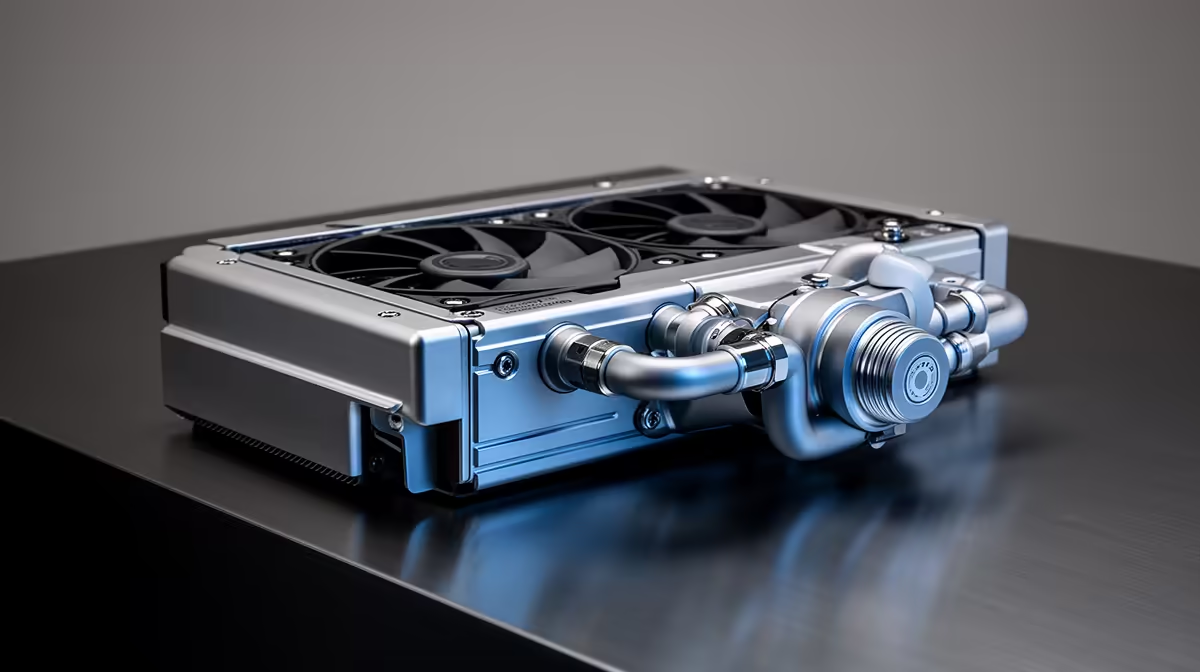
An AIO, short for all-in-one, uses a factory-sealed loop that never needs topping up or maintenance like a custom water cooling setup would. A CPU block sits directly on the processor, and the pump inside pushes coolant out through the tubing to the radiator and back on a continuous loop, drawing heat off the chip the whole time the system runs.
The pump is the component doing the actual work of moving that coolant, and its flow rate, alongside the radiator's surface area, is what largely determines how much heat the system can dissipate under sustained load. On the MasterLiquid 240 Atmos, this pump sits under a customisable cap, which lets builders adjust the visual insert without affecting the pump's internal mechanism or performance at all.
The Radiator's Role
The radiator is where heat actually leaves the coolant and enters the surrounding air, and its size, in this case 240mm across two 120mm fan mounts, largely dictates the ceiling on cooling capacity. A 240mm radiator sits above single-fan 120mm and 140mm units in raw capacity, while remaining more compact and typically more affordable than 360mm or 420mm radiators built for the highest-TDP chips.
For most of today's mainstream and enthusiast-class chips, a 240mm radiator carries more than enough surface area to keep temperatures well within safe limits, even during extended gaming or rendering sessions, without needing the extra case space a larger radiator demands.
🌀 Fans, Airflow and Noise
SickleFlow Edge PWM Fans
The two fans mounted to the radiator are just as important to overall performance as the radiator itself, since airflow across the radiator's fins is what actually carries heat away into the surrounding case air. The MasterLiquid 240 Atmos uses SickleFlow Edge PWM fans, which use pulse-width modulation to adjust their speed automatically based on thermal load rather than running at one fixed rate.
This means the fans stay quiet during light everyday use, such as browsing or working, and only ramp up when the CPU is genuinely under load from gaming, rendering or other demanding tasks. That kind of restraint at idle, paired with a quick ramp under real load, is generally what separates a properly engineered cooler from a budget model stuck at one fan speed regardless of demand.
Noise Versus Cooling Trade-offs
There is no way to fully escape the trade-off between airflow and noise, since higher fan speeds generally mean more audible operation. What a good PWM fan curve achieves is making sure that trade-off only applies when it is actually needed, keeping the system quiet the rest of the time rather than running loud regardless of what the CPU is doing.
🔧 Socket Compatibility and Fitting a Build
Coverage Across AMD and Intel Platforms
Socket support is one of the more overlooked details when shopping for a cooler, yet it decides whether a unit works with a specific motherboard at all. Working out whether this one will bolt to a given board is easy: AM5 and AM4 cover the AMD side, while LGA 1851, 1700 and 1200 handle Intel, spanning both current-generation platforms and a large share of recent builds still running slightly older hardware.
This breadth matters for two groups of builders in particular: those upgrading a CPU within an existing platform, where the same cooler carries over without needing new mounting hardware, and those assembling a fresh AM5 or LGA 1851 system who want confirmation the cooler will fit before ordering.
Case Size and Radiator Clearance
Beyond socket compatibility, physical case clearance matters just as much for a 240mm radiator. Most mid-tower cases built in the last several years accommodate a 240mm radiator in either the front or top mount, though thickness, including the radiator plus fans, should be checked against the case's specified clearance before assuming a fit.
Evetech's CPU liquid cooler range for South African builds lists radiator dimensions clearly, which is worth checking against a case's specification sheet before finalising a purchase, particularly for smaller or budget-focused cases with tighter internal clearances.
🛠️ Installing and Maintaining a 240mm AIO
Installation follows a broadly similar process across sockets, though the exact steps for mounting the CPU block and backplate differ between AMD and Intel platforms. Applying even pressure across the CPU block during mounting helps ensure consistent contact with the thermal paste, which directly affects how efficiently heat transfers from the chip into the coolant loop.
Because the loop is sealed, there is no coolant top-up required over the life of the cooler, unlike a custom loop setup. The main maintenance task is keeping the radiator fins free of dust buildup, since accumulated dust reduces airflow efficiency over time and can gradually raise operating temperatures even without any other change to the system.
Frequently Asked Questions
Is a 240mm AIO better than a high-end air cooler?
For most builds, a 240mm AIO offers similar or slightly better cooling than a premium air cooler, with the main advantage being lower noise under sustained load rather than a dramatic temperature difference.
How long does a sealed AIO loop typically last before needing replacement?
Sealed loops are generally designed to last several years of regular use, since there is no coolant to top up, though pump wear over a long service life is the eventual limiting factor.
Does a 240mm cooler fit in a small form factor case?
Not always. Many compact cases only support smaller radiators or none at all, so checking a case's specified radiator clearance beforehand is essential.
Do all 240mm coolers perform the same regardless of brand?
No, fan quality, pump design and radiator fin density all vary between models, which is why two coolers with the same radiator size can still perform differently.
Is the MasterLiquid 240 Atmos suitable for both new builds and upgrades?
Yes, its bracket set covers AM5 and AM4 for AMD plus LGA 1851, 1700 and 1200 for Intel, making it suitable for fresh builds and CPU upgrades within an existing platform alike.
Does dust buildup really affect cooling performance over time?
Yes, dust accumulation on radiator fins reduces airflow efficiency, which can gradually raise temperatures even if nothing else about the system has changed.
For the full specification sheet on this model, visit the MasterLiquid 240 Atmos product listing, or browse Evetech's broader CPU coolers category to compare it against other sizes and brands.
Ready to get the full picture on 240mm AIO coolers?
Add Evetech's Cooler Master 240 Atmos AIO (R1,399) at Evetech, as a well-rounded 240mm option for most gaming builds.