Quick Answer
HDMI 2.0 cables (rated at 18Gbps) are the correct and cost-effective choice for any 4K 60Hz display. They support HDR10, Dolby Vision, and HLG, work at lengths up to 5m in passive form, and cost between R120 and R350 at South African retailers.
The HDMI 2.0 Spec in Full 📋
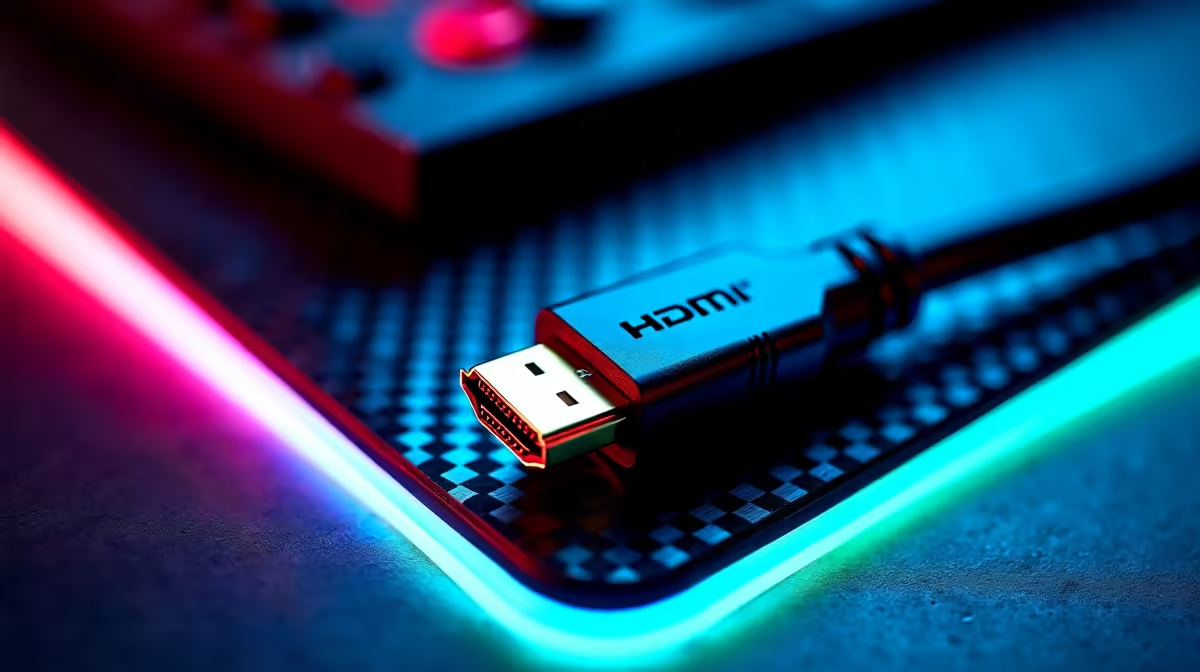
HDMI 2.0, released in 2013 and updated to 2.0a (HDR) and 2.0b (HLG), raises the bandwidth ceiling from HDMI 1.4's 10.2Gbps to 18Gbps. This enables 4K at 60Hz with 4:4:4 chroma, simultaneous multi-stream audio to multiple users, 32-channel audio, and dynamic HDR metadata signalling. The 2.0b revision added Hybrid Log-Gamma (HLG) support, which is the HDR standard used by South African broadcast services and Blu-ray. For practical purposes, any cable labelled HDMI 2.0 (not 2.0a or 2.0b specifically) supports all of these features; the sub-revisions relate to the source and display firmware, not the cable hardware. Cabling at HDMI 2.0 costs R120 to R350 depending on length, and quality certified units are available locally stocked at Evetech.
Choosing the Right Cable Length 📏
For desk setups with a PC and a nearby monitor, 1m or 2m cables are standard. For console-to-TV lounge setups or wall-mounted screens, 3m or 5m cables are more practical. Passive HDMI 2.0 cables maintain full 18Gbps up to 5m. Beyond 5m, you need an active HDMI cable with a built-in signal booster, which adds R150 to R300 to the cost but extends reliable range to 15m or more. In SA student residences and flat setups, 3m is often the sweet spot, reaching from a desk-mounted TV to a console shelf below.
HDR Compatibility Checklist for SA Buyers 🎮
To get HDR from an HDMI 2.0 cable you need all four elements to align: an HDR-capable source (PS5, Xbox Series, RTX 5070 PC, or Blu-ray player), an HDR-capable display (look for HDR10 or Dolby Vision certification on the TV spec sheet), an HDMI 2.0 cable (18Gbps), and the correct port mode enabled (set to Enhanced or HDMI 2.0 in the TV's settings). Any one of these missing breaks the HDR chain. Dolby Vision additionally requires a Dolby Vision-licensed display; HDR10 is the more universal format and works on any HDR display. Most Samsung, LG, Hisense, and Sony TVs sold in South Africa since 2018 support HDR10 as a minimum.
Cable Swap Test for Intermittent 4K Issues ⚡
If your 4K display is showing flickering, colour dropouts, or a 30Hz cap, swap your current cable with a known-good HDMI 2.0 cable before blaming the TV or source device. Borderline-spec cables often pass at 1080p but fail at 4K 60Hz HDR due to slightly undersized conductors. A certified replacement cable costs R150 to R250 and eliminates the cable as a variable in 30 seconds.
FAQ
Can I use my old HDMI 1.4 cable for a 4K 60Hz display?
You can plug it in, but the display will cap at 4K 30Hz or 1080p 60Hz. HDMI 1.4's 10.2Gbps ceiling cannot carry a full 4K 60Hz signal. For proper 4K at 60Hz, you need an HDMI 2.0 replacement.
My 4K monitor has DisplayPort. Should I use that instead of HDMI 2.0?
DisplayPort 1.4 carries 4K 60Hz with HDR equally well and is common on gaming monitors. For PC-to-monitor connections, use whichever port your GPU offers. For consoles (which only have HDMI), HDMI 2.0 is your only option.
How do I tell if a cable sold in SA is genuinely HDMI 2.0?
Look for the 18Gbps rating or explicit HDMI 2.0 labelling on the cable jacket or box. Cables labelled only as 'High Speed' without a bandwidth rating are typically HDMI 1.4. Sticking to cables stocked by reputable SA retailers removes most of the guesswork.
Building or upgrading a 4K display setup?
Evetech carries certified HDMI 2.0 cables in 1m, 2m, 3m, and 5m lengths, suitable for gaming monitors, TVs, and console setups across South Africa.