Quick Answer
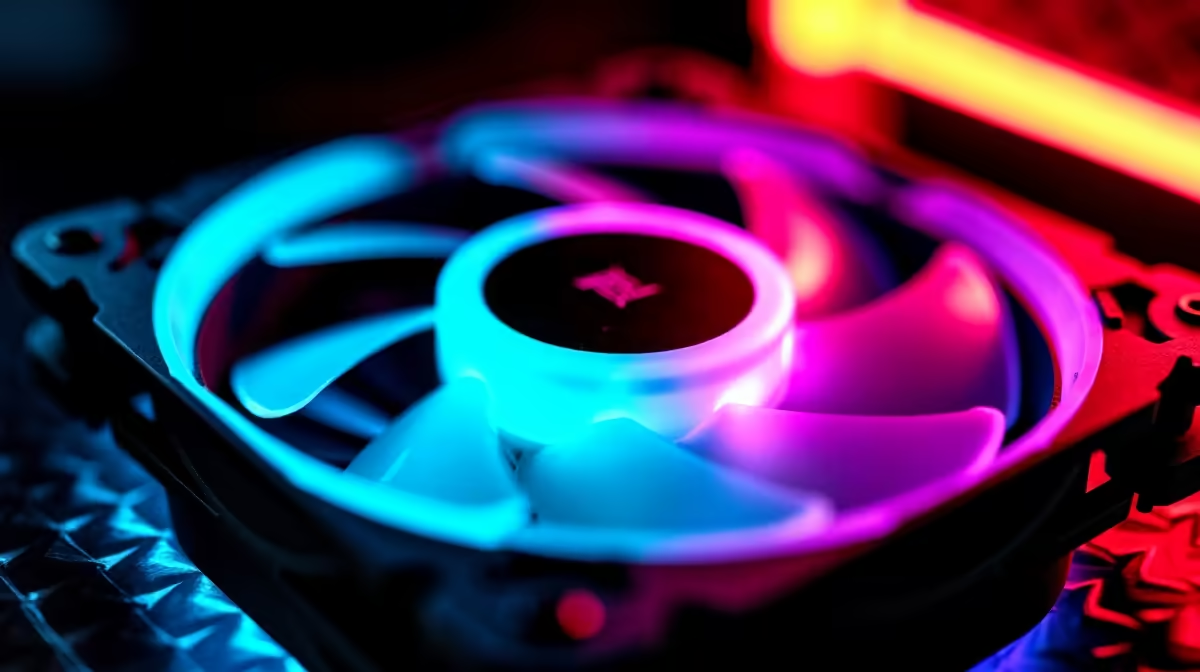
Liquid Crystal Polymer (LCP) is a high-performance thermoplastic used in premium fan blades because it combines extreme stiffness, low density, heat resistance up to 200 degrees Celsius, and dimensional stability that standard ABS plastic cannot approach. These properties translate directly to quieter operation, more consistent airflow across the fan's lifespan, and reduced vibration in high-RPM applications.
The Material Science of LCP Blades 🔧
LCP belongs to the aromatic polyester family and forms a liquid crystalline phase during processing. When injection-moulded, its polymer chains align creating a highly ordered molecular structure. This alignment gives LCP a tensile modulus of 10 to 20 GPa compared to 2 to 3 GPa for ABS, and a heat deflection temperature of 150 to 280 degrees Celsius versus 70 to 90 degrees Celsius for ABS.
For a fan blade, stiffness means the blade resists flexing under aerodynamic and centrifugal loads at high RPM. A rigid blade holds its designed pitch angle throughout the speed range, maintaining designed airflow output. A flexible ABS blade changes pitch slightly under centrifugal force at 2,000 RPM, delivering less airflow and more vibration than its rated spec suggests. LCP blades deliver rated airflow consistently from minimum to maximum RPM.
LCP's Role in SA Climate Conditions 🌡️
South Africa's high summer ambient temperatures and thermal cycling between cold winter nights and hot summer afternoons stress fan blade materials more than the stable European and North American climates where most hardware is tested. ABS blades subjected to years of cycling between 15-degree Celsius winter ambient and 50-degree Celsius summer case internals accumulate micro-deformation that gradually shifts blade balance and pitch. LCP's heat deflection temperature exceeds 150 degrees Celsius, making SA's thermal cycling range irrelevant to its dimensional stability. An LCP-bladed fan bought today should deliver identical performance in five years regardless of SA summer exposure.
Identifying Genuine LCP in the SA Market 💰
LCP fan blades retail between R1,100 and R1,800 for a triple 120mm set. Genuine LCP is identifiable by its semi-translucent appearance or fine crystalline surface sheen, and is explicitly listed as LCP or Liquid Crystal Polymer in the product datasheet, not as "reinforced nylon" or "composite material". Brands that genuinely use LCP include Lian Li (Uni Fan SL series) and Phanteks (T30 series). Check the spec sheet rather than the marketing summary to confirm LCP content.
LCP Blades Pair Best with Fluid Dynamic Bearings ⚡
describes only the blade material. The bearing type is a separate specification. Pairing LCP blades with a sleeve bearing is a mismatch: you get blade durability but bearing-limited noise and lifespan. For the full quiet, long-life benefit, confirm both LCP blades and FDB in the product spec before purchasing. Premium LCP-plus-FDB triple packs are available at Evetech.
FAQ
Does LCP improve static pressure, airflow, or both?
LCP improves consistency of both. Because blades hold their designed geometry at all RPM, measured airflow and static pressure stay closer to rated values throughout the speed range than with ABS blades. The improvement is in reliability of the spec, not a raw increase over what good ABS geometry can achieve.
Are there any downsides to LCP fan blades?
LCP blades are slightly more brittle than ABS under impact. Dropping a fan or striking blades during installation can chip an LCP blade where ABS might flex and recover. Handle LCP fans carefully during installation.
How does LCP compare to polycarbonate fan blades?
Polycarbonate is tougher and more impact-resistant than LCP but significantly less stiff and heat-resistant. Polycarbonate is a reasonable middle ground for budget fans, but LCP outperforms it on all acoustic and thermal stability metrics relevant to high-performance cooling.
Looking for the quietest, most durable case fans for your SA build?
Browse LCP-bladed fan packs at Evetech, stocked locally for South African builders.