


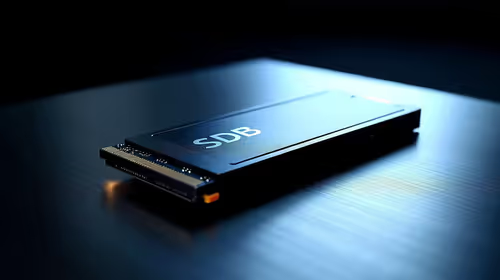
PCIe 5.0 vs PCIe 4.0 for Video editing in 4k in SA
PCIe 5.0 vs PCIe 4.0 for video editing in 4k is mainly about fit, features, compatibility, cost, and upgrade path, not one automatic winner. SA buyers should match the choice to the setup.
Read moreWi-Fi handles network traffic, while Bluetooth connects nearby peripherals. Newer versions can add capability or efficiency, but both endpoints must support the feature. Coverage, interference, drivers and device design often matter more than the version label.

Wireless version numbers are only the start of a useful connection plan. A guide to Wi-Fi 7 and Bluetooth 5.4 laptops must separate network traffic from nearby peripherals, then account for routers, client devices, radio conditions, antennas, drivers and software. The R27,999 Lenovo Yoga 7 14AGP11 has Ryzen AI 7, 32GB of wireless-workflow memory, a 1TB SSD for wireless work and a 14-inch convertible form.
Wi-Fi connects a laptop to a local network and internet route; Bluetooth links nearby accessories such as mice, keyboards, headsets and phones. Newer generations can add capability and efficiency, but useful gains depend on both ends of the link. Coverage, congestion and device design often matter more than a version label.
A laptop and access point negotiate features they both support. Adding one newer client does not give an older router new radio capability. The connection can still work through compatible modes, but its speed, channel use and latency follow the shared path.
Internet speed is another limit. A very fast local wireless link cannot make a slow fibre package, remote server or busy international route respond faster. Test local network transfer and internet service separately.
Evetech's Ryzen AI 7 laptop range helps place wireless requirements alongside processor and memory needs.
Radio rates include signalling overhead and change with distance, channel width, interference and retransmission. Measure the file transfer, call stability or application latency that matters. Repeat from the desk, meeting room and weakest important location.
Wi-Fi 7 introduces newer capabilities designed for higher throughput, lower latency and more flexible use of available spectrum on suitable equipment. The practical result depends on access-point support, regional bands, channel conditions and the laptop's radio design.
A router upgrade can benefit several compatible devices, heavy local transfers or congested rooms. It may have little visible effect when one laptop performs basic browsing close to an already stable access point and the internet connection is the bottleneck.
Record dead zones, peak-hour latency, call dropouts and local transfer speed. Reposition the current access point and choose a cleaner channel before buying. A well-placed older system can outperform a poorly placed new router behind dense walls.
Ethernet remains useful for a fixed workstation, large backups or diagnosing the network. A wired baseline shows whether a fault sits in the wireless hop or farther upstream. It also frees airtime for mobile devices.
Bluetooth supports peripherals and short-range exchanges rather than replacing the primary network. Newer versions can improve efficiency or enable features when the laptop, accessory, operating system and application all participate.
Audio behaviour also depends on codecs, profiles, microphone use and headset design. A high version number does not guarantee low latency or studio-quality microphone sound. Test calls, media and any game or editing workflow separately.
The AI laptop finder can connect a laptop's broader workload with the accessory ecosystem around it.
Wi-Fi and Bluetooth can share nearby spectrum. USB 3 devices, crowded access points and many active accessories may add interference. Keep receivers away from noisy hubs, remove unused pairings and compare with high-speed USB storage disconnected.
Name similar keyboards and headsets clearly, remove retired devices and place the accessory in pairing mode only when needed. For shared offices, confirm the intended device before accepting a prompt. Update accessory firmware through its trusted application where appropriate.
Radio performance depends on antenna position, chassis materials, transmit power and how the device is held. Folding a convertible or placing it beside metal equipment can change orientation relative to the access point. Test the postures used in real rooms.
Signal bars are a rough indicator, not a complete performance measurement. Track latency, retransmission symptoms, transfer rate and stability over time. A link can show a strong signal while sharing a congested channel.
The Ryzen 7 laptop selection supplies broader computer comparisons. The Yoga reference brings a 14-inch convertible design, Ryzen AI 7, 32GB of wireless-workflow memory, 1TB for wireless work and a R27,999 price; select wireless capabilities according to the network and peripherals in use.
Aim for a central, elevated, open position away from thick masonry, large metal objects and enclosed cabinets. Mesh systems need a healthy link between nodes; a node placed inside the dead zone merely repeats a weak route.
First decide whether Wi-Fi, internet service, Bluetooth or the application is failing. Test another website or local destination. Compare a second client in the same location, then move close to the access point. Restart only one component at a time.
For Bluetooth, charge the accessory, remove competing pairings and test at close range. For Wi-Fi, compare a wired baseline, then check access-point load and the selected band. Preserve the working condition before changing drivers or network configuration.
Create rows for desk, meeting room and travel hotspot. Add columns for signal, local transfer, internet result, call quality and Bluetooth behaviour. Test morning and peak evening periods. Patterns across rows reveal coverage or congestion more clearly than one speed test.
Operating-system, radio and router updates can improve stability or security. Record the version and working result before a major change. If a fault starts immediately afterwards, the timeline helps support or an administrator choose the next step.
Use current network encryption, a strong router administrator password and separate guest access where appropriate. Avoid automatic connection to unfamiliar open networks. On public Wi-Fi, prefer encrypted services and the organisation's approved remote-access method.
Turn off discovery or file sharing when the context does not need it. Remove old Bluetooth pairings from devices that are sold or reassigned. Convenience should not leave a permanent trust relationship behind.
A phone hotspot adds mobile signal, network load and battery state to the path. Test it with the intended call or file workload before relying on it for a deadline. Keep a charging plan and know how quickly the data allowance can be consumed.
Yes. The laptop and access point must share a feature before that feature can operate on their link.
It can add capability or efficiency, while the accessory, operating system and application still determine which benefits appear.
Placement, antenna design, channel conditions, drivers and background traffic can outweigh the generation label during a particular task.
Separate Wi-Fi from internet service and Bluetooth, compare another device, move closer, then change one component at a time.
It is worthwhile when it solves measured coverage, congestion, capacity or latency needs. Basic browsing on an already stable network may change little.
Make the network and accessory capabilities explicit buying requirements. The R27,999 Yoga reference has Ryzen AI 7, 32GB of wireless-workflow memory, 1TB for wireless work and a 14-inch convertible form.
Placement, chassis design and orientation affect signal strength and stability, so two clients using the same generation can perform differently.
Ready to replace wireless version chasing with a room-by-room connection plan? Compare Evetech's Ryzen AI laptops against the router, accessories, travel route and measured weak spots that shape everyday connectivity.
Yes. The laptop and access point must share a feature before that feature can operate on their link.
It can add capability or efficiency, while the accessory, operating system and application still determine which benefits appear.
Placement, antenna design, channel conditions, drivers and background traffic can outweigh the generation label during a particular task.
Separate Wi-Fi from internet service and Bluetooth, compare another device, move closer, then change one component at a time.
It is worthwhile when it solves measured coverage, congestion, capacity or latency needs. Basic browsing on an already stable network may change little.
Make the network and accessory capabilities explicit buying requirements. The R27,999 Yoga reference has Ryzen AI 7, 32GB of wireless-workflow memory, 1TB for wireless work and a 14-inch convertible form.
Placement, chassis design and orientation affect signal strength and stability, so two clients using the same generation can perform differently.
PCIe 5.0 vs PCIe 4.0 for video editing in 4k is mainly about fit, features, compatibility, cost, and upgrade path, not one automatic winner. SA buyers should match the choice to the setup.
Read more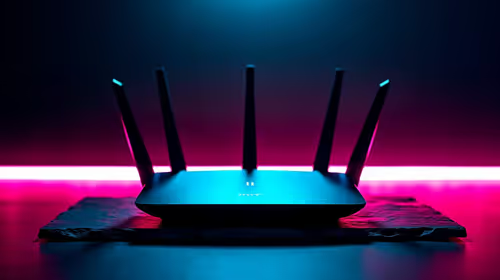
Wi-Fi 7 vs Wi-Fi 6e for competitive esports comes down to router support, latency goals, device compatibility, and coverage. SA buyers should match the choice to the real network setup.
Read more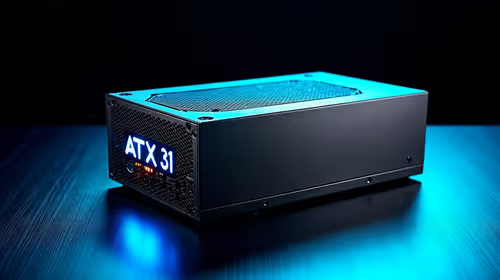
ATX 3.1 vs ATX 3.0 for mMO and live-service games buyers - what changes is mostly about compatibility, budget, upgrade path, and setup fit. SA buyers should check device support and real needs before expecting a clear win from either option.
Read more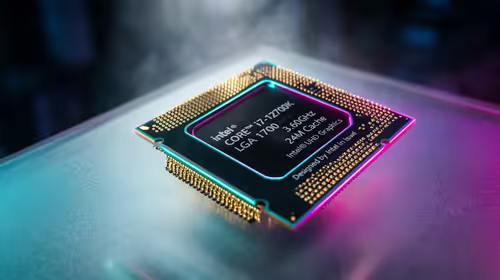
LGA 1851 vs LGA 1700 can affect Twitch and YouTube streaming when gaming and encoding share CPU resources. For SA creators, the real-world difference depends on encoder choice, memory support, motherboard cost, thermals, and upgrade plans.
Read more
X870E vs X670E for aaa single-player gaming is mainly about fit, features, compatibility, cost, and upgrade path, not one automatic winner. SA buyers should match the choice to the setup.
Read more
Hall Effect switches vs Mechanical switches for mMO and live-service games is mostly about compatibility, budget, upgrade path, and setup fit. SA buyers should check device support and real needs before expecting a clear win from either option.
Read more
A fake 113GB GTA VI ISO reportedly used empty padding around a small malware payload. SA gamers should delete unofficial builds, keep Windows security active and wait for official channels.

Wi-Fi 6E vs Wi-Fi 6 matters for 4K video editing when files move across a network. The real-world difference between Wi-Fi 6E and Wi-Fi 6 for video editing in 4K depends on NAS access, cloud uploads, router range, and SA creator workflows.

The difference between PCIe 5.0 and PCIe 4.0 for SA gamers is mostly bandwidth headroom. Compare GPU slot needs, NVMe speed, motherboard support, and upgrade timing before paying extra for a newer platform.

Gaming PC stuck pixel checks in South Africa should confirm the monitor fault first. Use colour tests, screenshot comparison, cable swaps, display menu checks, and clear photos before deciding on support.

Shokz OpenFit Air 2 earbuds weigh 7.2g each and use a redesigned dual-driver open-ear layout. SA buyers should choose them for comfort and awareness, not maximum isolation.

AMD's current driver now lists a Radeon RX 9050 4GB, while product coverage details a narrowed memory system. SA buyers should weigh the low VRAM ceiling against current local Radeon options.

Samsung Display has demonstrated a 16-inch 2.5K OLED laptop panel running at 300Hz. SA buyers should wait for a named notebook, full panel specifications and a local price before planning an upgrade.

Microsoft says some Windows 11 game crashes after recent updates are linked to RGB-related drivers. Affected SA gamers should confirm the update and driver before using the published registry workaround.
RTX 5090 on a 650W PSU is a tight pairing with very limited headroom. For SA gaming PCs, focus on total system draw, PSU quality, connector support, CPU choice, and avoid OC plans unless the full build is carefully power-limited.
PCIe 5.0 vs PCIe 4.0 for video editing in 4k is mainly about fit, features, compatibility, cost, and upgrade path, not one automatic winner. SA buyers should match the choice to the setup.
850W PSU safety for RTX 5090 is plausible with a quality unit and balanced parts. In SA, confirm connector support, CPU power draw, case airflow, PSU age, and spare capacity before building around 850W.
Wi-Fi 7 vs Wi-Fi 6e for competitive esports comes down to router support, latency goals, device compatibility, and coverage. SA buyers should match the choice to the real network setup.