Quick Answer
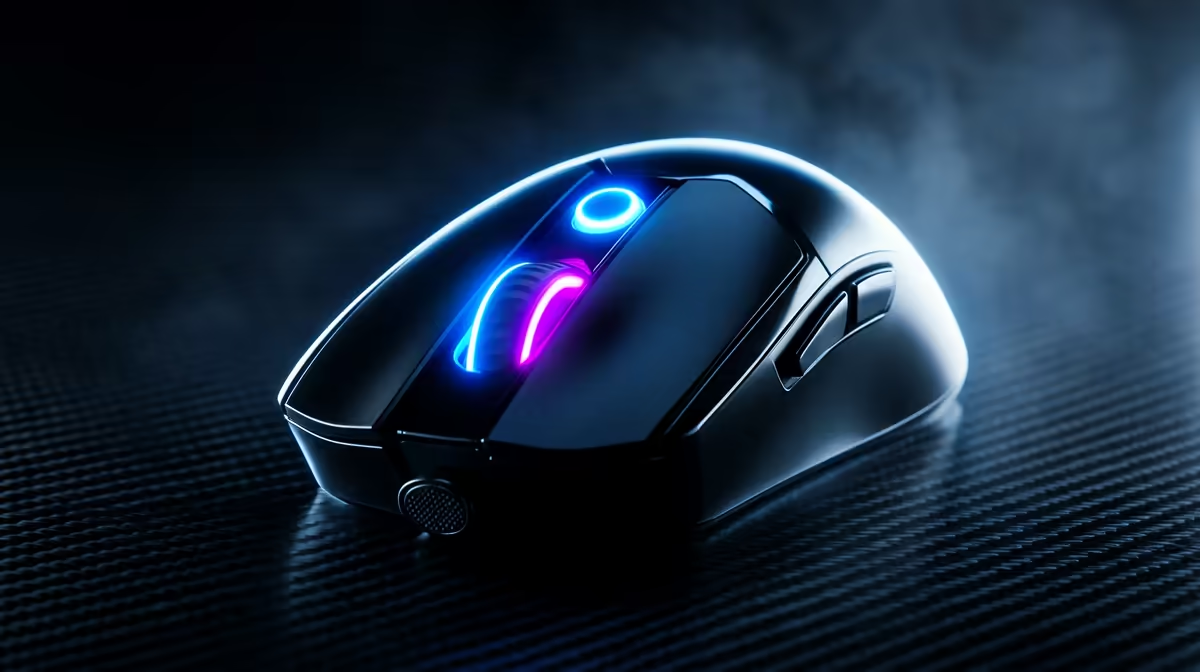
For a portable PC setup, prioritise these specs in order: weight under 80 g, dual wireless (2.4 GHz and Bluetooth), sensor with no hardware acceleration, receiver storage inside the mouse body, and battery life above 150 hours. Everything else is secondary.
The Non-Negotiable Specs for Portable Use 🎒
Portable setups demand a different priority weighting than desktop-only gaming rigs. Weight under 80 g prevents wrist fatigue across long commute sessions; sub-60 g is ideal for fingertip and claw grip users. Dual wireless is essential: 2.4 GHz gives competitive latency for gaming, Bluetooth eliminates the dongle for laptop and mobile pairing on the move. Integrated receiver storage prevents the most common travel disaster, which is arriving at a venue without the nano-receiver. Sensor quality matters but a mid-tier sensor like the 5G Advanced or Pixart 3370 is more than adequate; you do not need a 30K DPI flagship sensor for portable use. Choose a sensor rated for at least 300 IPS tracking speed so fast cursor sweeps on a travel pad do not cause skip.
Battery Life and Charging: What to Look For 🔋
Rechargeable mice via USB-C are convenient at home but introduce charging dependency when travelling. AA-battery mice like the Razer Orochi V2 eliminate this anxiety entirely since AAs are available at any South African petrol station, campus tuck shop, or Pick n Pay. If you prefer rechargeable, verify that the mouse charges via USB-C (not micro-USB, which is an outdated connector increasingly absent from modern laptops) and charges fast enough for a 30-minute top-up to give several hours of play. Target 150 hours minimum on 2.4 GHz and 200-plus hours on Bluetooth for a portable mouse, so you charge weekly rather than daily.
Grip, Size, and Ergonomics for Compact Setups ✋
Travel mice split into two categories: ambidextrous compact (typically 115 to 125 mm long) and full-size portable (130 to 140 mm). Compact ambidextrous mice suit small packs, tight desk spaces in res rooms, and shared workstation scenarios. If you have larger hands, check the palm length spec: a 120 mm mouse under palm grip leaves fingers hanging off the front edge, which causes cramping on long sessions. Claw and fingertip grips are far more comfortable on compact mice. SA students gaming in tight res rooms or hotdesking at campus computer labs will find a compact ambidextrous mouse more versatile than a full-size right-handed ergonomic model.
Pack a Slim Hard-Shell Pouch ⚡
A rigid clamshell pouch the size of a glasses case protects your travel mouse and receiver better than loose bag pockets. Drops that crack shells happen most often when a mouse rattles freely against laptop charger bricks. Small hard cases are available at local accessory shops for R50 to R150 and add almost no weight to your pack.
FAQ
Is polling rate important for a portable mouse used mainly for work?
For work use (spreadsheets, web browsing, light creative tasks), standard 125 Hz Bluetooth polling is imperceptible from 1,000 Hz. High polling rate matters only during competitive gaming. Save battery and reduce wireless congestion by using Bluetooth at 125 Hz for non-gaming tasks.
Should I buy a mousepad designed for travel as well?
Yes, if you game on varying surfaces. A thin roll-up cloth mousepad around 3 mm thick and 350 x 250 mm fits in a laptop sleeve without adding noticeable bulk. Hard plastic travel pads (around 200 x 150 mm) are even smaller but suit only fingertip grip users on compact mice.
What is a realistic budget for a quality portable wireless gaming mouse in South Africa?
Expect to spend R800 to R2,000 for a mouse that ticks all portable-use boxes: dual wireless, sub-80 g, integrated receiver storage, and a clean optical sensor. Flagship options with 4,000 Hz polling push to R3,000 to R4,500 but are unnecessary for portable use.
Building a portable gaming setup that goes everywhere you do?
Evetech has a full range of lightweight wireless gaming mice suited to students, LAN travellers, and mobile professionals across South Africa.