Quick Answer
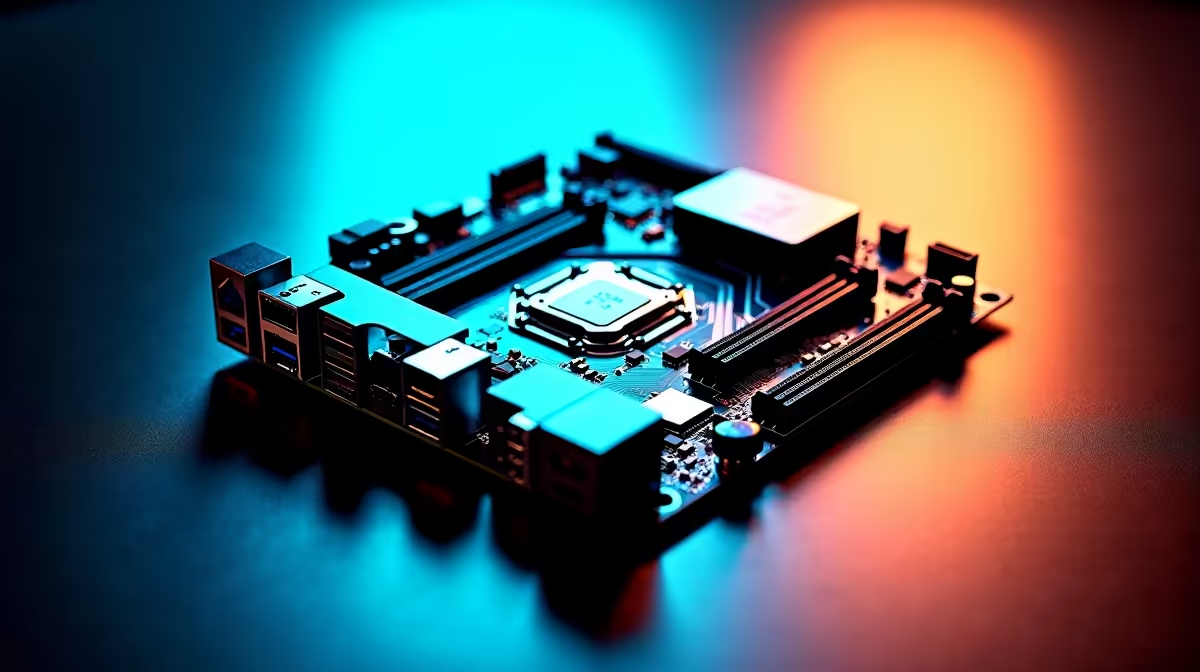
The Core Ultra 7 265K runs best on an LGA1851 board with a strong VRM: for gaming, a B860 board around R4,000-R5,500 is plenty, while Z890 (R6,000-plus) suits overclockers and multi-drive builds. Both give PCIe 5.0 and DDR5-6400 support; for most buyers a B860 with a 14-phase VRM and a good cooler is the value sweet spot.
Named Boards And VRM Phases
A mid B860 board such as an MSI B860 or Gigabyte B860 Gaming class (roughly R4,000-R5,000) typically runs a 12-16 phase VRM, ample for the 265K's 20 threads. A Z890 board like an MSI MAG Z890 Tomahawk (around R7,000) steps up to 16-22 phases plus extra Gen5 M.2 slots and stronger I/O. The 265K does not need flagship power delivery to game; the phase count matters more for sustained all-core rendering.
What Else To Check
Confirm a BIOS supporting Core Ultra Series 2 out of the box, DDR5-6400 CL32 on the QVL (32GB kit around R2,500-R3,000), and at least one Gen5 x4 M.2 slot. A 280-360mm AIO keeps boost clocks stable. USB-C and 2.5G LAN are worth a small premium for future use.
Is A Flagship Overkill?
For a single-GPU gaming rig, yes. The frame rates come from the graphics card, so a B860 board plus a stronger GPU beats a Z890 board paired with a weaker card almost every time.
FAQ
How many VRM phases does the 265K need?
A 12-16 phase VRM on a mid B860 board handles the 265K comfortably for gaming. Heavy all-core rendering benefits from a 16-phase-plus Z890 board.
Is Z890 overkill for gaming?
For gaming alone, generally yes. B860 delivers identical frame rates; Z890 only adds value through overclocking, extra Gen5 lanes and richer I/O.
What RAM should I pair with the 265K?
DDR5-6400 CL32 is the practical target on LGA1851. Verify your kit on the board QVL for a clean boot at rated speed.
a 14-phase B860 board plus a strong GPU rather than a Z890 flagship; for gaming the card sets your frame rate, not the chipset.