


PCIe 5.0 vs PCIe 4.0 for Video editing in 4k in SA
PCIe 5.0 vs PCIe 4.0 for video editing in 4k is mainly about fit, features, compatibility, cost, and upgrade path, not one automatic winner. SA buyers should match the choice to the setup.
Read more8,000Hz polling provides a 0.125ms report interval, narrowing one part of input delay. Real use still depends on stable system performance, suitable actuation and a responsive game and display path, so test it under normal loads.

High polling reduces the time between report opportunities, but it is one small interval inside a system that still includes key travel, firmware, game logic and display output. Understanding 8,000Hz keyboard polling in real use requires both the 0.125ms mathematics and a stable system test. The R1,799 CLIPPER PRO MINI 60 supports this report rate.
An 8,000Hz keyboard can report every 0.125ms, compared with 1ms at 1,000Hz, but that figure excludes actuation and downstream processing. The R1,799 Corsair board combines high polling with adjustable magnetic switches, so polling should be tested after the key profile is stable.
Polling is the frequency at which the keyboard reports its current state to the computer. Dividing one second by 8,000 gives 0.000125 seconds, or 0.125ms. At 1,000Hz, the equivalent interval is 1ms.
The keyboard may report sooner, but the finger must still move to the configured actuation point. Firmware interprets that position, the operating system receives it, the game processes it and the display presents a later frame.
Evetech's gaming keyboard range lets buyers compare polling figures with the rest of the input package.
The CLIPPER PRO MINI 60 supports 0.2-3.8mm actuation. A very deep point can add more finger travel than the difference between polling intervals. Rapid Trigger changes release behaviour, creating another separate response stage.
Build one stable profile and keep it unchanged. Use the same game, scene and movement drill at 1,000Hz and 8,000Hz if the configuration allows. Several runs reduce the chance that ordinary performance variation becomes the conclusion.
Higher polling creates more frequent reports for the system to handle. Monitor game stability, frame consistency and background workload while testing. A shorter report interval is not valuable if the complete setup becomes less consistent.
Use the normal competitive environment, including voice chat or capture tools, after the clean baseline. A setting that passes an empty desktop but struggles under real load needs further evaluation.
The keyboard switch selection at Evetech provides context for the detection stage that precedes reporting.
Competitive play may be the strongest use case for 8,000Hz. Typing, general work and slower games may show no meaningful benefit. Profiles can keep a stable rate suited to each activity if the platform supports it.
FlashTap SOCD and Rapid Trigger should remain unchanged during the polling comparison. The 60% layout affects desk use, and IP57 affects physical resistance; neither belongs in the latency arithmetic.
At R1,799, the board presents all of these features together. Evetech's gaming keyboard deals supplies current Rand context.
Record polling rate, actuation profile, game settings and essential background tools after a stable result. Retest the same scene following major system changes. This creates evidence of whether an update affected high-polling behaviour.
The polling interval is a maximum window between report opportunities, while an input can occur anywhere inside it. Average waiting time is smaller than the full interval. Use this distinction when discussing expected gains, and avoid treating every key press as if it waits exactly 1ms or 0.125ms.
The comparison remains valid: more frequent opportunities reduce the reporting window, but the complete effect depends on where each event lands.
Record frame-time consistency, CPU behaviour, input stability and background application performance. An average frame-rate number may stay unchanged while intermittent spikes make the experience less reliable. Use a repeatable workload and inspect several minutes rather than one benchmark score.
If trouble appears, return to the last stable polling rate before changing actuation or game settings.
The game samples input and produces frames according to its own logic, while the display refreshes on another schedule. High keyboard polling supplies more frequent reports but cannot force every downstream stage to react immediately. A high-refresh, stable competitive system presents the strongest context for testing, though no display figure guarantees perceptibility.
Write the keyboard profile, polling rate, game version, scene and background tools. Repeat after major updates using the same order. Reproducibility turns future changes into evidence instead of memory and prevents a driver or game patch from being mistaken for a keyboard-frequency effect.
If the system struggles under 8,000Hz or the display and game cadence dominate response, another upgrade may have a larger practical effect. List observed bottlenecks rather than assuming the keyboard frequency must be maximised first.
Retain 8,000Hz when it remains stable and the competitive setup benefits from the smaller window. Use a lower rate when system consistency improves and the player cannot distinguish the difference. This is not a rejection of high polling; it is an allocation decision within the complete PC. Future hardware changes can justify rerunning the benchmark with the saved methodology.
A ten-second test cannot reveal intermittent system pressure. Run the same movement and key-repeat sequence at the start, middle and end of a thirty-minute session. Record frame-time spikes, missed commands and any change after background tools become active.
Compare 8,000Hz with the lower-rate control using the same schedule. A setting that remains clean throughout earns more confidence than one that produces the best short benchmark. Long-duration consistency is especially important for competition and capture workloads, where a rare interruption can matter more than the average polling interval.
If repeated trials produce mixed results, keep the stable rate and describe the difference as unresolved for that system. Do not force a winner from noisy evidence. Future processor, game or firmware changes can justify rerunning the saved benchmark. A careful inconclusive result is more useful than attributing ordinary variation to high polling.
It can provide up to 8,000 report opportunities each second, producing a theoretical 0.125ms interval.
It excludes finger travel, actuation, keyboard processing, operating-system handling, game logic and display presentation.
The computer must handle the frequent reports while maintaining stable game and background performance.
Yes. More frequent reports can increase processing demand, so stability should be observed during real use.
The key must reach its configured actuation point before an input state exists for the keyboard to report.
Use the same game drill, profile and system load across several runs, changing only the polling rate.
No. Use it where the benefit and system stability justify it; other tasks may not need the shortest interval.
The R1,799 Corsair CLIPPER PRO MINI 60 includes 8,000Hz support.
Ready to test 8,000Hz as part of a system rather than a solitary number? Compare Evetech's high-polling keyboards, lock every other response setting, and watch game stability across repeated real workloads.
It can provide up to 8,000 report opportunities each second, producing a theoretical 0.125ms interval.
It excludes finger travel, actuation, keyboard processing, operating-system handling, game logic and display presentation.
The computer must handle the frequent reports while maintaining stable game and background performance.
Yes. More frequent reports can increase processing demand, so stability should be observed during real use.
The key must reach its configured actuation point before an input state exists for the keyboard to report.
Use the same game drill, profile and system load across several runs, changing only the polling rate.
No. Use it where the benefit and system stability justify it; other tasks may not need the shortest interval.
The R1,799 Corsair CLIPPER PRO MINI 60 includes 8,000Hz support.
PCIe 5.0 vs PCIe 4.0 for video editing in 4k is mainly about fit, features, compatibility, cost, and upgrade path, not one automatic winner. SA buyers should match the choice to the setup.
Read more
Wi-Fi 7 vs Wi-Fi 6e for competitive esports comes down to router support, latency goals, device compatibility, and coverage. SA buyers should match the choice to the real network setup.
Read more
ATX 3.1 vs ATX 3.0 for mMO and live-service games buyers - what changes is mostly about compatibility, budget, upgrade path, and setup fit. SA buyers should check device support and real needs before expecting a clear win from either option.
Read more
LGA 1851 vs LGA 1700 can affect Twitch and YouTube streaming when gaming and encoding share CPU resources. For SA creators, the real-world difference depends on encoder choice, memory support, motherboard cost, thermals, and upgrade plans.
Read more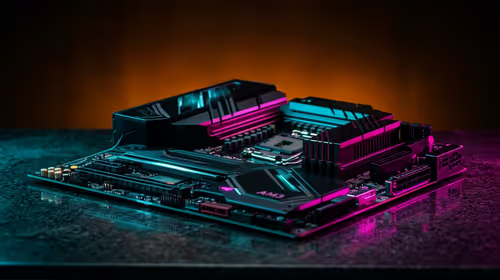
X870E vs X670E for aaa single-player gaming is mainly about fit, features, compatibility, cost, and upgrade path, not one automatic winner. SA buyers should match the choice to the setup.
Read more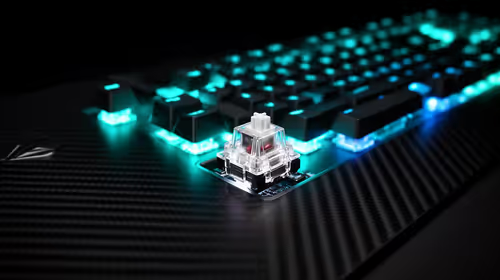
Hall Effect switches vs Mechanical switches for mMO and live-service games is mostly about compatibility, budget, upgrade path, and setup fit. SA buyers should check device support and real needs before expecting a clear win from either option.
Read more
A fake 113GB GTA VI ISO reportedly used empty padding around a small malware payload. SA gamers should delete unofficial builds, keep Windows security active and wait for official channels.

Wi-Fi 6E vs Wi-Fi 6 matters for 4K video editing when files move across a network. The real-world difference between Wi-Fi 6E and Wi-Fi 6 for video editing in 4K depends on NAS access, cloud uploads, router range, and SA creator workflows.

The difference between PCIe 5.0 and PCIe 4.0 for SA gamers is mostly bandwidth headroom. Compare GPU slot needs, NVMe speed, motherboard support, and upgrade timing before paying extra for a newer platform.

Gaming PC stuck pixel checks in South Africa should confirm the monitor fault first. Use colour tests, screenshot comparison, cable swaps, display menu checks, and clear photos before deciding on support.

Shokz OpenFit Air 2 earbuds weigh 7.2g each and use a redesigned dual-driver open-ear layout. SA buyers should choose them for comfort and awareness, not maximum isolation.

AMD's current driver now lists a Radeon RX 9050 4GB, while product coverage details a narrowed memory system. SA buyers should weigh the low VRAM ceiling against current local Radeon options.

Samsung Display has demonstrated a 16-inch 2.5K OLED laptop panel running at 300Hz. SA buyers should wait for a named notebook, full panel specifications and a local price before planning an upgrade.

Microsoft says some Windows 11 game crashes after recent updates are linked to RGB-related drivers. Affected SA gamers should confirm the update and driver before using the published registry workaround.
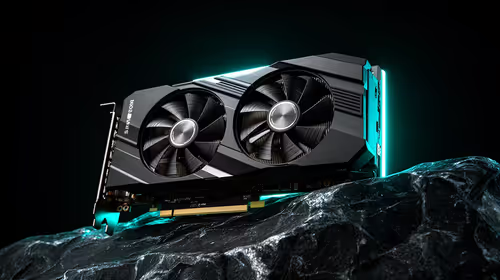
RTX 5090 on a 650W PSU is a tight pairing with very limited headroom. For SA gaming PCs, focus on total system draw, PSU quality, connector support, CPU choice, and avoid OC plans unless the full build is carefully power-limited.
PCIe 5.0 vs PCIe 4.0 for video editing in 4k is mainly about fit, features, compatibility, cost, and upgrade path, not one automatic winner. SA buyers should match the choice to the setup.
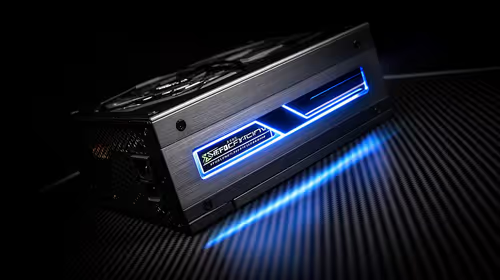
850W PSU safety for RTX 5090 is plausible with a quality unit and balanced parts. In SA, confirm connector support, CPU power draw, case airflow, PSU age, and spare capacity before building around 850W.
Wi-Fi 7 vs Wi-Fi 6e for competitive esports comes down to router support, latency goals, device compatibility, and coverage. SA buyers should match the choice to the real network setup.