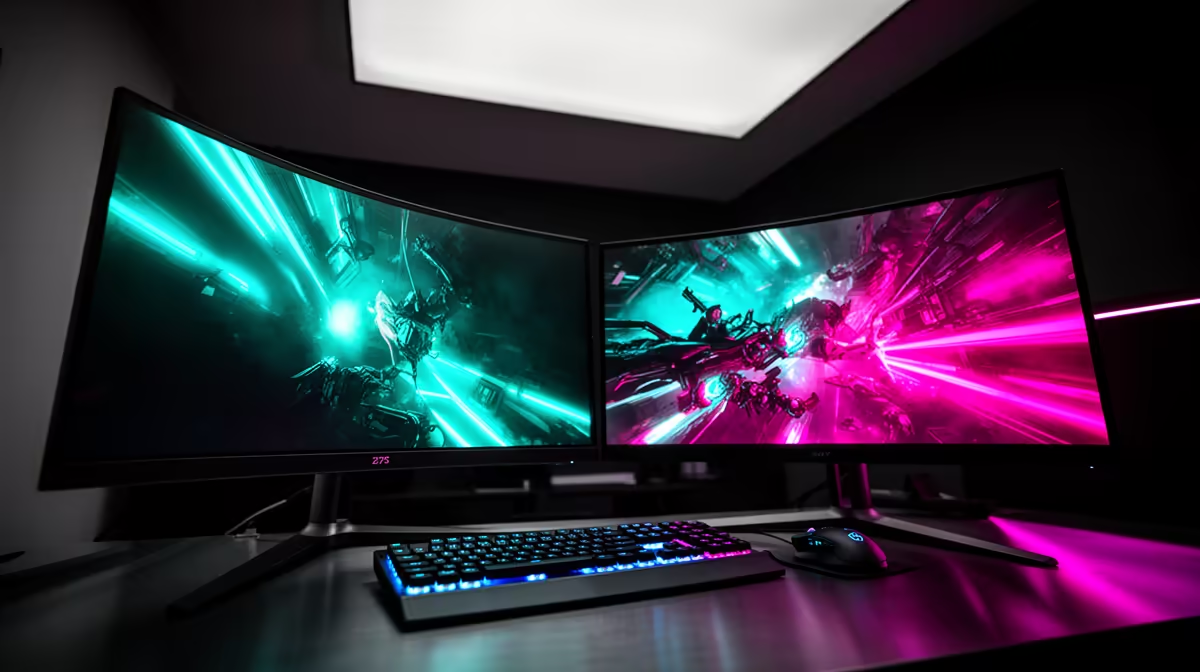
Moving from 1440p to 4K gives you sharper text, finer game detail and more desktop workspace. It also asks the graphics card to process 2.25 times as many pixels. The upgrade is worth it when the GPU, screen size and games can turn that extra resolution into a better daily experience.
Quick Answer
Choose 4K when you have a strong GPU, sit close enough to see the pixel-density gain, and value sharp single-player games or creative work. Keep 1440p when high refresh, competitive frame rate and a mid-range graphics card matter more. Compare complete monitors, rather than resolution alone.
Browse current PC monitor options and compare them with popular monitor models. Use the live price, panel, refresh rate, ports and warranty of the exact display.
The Pixel Jump Is Large
2560 x 1440 contains about 3.7 million pixels. 3840 x 2160 contains about 8.3 million. That extra density can make small text, diagonal edges and distant game detail look cleaner at the same screen size.
The gain changes with size and viewing distance. A 27-inch 4K panel has very fine pixels and often needs Windows scaling. A 32-inch model gives you a larger image while remaining sharper than 1440p at the same size.
If you sit far from the screen, the difference narrows. Measure desk depth and view both resolutions at your normal distance where possible.
The GPU Pays for Every Frame
Rendering 4K creates a much heavier graphics workload. A card that delivers 144fps at 1440p may fall well below that at native 4K. Game engine, settings, ray tracing and VRAM determine the exact change.
Choose five demanding games and compare native 4K performance. Check average rate, 1 percent lows and VRAM behaviour. High-resolution textures and ray-traced assets can increase memory pressure alongside the pixel load.
Upscaling can restore performance. DLSS, FSR or XeSS Quality modes render fewer pixels and reconstruct the 4K output. Judge fine detail in motion, since foliage, wires and newly revealed objects can expose shimmer or ghosting.
Refresh Rate Changes the Budget
A 4K 60Hz panel needs far less GPU performance than a 4K 144Hz or 240Hz model. Set the refresh target before choosing the card. Paying for a fast screen is wasteful when the system remains near 60fps in every game you play.
Adaptive sync helps when frame rate moves below the maximum. Check the monitor's supported range, overdrive behaviour and any flicker reports. A steady 90fps with good variable refresh can feel excellent even when the counter never reaches 144.
For competitive shooters, 1440p at 240Hz can offer a better balance of clarity and attainable frames. For a cinematic game, 4K at a lower refresh may carry more value.
Panel Quality Can Matter More Than Resolution
Contrast, response, colour, viewing angle and uniformity shape every image. A good 1440p OLED or fast IPS panel can look better in motion and dark scenes than a weak 4K display.
HDR needs enough brightness control and contrast to create range. A 4K badge does not improve black levels or highlight detail. Read measurements for the exact model, including local dimming or OLED behaviour.
Check pixel response across refresh rates. A high refresh label cannot overcome slow transitions that smear moving objects. Input lag and overdrive tuning matter for games.
Work Can Justify 4K Without a Flagship GPU
Text, code, spreadsheets, timelines and high-resolution images benefit from the denser canvas. Desktop work places little 3D load on the graphics card, so a modest GPU can drive a 4K workspace.
Windows scaling affects usable space. At 150 percent, text becomes comfortable while the desktop still gains room over 1440p. Check whether older applications scale cleanly and whether remote sessions handle the setting.
Creators should compare colour gamut, calibration controls and bit-depth support. Resolution helps inspect detail; it cannot guarantee accurate colour.
Ports and Cables Set the Maximum
Confirm that the GPU and monitor share a connection capable of the chosen 4K refresh and colour depth. DisplayPort and HDMI version labels need to be checked alongside actual port capabilities, DSC support and chroma format.
Use a suitable certified cable. A marginal cable can cause blanking, sparkles or a missing high-refresh mode. Avoid adapters when a direct connection is available.
Consoles have their own HDMI and refresh support. If the screen serves both PC and console, count HDMI ports and verify variable refresh on each input.
Price the Supporting Upgrade
Add the monitor, graphics card, PSU and any cable or mount. A 4K screen can trigger a much larger GPU purchase, while a strong current card may make the display the only cost.
Compare a premium 1440p panel and mid-range GPU with an entry 4K monitor and stronger card at the same total. The first can win on motion, HDR and frame rate. The second can win on sharpness and workspace.
Avoid planning around a future GPU with no date. The new monitor should make sense with the system you will use from the first day.
Check the Desk and Mount
A larger 4K panel needs enough depth to keep the whole image in a comfortable field of view. Measure the stand footprint, screen height and VESA pattern. A monitor arm can recover desk space, but its weight rating must cover the panel and any curved centre of gravity.
Check height adjustment, tilt and glare at the time of day you play. Higher resolution cannot fix a stand that leaves your neck bent or a glossy panel reflecting a bright window. Ergonomics become part of the upgrade when the display stays in front of you for hours.
Run a Resolution Trial
Use dynamic super resolution or a game's 4K render-scale option on the current monitor to estimate GPU demand. This does not show the physical sharpness of a 4K panel, but it reveals whether the card can handle the pixel workload.
Then view a 4K screen at the intended size and distance. Check text scaling, game motion and your main application. A showroom demo video cannot answer whether 27-inch 4K text feels too small or whether 32 inches fits the desk.
FAQ
Is 4K much sharper than 1440p?
Yes at the same size and close distance. The visible gain narrows as the screen gets farther away.
Do I need a flagship GPU for 4K?
No for desktop work or 60fps in lighter games. High-refresh native 4K and heavy ray tracing demand far more graphics power.
Is 1440p better for competitive gaming?
It often offers higher attainable frame rates and cheaper high-refresh panels while retaining good clarity.
Test your GPU with a 4K render load, measure viewing distance and compare complete 1440p and 4K monitor builds at one total.